
Livraison le jour même ou le lendemain

Qualité garantie

Débloquez vos offres de bienvenue: Livraison GRATUITE | Jusqu'à -80 % | 30 jours d'essai gratuits à JoyPlus
Téléchargez l'application
A portable air pump can be a lifesaver at the roadside, make preparing for a weekend camping trip much easier, or save you from having to dig out a manual pump for inflating an airbed. But the numbers printed on the packaging aren't always enough to compare different models.
Before you buy, three common pitfalls keep cropping up:
The right choice therefore depends mainly on the volume you need to inflate, the pressure required, and how often you'll use it.
Pressure is usually expressed in PSI, bar or kPa. Car tyres need a relatively high pressure, whereas an airbed, a lilo or an inflatable boat mainly require a high airflow at low pressure.
Measured in L/min, the flow rate gives you a much better idea of how quickly a large item can be filled. A portable compressor that can reach high pressure might be perfect for a tyre, but could prove impractical for a large airbed if it doesn't have a low-pressure mode.
For a car tyre inflator, also check:
A rechargeable air pump gives you genuine freedom of movement, but its battery life varies depending on the pressure required, the temperature and the charge level. A large-capacity battery alone won't tell you how many tyres you can inflate.
The Porbi Q16, for example, claims a 4,000 mAh battery, around 25 minutes of use, and an inflation time of 7 to 8 minutes for a completely flat 195-size car tyre. So it's better suited to regular top-ups and occasional emergencies than to inflating several tyres in a row.
For heavy-duty use, a mains or 12 V power supply can avoid interruptions caused by recharging. Also check whether the battery and charger are included, especially for devices that use a proprietary battery.
An inflator with auto shut-off stops working once the programmed pressure is reached. This feature reduces the risk of exceeding the pressure recommended by the vehicle or inflatable equipment manufacturer. However, it doesn't replace the need to check the guidelines on the vehicle or item itself.
Accessories also play a vital role. For a versatile device, choose a model that comes with several adaptors for bicycle valves, balls, airbeds and toys. A manual air pump remains a reliable solution when there's no socket or battery to hand, as long as you're prepared to put in a bit more physical effort.
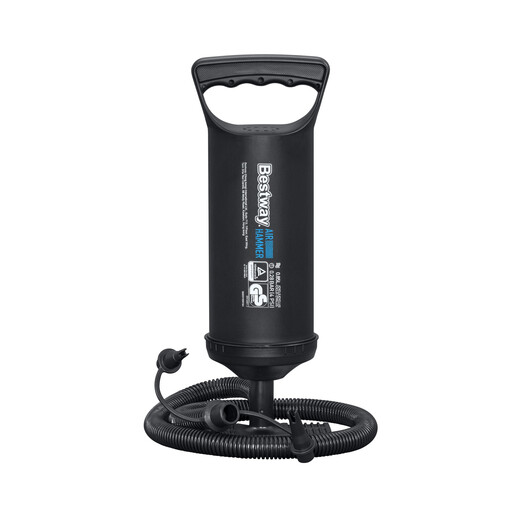
Why this choice suits this profile: This manual pump works without any cables or recharging. It's ideal for lilos, airbeds, toys and other camping equipment.
Its operation doesn't rely on any stated battery life. The three supplied adaptors cover different types of valves.
Flow rate of 0.85 L per cycle and bidirectional airflow thanks to the back-and-forth motion.
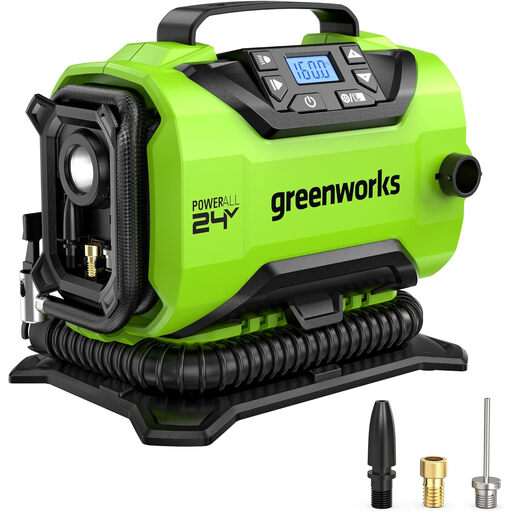
Why this choice suits this profile: Its digital display, two pressure modes and auto shut-off make it easy to use for a variety of tasks, from the car to the airbed.
The 24 V battery and charger are not included. So you need to factor their cost into your budget before buying.
Maximum stated pressure of 11 bar, auto shut-off, three adaptors and a 0.5 m hose.
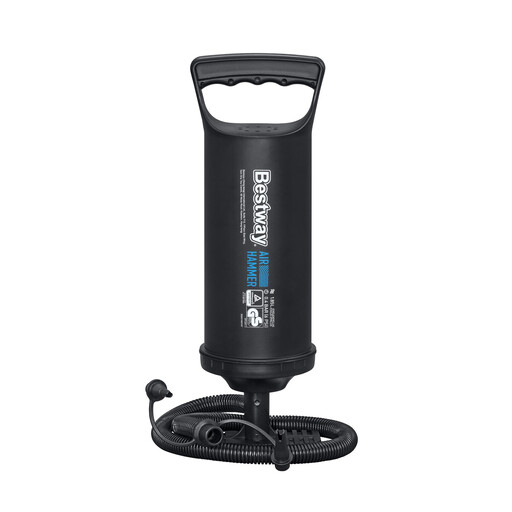
Why this choice suits this profile: Its 1.85 L per cycle volume is ideal for large airbeds, rafts and inflatable equipment used outdoors.
It is designed for large items and is not marketed as a high-pressure compressor for tyres.
Bidirectional airflow, three universal adaptors and no electricity required.
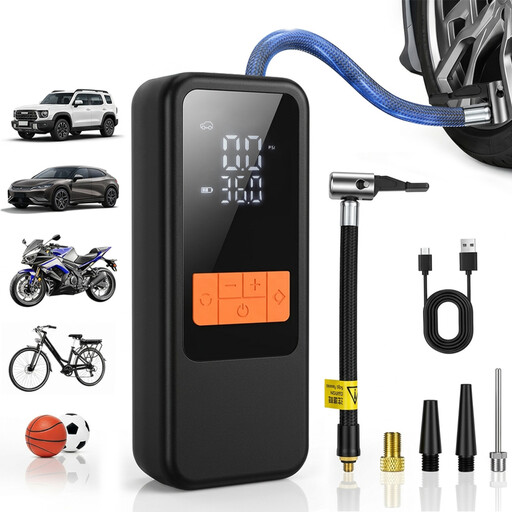
Why this choice suits this profile: Compact and rechargeable via USB-C, it slips easily into a car, motorbike or bag for daily commutes and weekend trips.
The five modes — car, motorbike, bicycle, ball and custom — mean you don't have to guess the pressure setting.
Maximum stated pressure of 150 PSI, flow rate of 26 L/min, continuous light and SOS mode.
We've put together a comprehensive, real-time updated selection of products that meet these demanding criteria, as well as European safety standards.
For a bicycle or motorbike inflator, choose a model with adjustable pressure, a suitable nozzle and a compact design that's easy to store. For a car, rely on the pressure recommended by the manufacturer rather than the maximum value stated on the pump.
A pump intended for an airbed or an inflatable boat needs to deliver a large volume of air at low pressure. The Intex QuickFill electric model works on 230 V mains and a 12 V socket, and can both inflate and deflate. However, its spec sheet clearly states it is not designed for high-pressure tyres or sports equipment.
It all depends on the size of the tyre, its starting pressure, the pump's flow rate and the motor temperature. A simple top-up will generally be much quicker than a full inflation. Always follow the rest periods indicated in the manual to avoid overheating.
First, check the operating and storage temperatures specified by the manufacturer. The Porbi Q16, for example, states an operating temperature range of -20 °C to 50 °C, and a storage temperature range of -20 °C to 60 °C. However, avoid leaving a battery in a hot car interior for long periods, and remember to recharge it before a long journey.
Power consumption depends on the device's wattage, how long it runs and its power source. For a few tyre top-ups, a rechargeable battery will usually be more than enough. For inflating several large items, a mains-powered model or a manual pump may be more practical and reduce the need for recharging.