
Livraison le jour même ou le lendemain

Qualité garantie

Débloquez vos offres de bienvenue: Livraison GRATUITE | Jusqu'à -80 % | 30 jours d'essai gratuits à JoyPlus
Téléchargez l'application
An underinflated tyre isn't just a minor inconvenience—it's a real safety hazard and a drain on your fuel economy. Equipping yourself with a portable air compressor is a smart move for any driver. However, the market is saturated with models making tempting promises that often don't hold up. Before you pull out your credit card, it's best to know the most common marketing traps to avoid turning a good investment into a useless gadget.
As the Head of Product Selections at Joybuy, I'm here to help you navigate the options. Here are the crucial points to check to make a smart purchase.
Overstated battery life on cordless models: Many manufacturers boast a huge battery capacity (in mAh), but this figure doesn't guarantee the device's real-world endurance. A poor-quality cordless tyre inflator will struggle to inflate a single car tyre before it dies, especially in cold weather when lithium batteries lose efficiency. And a device that fails you at a critical moment is, by definition, useless.
Confusion between pressure (PSI) and airflow (L/min): Most compressors display an impressive maximum pressure, often 150?PSI. While this number is important, it says nothing about the inflation speed. The true performance indicator is the airflow, measured in litres per minute (L/min). A low airflow (e.g., 10-15 L/min) means you'll spend an eternity inflating an SUV tyre, even if the advertised maximum pressure is high.
Multiple functions at the expense of reliability: A battery booster with a compressor might seem like the ideal all-in-one solution. Be careful, though: entry-level models that promise the world rarely excel in all areas. You might end up with a jump starter that's too weak for your diesel engine and an anemic compressor for your tyres.
To avoid these pitfalls, focus on a few key technical specifications. This will help you determine if the device truly meets your needs.
The choice depends on your primary use case.
12V Portable Compressor (Corded): Plugs into your vehicle's cigarette lighter socket.
Cordless Tyre Inflator (Battery-Powered): Features its own rechargeable battery.
Don't be impressed by pressure alone. For automotive use, a maximum pressure of 120-150?PSI is more than enough. The truly decisive criterion is the airflow.
A device combining a mini air compressor and an emergency jump starter can be very practical, provided you carefully check the specifications for each function:
Here are a few models that stand out from the crowd, designed for specific user profiles and in line with the criteria we've just discussed.
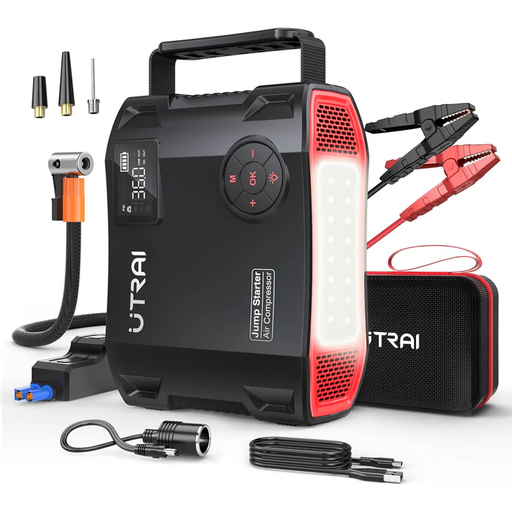
Our take: For the driver who wants to make no compromises. This device combines an extremely powerful emergency jump starter, capable of starting large diesel engines, with a high-performance air compressor. It's peace of mind in a single case.
It bypasses the trap of unreliable multi-functions by offering high-end specs for each feature: a peak current of 6000 A for the booster and an airflow of 45 L/min for the compressor.
Extreme versatility (jump-starting, inflation, 12V power supply, power bank). Performance suitable for petrol and diesel vehicles up to 10.0L.
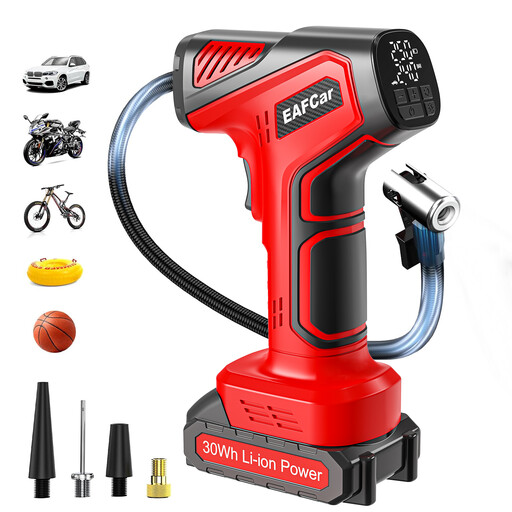
Our take: Ideal for those looking for a simple, compact solution for regular tyre pressure maintenance. Easy to store in the glove box or boot, it's perfect for quick adjustments and minor emergencies, without the hassle of cables.
It avoids the overstated battery life pitfall by focusing on its main function: inflation. Its 30Wh battery is sized for targeted uses (car, motorbike, bicycle, ball) with preset modes and an auto-shutoff feature that optimises every charge.
Completely wireless and ultra-portable. Digital display and preset modes for intuitive use and no risk of over-inflation.
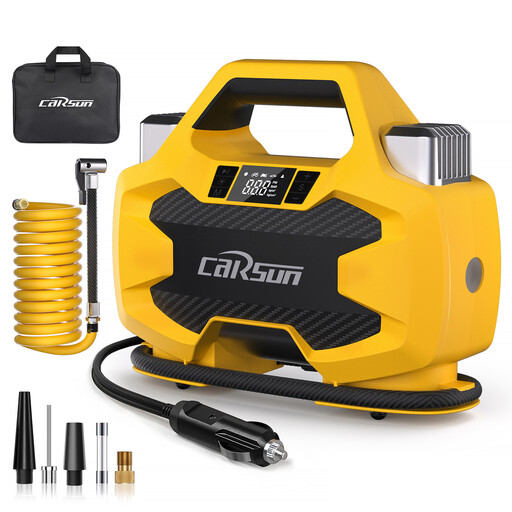
Our take: The tyres on SUVs and campervans require a large volume of air. This 12V corded, dual-cylinder model is designed to deliver a high and sustained airflow, which is essential for quickly inflating these large tyres without overheating the device.
It directly tackles the misleading airflow pitfall. Rather than focusing on PSI, its dual-cylinder design aims to maximise the volume of air moved, thereby meeting the specific needs of large tyres.
Engineered for high airflow, ideal for SUVs and campervans. Reliable 12V power for long inflation sessions.
We have curated a complete and up-to-date selection of products that meet our strict selection criteria and current safety standards.
The risk is minimal, on one simple condition: keep your car's engine running while you use the compressor. The alternator will then provide enough current to power the device while maintaining the battery's charge. However, using the compressor for an extended period with the engine off, especially with an ageing battery, could indeed drain it.
Its lifespan primarily depends on its lithium-ion battery. With proper use and maintenance, a quality model will last for several years. To preserve the battery, remember to recharge it at least once every 3-4 months, even when not in use, and store the device in a temperate location (away from frost and extreme heat).
Yes, but be mindful of the impact of extreme temperatures. In the middle of summer, the heat inside a car's cabin can prematurely degrade lithium batteries. In winter, severe cold temporarily reduces their capacity and power output. It's best to check the operating temperature range specified by the manufacturer. Note that some recent models, equipped with sodium-ion batteries, are designed to better withstand these conditions.