
Livraison le jour même ou le lendemain

Qualité garantie

Débloquez vos offres de bienvenue: Livraison GRATUITE | Jusqu'à -80 % | 30 jours d'essai gratuits à JoyPlus
Téléchargez l'application
An underinflated tyre isn't just an inconvenience—it's a serious safety hazard and a drain on your fuel economy. That's why the portable air compressor has become an essential accessory for many drivers, motorcyclists, and cyclists. The problem? The market is flooded with models making enticing promises that often fall flat.
As a product expert for Joybuy, my mission is to help you cut through the noise. Let's forget the marketing jargon and get down to specifics. Here are the three most common traps to avoid and the criteria that truly matter for making the right choice.
To ensure you choose a car tyre inflator that won't let you down, focus on these three essential points.
Two main types compete, each with its own strengths and weaknesses:
Almost all models advertise a maximum pressure of 150 PSI (about 10.3 bar). This is vastly overkill for a car tyre, which rarely requires more than 2.8 bar (40 PSI). This figure is primarily a marketing claim that suggests the motor's robustness.
The true measure of speed is the air flow rate, measured in litres per minute (L/min). The higher it is, the faster the inflation. For automotive use, a flow rate above 25 L/min is a sign of solid performance.
Beyond raw performance, certain smart features transform a simple inflator into a true safety partner:
Here is our selection of models that check all the right boxes, for different types of users.
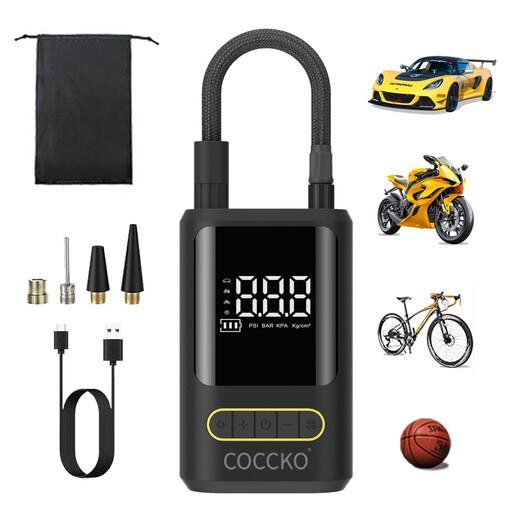
Why it stands out: Ideal for anyone looking for a simple and effective solution to tuck into the glove compartment. Its pocket-sized design and solid battery life make it the perfect tool for monthly pressure maintenance or minor daily emergencies.
It gets straight to the point: reliable inflation with automatic shut-off. No superfluous features, just clear performance (35 L/min flow rate) and a 4000 mAh battery fully dedicated to its main mission.
Its feather-light weight (under 500g) and intuitive operation thanks to 5 preset modes make it accessible to everyone.
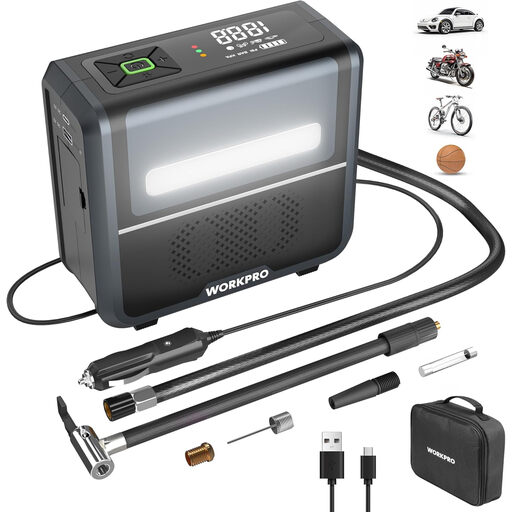
Why it stands out: Designed for frequent drivers and those who demand rock-solid reliability. Its dual power supply (battery + 12V) ensures continuous operation, even if you forgot to charge it. The power bank function is a real bonus on the go.
It avoids the dead-battery trap thanks to its 12V backup power. Its performance is quantified and transparent (e.g., 0 to 2.4 bar in 5 minutes for a 195/60 R16 tyre), which is rare enough to be highlighted.
Its dual power supply (3x2500 mAh battery + 12V socket) and its power bank function make it the traveller's Swiss Army knife.
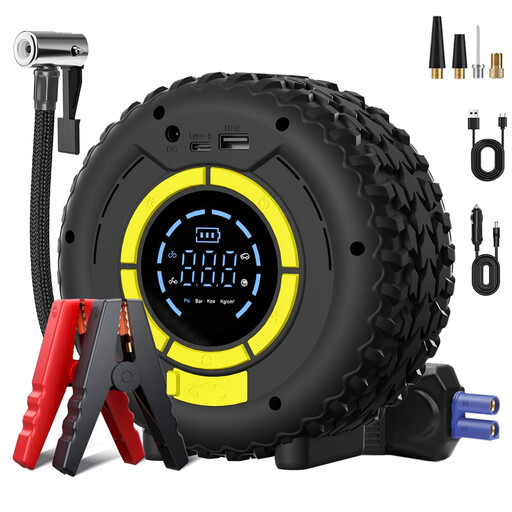
Why it stands out: This is the ultimate "zero-stress" solution. It combines two vital emergency tools into a single compact unit, preparing you for both a flat tyre and a dead battery.
Far from being a gadget, this battery booster with compressor is a true 2-in-1. It merges two powerful and genuinely useful functions, making it a smart investment rather than a superfluous purchase.
Its 2-in-1 concept (12V jump starter + 150 PSI compressor) optimises boot space and prepares you for the majority of roadside mishaps.
Discover our complete selection of products that meet our rigorous selection criteria and safety standards.
1. What is the lifespan of a battery-powered portable air compressor? It all depends on the health of its lithium-ion battery. To preserve it, never let it fully discharge and remember to recharge it every 2 to 3 months, even when not in use. Above all, avoid leaving it in the car in scorching heat or freezing cold: extreme temperatures are the number one enemy of batteries.
2. Is a 150 PSI compressor really necessary for a car? Absolutely not. A car tyre's pressure rarely exceeds 3 bar (about 44 PSI). The 150 PSI is a marketing claim to suggest the motor's power. The only crucial feature is the automatic shut-off: it ensures you inflate to the correct pressure, no more, no less.
3. Can I leave the compressor permanently plugged in in my car? For a 12V model, only plug it in when you're using it with the engine running to avoid draining the car's battery. For a cordless model, leaving it permanently in the cabin is a very bad idea. The wide temperature fluctuations will ruin its battery. The best practice? Store it charged in the boot or glove compartment and check its charge level from time to time.