
Livraison le jour même ou le lendemain

Qualité garantie

Débloquez vos offres de bienvenue: Livraison GRATUITE | Jusqu'à -80 % | 30 jours d'essai gratuits à JoyPlus
Téléchargez l'application
A great pasta dish deserves more than a flat plate or just any old bowl. Yet, finding the ideal pasta bowl can often feel like an uphill battle. Between marketing promises and flashy designs, it's easy to end up with a purchase you immediately regret. As the head of product selection at Joybuy, my mission is to help you see things more clearly. This guide breaks down the essential criteria for making a smart and lasting choice.
Before you start shopping, it's crucial to avoid the most common pitfalls that turn a promising purchase into a disappointment.
To avoid these traps, focus on three key parameters that define a bowl's quality and suitability.
The word "ceramic" is often a catch-all term. The durability of your bowl actually depends on its specific composition.
Heads-up: Always check for the pictograms indicating dishwasher and microwave compatibility. The absence of these symbols should be a red flag.
A pasta bowl is not just a designer soup plate. Its shape is engineered for a very specific function.
Space optimisation is a major challenge in the kitchen. Prioritise stackable bowls. A well-thought-out design allows the bowls to nest perfectly without the risk of tipping or getting damaged. A flat, sufficiently wide base ensures stability, both on the table and in the cupboards.
To help you see these criteria in action, here are a few options that meet specific needs.
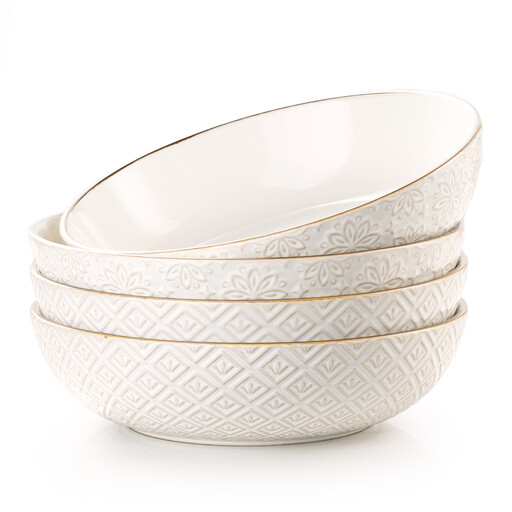
Why we love it: This set perfectly meets the demands of intensive daily use. Its shape and size are ideal for main courses, from pasta to large salads, and its robust construction ensures excellent durability.
It sidesteps the issue of impractical design. Its shape is specifically designed to be stackable, optimising cupboard storage—a crucial point for family kitchens.
Full compatibility: Safe for the dishwasher, microwave, and even the conventional oven. Quality ceramic: Scratch-resistant and guaranteed food-safe.
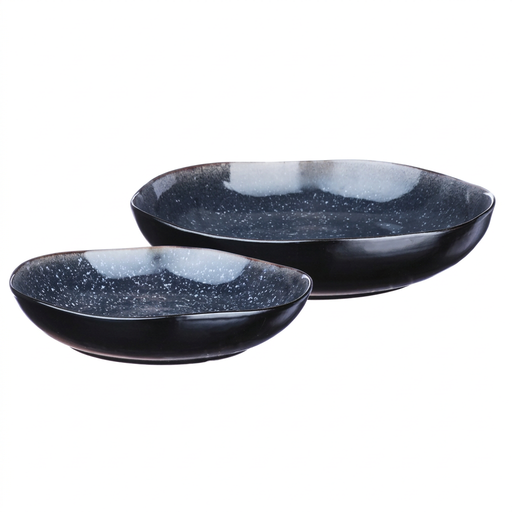
Why we love it: For those who want to combine aesthetics with functionality. This set of two complementary-sized bowls (?27.5 cm and ?32.5 cm) works just as well as a large serving dish for pasta or salads as it does as a centrepiece on a table.
It avoids the "fake multi-purpose bowl" trap. Its generous dimensions are truly intended for serving shared dishes, unlike individual bowls that claim to be versatile but are too small.
Elegant design: The midnight blue finish and durable ceramic add a touch of sophistication. Dual purpose: Perfect for displaying fruit or serving dishes at gatherings.
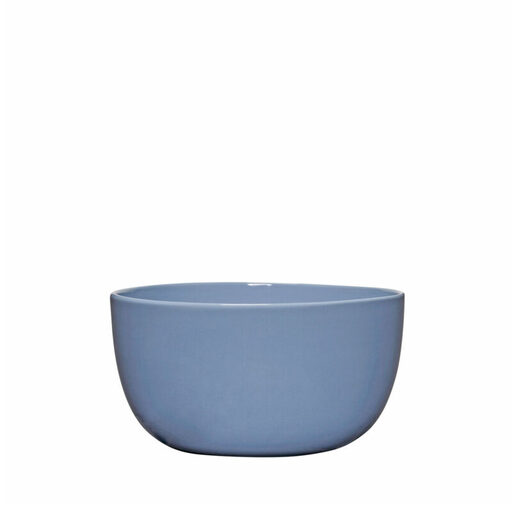
Why we love it: This large serving bowl (?28 cm) is perfect for big dinner parties. Its stone powder material gives it a unique texture and solidity, ideal for generously presenting salads, pasta, or fruit.
It avoids the hidden fragility trap. Handcrafted from stone powder, it offers superior robustness compared to many standard ceramics, while still being certified food-safe.
Ultra-practical: Dishwasher, microwave, and oven safe, it simplifies preparation, serving, and cleanup. Unique piece: Its artisanal appearance makes it a decorative object in its own right.
Explore our complete selection of products, all rigorously chosen to meet our quality criteria and current standards.
The difference is primarily in the shape. A soup plate has slightly raised edges but a mostly flat bottom. A pasta bowl, on the other hand, has a more pronounced curve and greater depth, while still retaining wide, flared rims. This design contains sauce and makes mixing ingredients easier than in a plate, while offering better accessibility than a traditional soup bowl.
Examine the glaze surface: it should be smooth, uniform, and free of bubbles or cracks. Gently tap the rim of the bowl with your fingernail: a clear, high-pitched sound is often a sign of high-temperature firing and good density, whereas a dull sound may indicate lower quality. Finally, trust the weight: a quality stoneware or porcelain bowl will have a reassuring heft, a sign of its solidity.
Its wide, shallow shape makes it very versatile. It's excellent for large salads, saucy dishes like curries or risottos, and of course, all kinds of pasta. It can also serve as a large serving bowl for appetisers (crisps, vegetables) or fruit. However, for very liquid soups, a deeper, narrower bowl will retain heat better and be easier to handle.