For an afternoon tea for older people, start by checking for the EU organic logo, the code of the inspection body and the agricultural origin shown next to the logo. Then read the ingredients: “organic” and “wellbeing” do not mean “caffeine-free” or “suitable for everyone”. If the person takes medication or has high blood pressure, pay particular attention to whether the blend contains liquorice. If in doubt, ask a healthcare professional for advice.
Who is this choice for?
The person organising afternoon tea
To choose a herbal tea labelled organic without relying on the colour of the box or the word “natural”, look for the EU organic logo, the inspection code and the agricultural origin. The European Commission explains that the logo is reserved for certified products.
An older person or carer who checks the ingredients
If medication or certain health conditions are a factor, the list of plants matters more than the recipe’s name. ANSES particularly advises caution around high, repeated consumption of liquorice and notes that it may interact with some medicines.
A host looking to avoid caffeine
If you want to serve a drink without tea or maté in the afternoon, check the ingredients of each product. Kusmi Tea, for example, lists green tea, maté and caffeine in one of its organic blends.
What should you look for?
For afternoon tea, check the organic labelling and ingredients first, then choose a format that suits the number of people you’ll be serving.
| Criteria |
What to check |
Who it matters to |
| Organic certification |
Look for the EU organic logo, the inspection body’s code and the agricultural origin next to the logo. |
If I’m preparing afternoon tea, I want to tell the difference between certification and a product simply presented as “natural”. Around 34% of consumers rank this check as their top priority. |
| Ingredients |
Read the full list of plants, particularly to check for liquorice; ask for advice if the person takes medication or you’re unsure. |
If someone takes medication, I don’t want to choose a blend based solely on its “wellbeing” claims. Ingredients are the main concern for around 26% of consumers. |
| Caffeine |
Check whether the blend contains tea, matcha or maté. |
If I want to offer a break without these sources of caffeine, I need to know which plants the blend actually contains. Avoiding caffeine comes first for around 20% of consumers. |
| Format |
Compare the number of tea bags or the net weight; choose between tea bags and loose-leaf tea to suit how you plan to serve it. |
If several people are having afternoon tea, I want to plan portions that are easy to serve. Format is the top priority for around 20% of consumers. |
Common misconceptions to avoid
-
Assuming “organic” means “caffeine-free”
Organic certification covers how a product is produced and inspected; it doesn’t mean it’s free from tea or maté. One of Kusmi Tea’s organic blends explicitly lists green tea, maté and caffeine.
If you want to avoid these ingredients at afternoon tea, check the product name and the full ingredients list on each box.
-
Overlooking liquorice in a herbal blend
According to ANSES, high, repeated consumption of liquorice can cause hypokalaemia and high blood pressure. It may also interact with some medicines.
Check the label for liquorice. If the person takes medication, has high blood pressure or you’re unsure about the ingredients, ask a pharmacist or doctor for advice.
-
Assuming the recipe’s name proves its effects
Terms such as “detox”, “sleep” or “digestion” don’t prove that a herbal tea has a therapeutic effect. The DGCCRF notes that health claims on food are regulated.
Choose a drink based on its flavour, ingredients and labelling, rather than treating it as a remedy.
Brands to know
Kusmi Tea
The brand offers organic teas and herbal teas in tea bags, tins and loose-leaf formats.
- A range of blends and formats makes it easier to find an option that suits how you plan to serve it.
- Not every product in the wellbeing range is caffeine-free: the brand lists green tea and maté in “Rituel Énergie”.
Lipton
Carrefour features Lipton teas and herbal teas among its drinks for everyday breaks.
- The range lets you compare different types of drink and formats.
- A Lipton product may be tea rather than a herbal infusion, so check its name and ingredients.
Auchan Bio
Auchan offers herbal teas under its Auchan Bio brand, among other products.
- The blends on offer include verbena and peppermint, as well as mixes of several plants.
- A name such as “sleep” is no reason to skip the ingredients list, and it doesn’t prove a health benefit.
Bio Village
Bio Village is a brand worth exploring among the herbal teas and infusions available from E.Leclerc.
- It gives you another option to compare labels when choosing a herbal tea.
- Check the organic labelling, blend and format of the specific product you’re considering.
Herbal teas available on Joybuy
These tea bags include simple blends and herbal mixes for afternoon tea. Products labelled “Organic” should still be checked for organic certification on the packaging; three of the blends below contain liquorice.
 Image unavailable
ELEPHANT Organic, verbena and mint herbal tea, 20 tea bags
A verbena and mint blend in tea bags, worth considering if you’re serving several people at afternoon tea.
Check the organic labelling and follow the preparation instructions on the box.
View on Joybuy
 Image unavailable
DAMMANN FRÉRES, chamomile herbal tea, 21 tea bags, 42 g
A chamomile option in individual portions for afternoon tea.
Check the organic labelling and preparation instructions on the packaging.
View on Joybuy
 Image unavailable
Pukka Organic Gingers, herbal tea 36 g
A blend to consider if you’re looking for a ginger recipe rather than a single-plant herbal tea.
This blend contains liquorice, so bear that in mind before serving it regularly, particularly if the person takes medication or has high blood pressure. Check the organic labelling on the packaging too.
View on Joybuy
 Image unavailable
Pukka Organic Digestion, herbal tea 40 g
A herbal blend for anyone who prefers a recipe with several ingredients; “Digestion” is a product name, not proof of an effect.
The ingredients include liquorice. Read the full list and check the organic labelling before choosing this box.
View on Joybuy
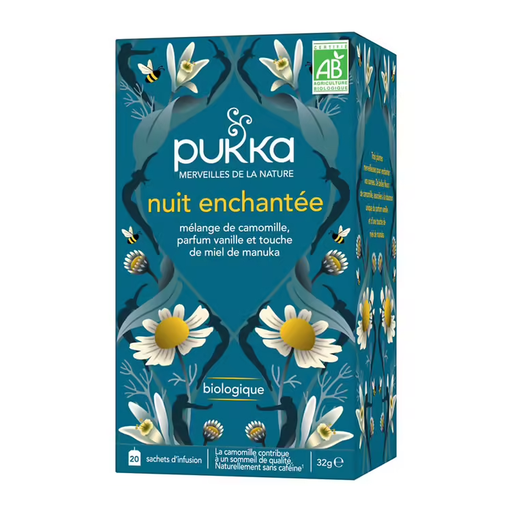 Image unavailable
Pukka Enchanted Night Organic, herbal tea 32 g
A chamomile-based blend to consider if you’d like to compare mixed blends with pure chamomile.
It also contains liquorice. Check the other ingredients, any caffeine information and the organic labelling on the packaging; its name does not promise an effect on sleep.
View on Joybuy
Frequently asked questions
How can you tell if a herbal tea is certified organic?
For pre-packed herbal tea sold as organic in the European Union, look for the EU organic logo, the inspection body’s code and the origin of the agricultural raw materials nearby. The European Commission explains that the logo is reserved for certified products; simply describing a product as “natural” is not the same thing.
Will a “digestion” or “sleep” herbal tea necessarily have the advertised effect?
No. The name of a blend alone is not enough to establish a health benefit. The DGCCRF notes that nutrition and health claims on food are regulated. When choosing a herbal tea, look at its ingredients and labelling instead.
Why check whether a herbal tea contains liquorice?
Take particular care if liquorice is consumed in large amounts over a long period: ANSES notes the risks of hypokalaemia and high blood pressure, as well as possible interactions with some medicines. If the person takes medication or you have any concerns about their health, ask a healthcare professional for advice before choosing the blend.


