Hosts keeping an eye on added sugar
You want to meet the ‘no added sugar’ criterion and check the amount of sugars per 100 ml, rather than relying solely on the front of the bottle.


For an Asian dinner party, choose an orange juice whose label confirms that it has no added sugar, but don’t confuse this with having no naturally occurring sugars. Match the pack size to the number of glasses you plan to serve and check the storage instructions for after opening. If you’re not sure what your guests prefer, a smooth, pulp-free version avoids imposing a particular texture.
You want to meet the ‘no added sugar’ criterion and check the amount of sugars per 100 ml, rather than relying solely on the front of the bottle.
You’re looking for a size that suits the number of glasses you plan to serve, without buying lots of small bottles or leaving a large container open unnecessarily.
You’re deciding between a pulp-free juice to share and a version with pulp for guests who enjoy that texture.
First, check the sugar information for the product you’re considering. Then work out how much you’ll need and choose a texture your guests will enjoy.
| Criterion | What to check | Who is this for? |
|---|---|---|
| Added sugars | The product description, ingredients, claim about added sugars and the ‘of which sugars’ line per 100 ml. | I want to meet the ‘no added sugar’ criterion without assuming the juice contains no sugar at all. Around 42% of consumers would put this check at the top of their list. |
| Pack size and storage | The net volume, the number of glasses you plan to serve and the storage instructions for that particular bottle once opened. | If only a few guests will have juice, I’d rather not leave a large container open after the party. The amount to serve would be the priority for around 33% of consumers. |
| Texture | Whether it says ‘with pulp’ or ‘without pulp’; also check the product description if you’re comparing different types of orange drinks. | If I know what my guests like, I can choose a version with pulp to suit them instead of imposing one texture on everyone at the table. Nearly 25% of consumers would prioritise texture. |
Orange juice contains naturally occurring sugars. For example, the Joybuy listing for Joker Le Fruit states that it contains 9.8 g of sugars per 100 ml.
Check the ‘of which sugars’ line per 100 ml and choose how much to serve without relying solely on the claim on the front of the bottle.
A bottle for sharing is only practical if you can use the juice within the time stated after opening. Carrefour says that one of its pure orange juices keeps for five days in the fridge after opening; this guidance doesn’t apply to every bottle.
Estimate how many glasses you’ll need and read the storage instructions for the specific product before choosing a size.
The product description alone isn’t enough to assume they have the same ingredients or to confirm that they meet the ‘no added sugar’ criterion.
Compare the product description, ingredients and added-sugar information for each specific product.
Pulp changes the texture of the juice you serve. The Tropicana product with pulp featured here is also marked ‘short-dated’.
Choose a texture to suit the group and check the best-before date before opting for a short-dated bottle.
The 1 L Le Fruit orange juice without pulp is a good option for sharing if your guests don’t want pulp.
A 1 L version with pulp could be a good choice if your guests enjoy that texture.
Larger packs may suit a group, depending on how much juice you actually plan to serve.
The range featured by E.Leclerc includes, among other products, a 1 L Jafaden pure orange juice without pulp.
A 20 cl bottle lets you offer an individual portion instead of a bottle for everyone to share.
These 1 L bottles are worth considering if you’re serving juice for everyone to share. The Tropicana version contains pulp; for the Hui yuan product, check the description and texture on the packaging before choosing.
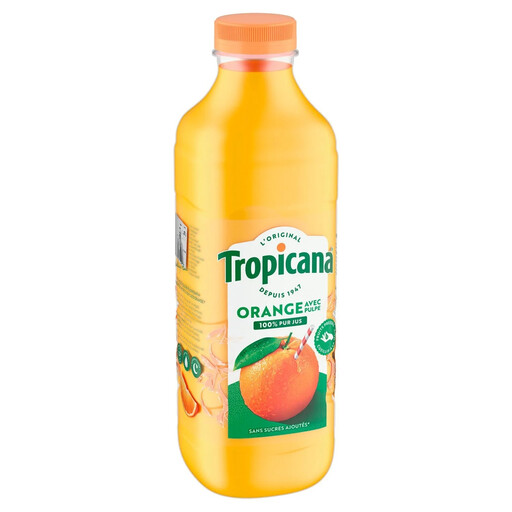 Image unavailable
If your guests enjoy pulp, Joybuy describes this 1 L bottle as juice made from 100% pressed oranges, with no added sugar. It’s marked ‘short-dated’, so check the best-before date before buying.
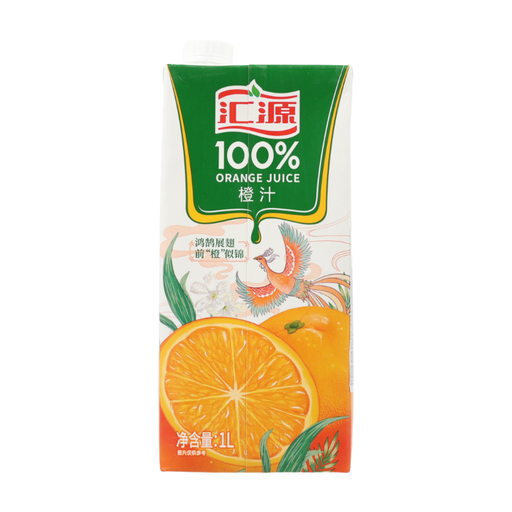 Image unavailable
If you’re considering a 1 L bottle to share, check the exact product description and whether it says ‘no added sugar’ or contains pulp on the packaging. Also read the storage instructions for after opening if you expect to have leftovers.
No: orange juice with no added sugar still contains the sugars naturally present in oranges. Check the ‘of which sugars’ line per 100 ml in the nutritional information. For example, the Joybuy listing for Joker Le Fruit states 9.8 g per 100 ml.
No: don’t assume these descriptions mean the products have the same ingredients. To meet your dinner party’s requirements, check the product description, ingredients and added-sugar information for each product.
Follow the instructions on the bottle you’ve bought: the storage time for one product won’t necessarily apply to another. For example, Carrefour says that one of its pure orange juices keeps for five days in the fridge after opening.
Yes, offering water too gives your guests a choice and helps you plan how much juice to serve. ‘No added sugar’ doesn’t mean the juice contains no sugar at all.