People who pay attention to ingredients
You want to tell “no added sugars” apart from “sugar-free”, and check the product description, ingredients and nutritional information before choosing.


When choosing no-added-sugar orange juice for breakfast, start with the product description and ingredients list, then check the “of which sugars” line: no added sugars does not mean there are no naturally occurring sugars. Next, choose a texture and bottle size that your household can finish within the stated period after opening.
You want to tell “no added sugars” apart from “sugar-free”, and check the product description, ingredients and nutritional information before choosing.
You’re looking for a bottle size that suits the glasses served in the morning and the stated period for drinking it after opening.
You prefer a smooth or pulpy texture, while checking the ingredients and sugar content separately.
For weekday breakfasts, first check what’s in the juice, then choose a size that suits how quickly you’ll drink it and your preferred texture.
| Criteria | What to check | Who is it for? |
|---|---|---|
| Ingredients and sugars | Read the product description and ingredients, and check the “of which sugars” line per 100 ml. Don’t confuse naturally occurring sugars with added sugars. | I want to know what the label on the bottle means, without assuming the juice is sugar-free. Around 50% of consumers are said to make this their top priority. |
| Size and storage | Compare the bottle size with the number of glasses your household serves, then read the storage instructions for the product you choose once it’s opened. | If the bottle stays open for several mornings, I want to be able to finish it within the stated period. Bottle size is said to be the first consideration for around 30% of consumers. |
| Whether it contains pulp | Look for “with pulp” or “without pulp”; check the ingredients separately. | I prefer to choose the juice texture before comparing bottles. Pulp is said to be the top priority for around 20% of consumers. |
Orange juice can contain naturally occurring sugars even when no sugar has been added. The Auchan product pages for the Tropicana, Joker and Auchan products mentioned here show different sugar contents depending on the product.
Check the “of which sugars” line per 100 ml and the size of the portion you serve.
Auchan and Carrefour product pages for several of the products mentioned recommend keeping the bottle chilled and drinking it within five days of opening.
Choose a size based on the glasses you actually serve, and follow the instructions on your bottle.
A bottle that isn’t finished within the stated period may go to waste.
The DGCCRF distinguishes between fruit juice, juice made from concentrate and nectars. So the word “orange” alone doesn’t tell you which category the product falls into or what it contains.
Read the product’s description and ingredients list for the specific product.
“With pulp” tells you about the texture, but doesn’t in itself indicate whether sugars have been added or how much sugar the juice contains overall.
Choose the texture you prefer, then check the ingredients and nutritional information separately.
These products show a range of textures and sizes; always check the information on the bottle you’re thinking of buying.
The Auchan product page describes a smooth orange juice in a 2 L bottle.
The Auchan product page describes a smooth pure orange juice in a 1 L bottle.
Carrefour product pages feature smooth pure orange juices, including 1.5 L and 2 L bottles.
The Auchan product page describes a smooth pure orange juice in a 2 L bottle.
E.Leclerc’s range includes orange juices with and without pulp; check the product description for each one.
This product is for anyone looking for orange juice with pulp for breakfast. Check the packaging for the ingredients, nutritional information and storage instructions for the product you buy.
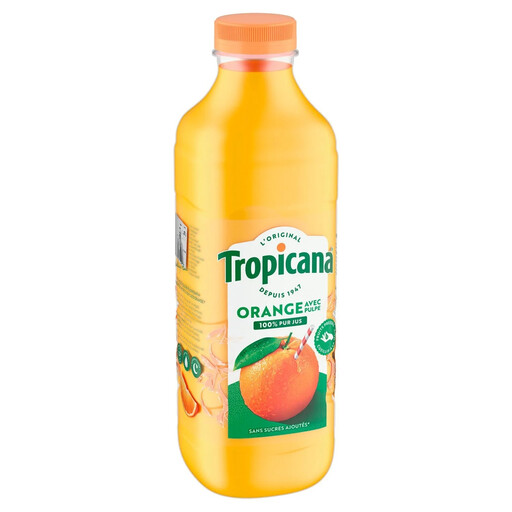 Image unavailable
Worth considering if you prefer juice with pulp and can use a 1 L bottle. The “Near Expiry” label means you should check the use-by date before buying. Also check the ingredients and the instructions for after opening.
Read the product description and ingredients list for the specific product, then check its “of which sugars” line. The DGCCRF states that the wording “contains naturally occurring sugars” is reserved for fruit juices; it does not mean the juice is sugar-free.
No. This label doesn’t remove the sugars that occur naturally in oranges. To compare two bottles, check their sugar values per 100 ml and take the portion you serve into account.
Follow the storage time and temperature shown on the bottle you buy. The Auchan and Carrefour product pages for several of the Tropicana, Auchan and Carrefour Extra products mentioned here say to keep them chilled and drink them within five days of opening. This advice doesn’t automatically apply to other products.
No. The DGCCRF distinguishes between fruit juices, juices made from concentrate and nectars based on their product descriptions and composition rules. If you’re looking for no-added-sugar orange juice, check the category and ingredients on the bottle rather than relying on the word “orange” alone.