People with two workouts close together
If you have another session after a long or intense workout, carbohydrate intake may play a bigger part in your choice. However, juice doesn’t replace water or a protein-rich food.


After a long session, or when you have two workouts close together, choose an orange juice by checking its carbohydrate and sugar content, as well as how much you plan to drink. It can contribute to your carbohydrate intake, but it doesn’t replace water or a protein-rich food. If you’re looking to limit sugar, don’t confuse ‘no added sugar’ with ‘sugar-free’; check the ‘of which sugars’ line in the nutritional information.
If you have another session after a long or intense workout, carbohydrate intake may play a bigger part in your choice. However, juice doesn’t replace water or a protein-rich food.
You want to tell the difference between a drink with ‘no added sugar’ and one that’s sugar-free. Check the amount listed under ‘of which sugars’ and how much you’ll actually drink to compare products.
You want to take juice with you after a session or share it. The pack size and whether it contains pulp can help you choose, but they don’t determine how much you’ll drink.
Start with what you need most after your session, then compare the product description, nutritional information and the amount you plan to serve.
| What to check | What to look for | Who is it for? |
|---|---|---|
| Carbohydrate content | Compare the carbohydrate content per 100 ml with your planned serving. Make sure you get water and protein from other sources. | If I have another session soon after a demanding workout, I first look at how much carbohydrate the juice provides. Around 42% of consumers put this need first. |
| Sugar content | Check ‘of which sugars’ per 100 ml and calculate the amount for the volume you’ll drink, even if the label says ‘no added sugar’. | I want to limit the sugar in my drink without relying on the claim on the front of the pack; this is the priority for around 33% of consumers. |
| Pack size and serving | Check the pack size and whether it contains pulp, then choose how much to serve. | After a session, I mainly want a convenient container, but I don’t assume the whole bottle is one serving. This need comes first for around 25% of consumers. |
The sugars naturally present in oranges remain in the juice. So this claim alone won’t tell you how much sugar you’ll drink.
Compare the ‘of which sugars’ value per 100 ml, then take your serving size into account.
Juice can provide carbohydrates, but it doesn’t replace water or a protein-rich food if these are part of your snack or meal after a demanding session.
Have it as one part of your snack, rather than making it the only part.
A picture of an orange doesn’t tell you what type of drink it is or what it contains.
Check the product description, ingredients and nutritional information before comparing two bottles.
A bottle that’s convenient to carry or share doesn’t determine how much you’ll want to drink.
Choose a pack size that suits how you’ll use it, then decide separately how much to serve.
Carrefour lists a Tropicana orange juice made from pressed oranges, with no pulp.
Auchan lists a 1 L bottle of Joker orange juice with no pulp and no added sugar.
Carrefour lists a 50 cl bottle of Carrefour Extra pure orange juice with no pulp and no added sugar.
E.Leclerc lists, among other products, a 1 L Marque Repère pure orange juice with pulp.
This selection features a 1 L bottle of orange juice with pulp. Compare its texture with the serving you plan to have after exercise.
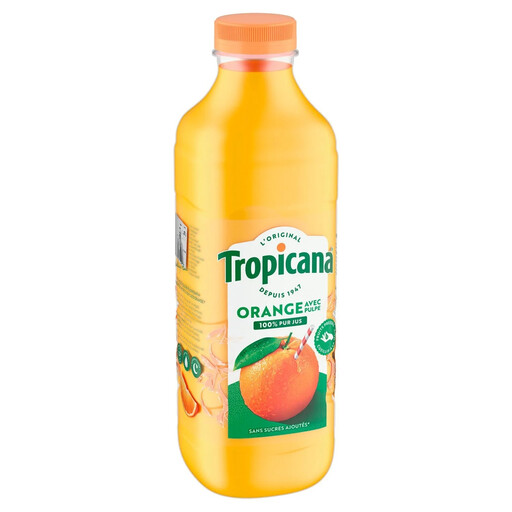 Image unavailable
Worth considering if you prefer juice with pulp and want to choose your own serving after exercise.
The Joybuy listing describes a recipe made with 100% pressed oranges and no added sugar. This doesn’t mean the juice is sugar-free.
This product is marked as short-dated. Check the date on the packaging before buying.
No. The sugars naturally present in oranges are still there. Check the ‘of which sugars’ line and calculate the amount for the volume you’ll drink.
No, it isn’t a complete recovery drink or snack on its own. After a demanding workout, particularly if you have another session soon afterwards, make sure you consider water, carbohydrates and a protein-rich food separately as part of your meal or snack.
Start by checking the product description on the label. Then look at the ingredients and nutritional information for each product, rather than relying on the fruit picture or the taste claim alone.
You don’t have to drink orange juice after a workout. Manger Bouger recommends limiting fruit juice to one glass a day and choosing water instead. If you do choose juice, take the serving into account as part of your daily diet.