People who count the carbohydrates in each glass
You want to match the figures on the label to the amount you actually serve, without confusing ‘no added sugar’ with ‘sugar-free’.


When shopping with diabetes in mind, don’t choose an orange juice based solely on the words ‘no added sugar’: it still contains the sugars naturally present in the fruit. Compare the sugars and carbohydrates per 100 ml, then consider how much you plan to serve. A lower-sugar orange drink may also contain less fruit than pure juice. According to the French health insurance service, a diabetes-friendly diet should be tailored to each person’s needs.
You want to match the figures on the label to the amount you actually serve, without confusing ‘no added sugar’ with ‘sugar-free’.
You’re looking for a recipe made from orange juice, while bearing in mind that it contains naturally occurring sugars.
Whether it’s a glass at breakfast or an occasional drink, you check the serving size and storage instructions after opening.
Start with the figures per 100 ml and the size of your glass, then check the product description: pure juice, vitamin-enriched juice and an orange drink aren’t necessarily made to the same recipe.
Worth considering: if the stated sugar content matters more to you than choosing pure juice.
Bear in mind: it may contain less fruit. According to its Auchan France product information, Joker Douceur is a flavoured orange drink containing 60% fruit.
Worth considering: if you’d like to compare a vitamin-enriched orange juice with other juices.
Remember: added vitamins don’t mean you can skip checking the sugars and carbohydrates on the label.
Worth considering: if a recipe made from orange juice is your top priority.
Remember: ‘no added sugar’ doesn’t mean there are no sugars in your glass.
| What to check | What to look for | Who this matters to |
|---|---|---|
| Sugars and carbohydrates | Read the figures per 100 ml and calculate them for the amount you’ll serve. | When I’m counting the carbohydrates in my glass, I want to compare them with the amount I’ll actually drink. Around 36% of consumers put this need first. |
| Juice ingredients | Check the product description and ingredients: pure juice and an orange drink are not the same category. | If I care most about choosing a recipe made from orange juice, a lower sugar content isn’t enough to guide my choice. Around 29% of consumers put ingredients first. |
| Portion size and frequency | Decide how much you’ll pour into your glass; don’t assume the pack size is a serving. | If I’m having juice occasionally, I prefer to know how much I’ll pour. Portion control is the top priority for around 21% of consumers. |
| Pack size and storage | Check the container size and storage instructions after opening. | If I’ll be using the bottle over several days, I look for a size that suits how I’ll store it after opening. Around 14% of consumers put these practical considerations and their product preferences first. |
This claim doesn’t remove the sugars naturally present in orange juice. Auchan France’s product information for Joker pure juice and Tropicana Pure Premium lists 8.6 g and 8.9 g of sugars per 100 ml respectively.
Compare the ‘of which sugars’ line and the carbohydrate content, then factor in the amount you’ll serve.
According to its Auchan France product information, Joker Douceur contains 5.1 g of sugars per 100 ml. However, it’s a flavoured orange drink containing 60% fruit, not pure juice.
Check the product description, fruit content and ingredients alongside the nutritional information.
A 1.5 L or 2 L container doesn’t tell you how much is in each glass. Manger Bouger recommends limiting fruit juice to a maximum of one glass a day and choosing whole fruit instead. This is general guidance and doesn’t replace personalised dietary advice.
Decide how much you’ll serve and choose a pack size that allows you to follow the storage instructions.
Bio Village’s E.Leclerc product information lists 8.7 g of sugars per 100 ml, despite its organic ingredients. Tropicana Vitamines+ is listed at 7 g of sugars per 100 ml on Auchan France’s product information: added vitamins don’t remove the sugars in the juice.
Use these details to tell the different recipes apart, but always check the nutritional information too.
Compare specific products rather than assuming that an entire brand has the same ingredients or nutritional values.
The range includes Pure Premium orange juice and the vitamin-enriched Vitamines+ variety.
The products considered include a smooth pure juice and Joker Douceur, an orange drink.
The product considered is a 1.5 L bottle of 100% pure orange juice without pulp.
The product considered is a chilled, smooth organic pure orange juice in a 90 cl pack.
The product considered is a 25 cl pack of orange juice made from concentrate.
This orange juice with pulp may suit people who want to compare a juice with their usual serving size. Pay particular attention to the near-expiry notice before you buy.
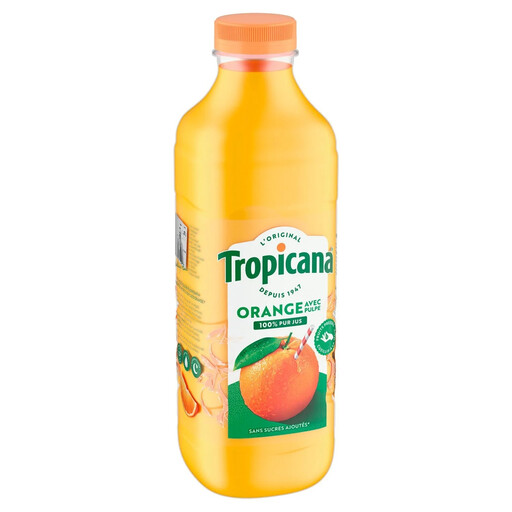 Image unavailable
If you’re looking for orange juice with pulp, compare the sugars and carbohydrates on the label with the amount you plan to serve.
Size: 1 L. This product is marked ‘Near Expiry’: check the date on the packaging before you buy.
No. This claim doesn’t remove the sugars naturally present in the juice. To find out how much sugar is in your glass, check the ‘of which sugars’ figure per 100 ml and take the serving size into account.
Check the sugars and carbohydrates per 100 ml, then work out what they amount to in your portion. Also check the product description and ingredients, as orange juice and an orange drink may have different compositions. According to the French health insurance service, a diabetes-friendly diet should be tailored to individual needs.
Manger Bouger recommends choosing whole fruit and limiting fruit juice to a maximum of one glass a day. This is general guidance and should be considered alongside personalised dietary advice for diabetes.