
Livraison le jour même ou le lendemain

Qualité garantie

Débloquez vos offres de bienvenue: Livraison GRATUITE | Jusqu'à -80 % | 30 jours d'essai gratuits à JoyPlus
Téléchargez l'application
A Nordlux outdoor wall light can transform an entrance, terrace or façade — provided you choose a model suited to its environment. Looks aren't everything: the IP rating, cap type, material and light direction will all have a direct impact on day-to-day use.
Before placing your order, three common mistakes keep cropping up:
The IP protection rating tells you how resistant the product is to solid objects and water.
For a bathroom wall light, IP44 can be suitable in certain zones. However, the exact position around a shower or bath must comply with current electrical regulations. Always check the installation zone and call in a qualified electrician if you have any doubts.
A GU10 wall light works with two-pin bulbs, which are generally easy to replace and well suited to directional lighting. The Canto, Tin, Dion and Aleria models shown below have one or two GU10 caps, with the maximum wattage stated on their product page.
An E27 wall light takes a larger screw-fit bulb. It's often the preferred choice when you want to show off a decorative bulb, such as on a lantern-style light. With a compatible bulb — and if the light is listed as dimmable — you can customise the brightness and colour temperature.
Bulbs are not supplied with the models selected below. So make sure you have a compatible light source for the cap, the 220–240 V or 230 V voltage, and the maximum wattage stated.
Die-cast aluminium offers a lightweight, versatile structure suitable for many outdoor uses. Natural brass, on the other hand, may darken over time and develop a patina. Some people love this evolution, while others prefer to keep a more uniform appearance.
For lighting a façade, an up-and-down light distribution creates a particularly striking graphic effect. A downward-only distribution is more suitable for marking out a path, steps or an entrance, while limiting light directed towards windows. The effect also varies depending on the diffuser: clear glass gives a sharper light than an opal diffuser, which spreads the illumination more evenly.
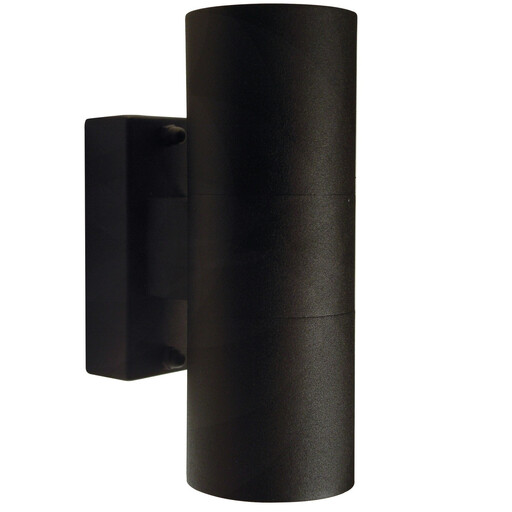
Why this choice suits this profile: Its understated design fits neatly by an entrance, in a garage, under a carport or along a driveway. The two GU10 sources light up and down, without imposing too strong an architectural signature.
The IP54 rating is clearly stated and the GU10 cap reduces the risk of choosing the wrong bulb. The product page also specifies a maximum wattage of 35 W per bulb.
Two GU10 caps, IP54 protection, black finish and bidirectional lighting. Class I installation with earthing.
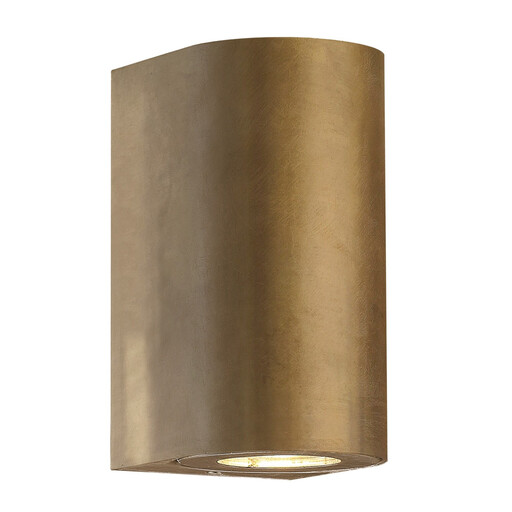
Why this choice suits this profile: Its sculptural design and natural brass finish dress up a contemporary façade, a well-kept terrace or a house near the coast.
The "Designed For Seaside" range is explicitly intended for coastal environments. However, the brass may develop a patina — it's best to be aware of this before buying.
Two GU10s, up-and-down lighting, solid brass and a stated 15-year guarantee against surface deterioration. Bulbs not included.
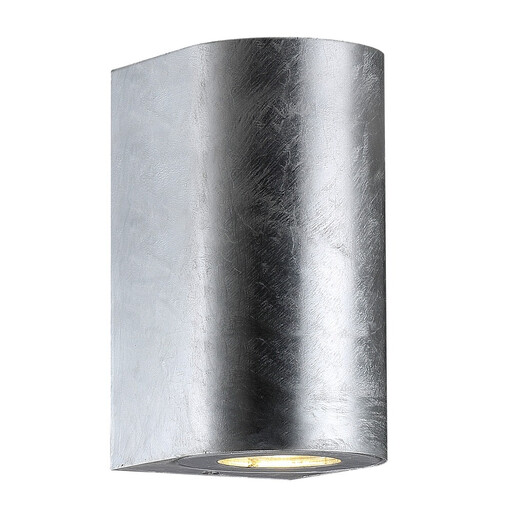
Why this choice suits this profile: It's built for a house exposed to sea spray and wind, or for an installation with several heavily used outdoor wall lights.
The product page mentions compatibility with coastal environments, parallel connection and a 15-year guarantee against surface deterioration.
Galvanised steel, two GU10s, up-and-down lighting, compact dimensions of 16 × 8.7 × 10 cm.
Class I models require earthing and must be connected by a qualified electrician. Always switch off the power supply before carrying out any work. For installation in a bathroom, check the regulations that apply to the relevant zone, even if the light has an IP44 rating.
Clean the glass and structure regularly with a soft cloth, without using any abrasive products. By the coast, a rinse with fresh water can help remove salt deposits — but this doesn't replace the manufacturer's recommendations. On a brass wall light, the patina that forms over time is normal. Its maintenance simply needs to remain compatible with the light's finish.
We've selected a full, real-time updated list of products that meet these demanding criteria as well as European safety regulations.
It can be suitable for an outdoor installation exposed to splashes, but the location, quality of installation and orientation of the light remain decisive factors. IP44 does not mean resistance to immersion or protection against all extreme weather conditions.
GU10 is suitable for directional lighting and a compact format. E27 offers a wider choice of decorative bulbs, particularly for a lantern-style light. In both cases, check the maximum wattage, compatibility with a dimmer and the fact that the bulb is not supplied.
Some IP44 models are presented as suitable for the bathroom, but they must be installed in an authorised zone, in accordance with French electrical regulations. Having an IP rating does not remove the need to check the distance from water points or to have the connection carried out by a qualified professional.