
Livraison le jour même ou le lendemain

Qualité garantie

Débloquez vos offres de bienvenue: Livraison GRATUITE | Jusqu'à -80 % | 30 jours d'essai gratuits à JoyPlus
Téléchargez l'application
An outdoor wall light can transform an entrance, terrace or pathway. But a choice based purely on design can spring a few unpleasant surprises. A stylish model might cast light in the wrong direction, require unexpected wiring, or deteriorate quickly in a damp environment.
Before you place your order, three pitfalls deserve your attention:
The IP rating consists of two digits. The first indicates the level of protection against solid objects and dust; the second relates to water resistance.
By the coast, salt accelerates corrosion. Models designed for marine environments, such as certain fittings in brass or galvanised steel, address a different challenge from that covered by the IP rating. You must still follow the manufacturer’s maintenance recommendations.
A GU10 outdoor wall light typically uses compact bulbs with a directional beam. It is ideal for up-and-down lighting or for highlighting a specific area of a façade. Check the maximum permitted wattage: some models accept 25 W, others 35 W per holder.
An E27 outdoor wall light offers more flexibility in bulb shape, particularly with a decorative bulb. It is especially well suited to lanterns and ambient lighting. The permitted wattage varies by model and may be limited to 10, 25 or 60 W.
In both cases, compatibility with a dimmable bulb must be checked separately. A wall light described as “adjustable” is not enough: the bulb and the dimmer switch must also be compatible.
A terrace or entrance wall light should illuminate effectively without causing glare. Models that cast light upwards and downwards create a decorative effect, while downward-facing lighting is better suited to steps, walkways and door thresholds.
Also remember to measure the projection of the fitting. In a narrow passage, a compact wall light like the ALERIA, which projects 14.7 cm, will often be more practical than a bulky lantern. For an installation without wiring, a solar outdoor wall light such as the Solar Wall S28 must be positioned to receive enough direct sunlight. Its panel must be kept clean and unobstructed.
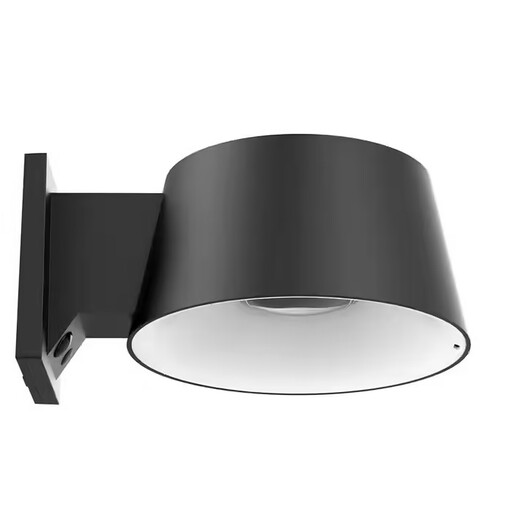
Why this choice suits this profile: This solar wall light fits without any mains connection. It can therefore be placed at an entrance, on a fence or along a small pathway where wiring is tricky.
It avoids wiring costs and work, but the instruction to expose it to sunlight must be followed. As the IP rating is not stated on the supplied datasheet, check this point before installing it in a very exposed location.
Integrated solar panel, automatic activation at dusk, downward-facing LED beam and wall mounting.
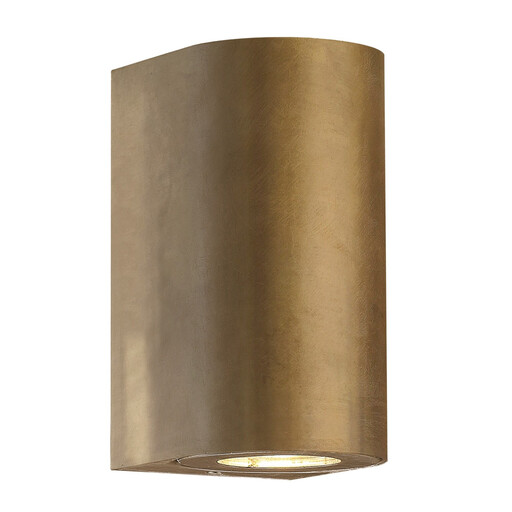
Why this choice suits this profile: Its solid brass and sculptural design will appeal to homeowners who want to coordinate several light points on a façade or terrace.
The datasheet states it is designed for coastal areas and comes with a 15-year guarantee against surface deterioration. This guarantee covers that specific point and does not necessarily cover all components.
Two GU10 holders, up-and-down lighting, natural brass that will patina and darken over time, parallel connection.
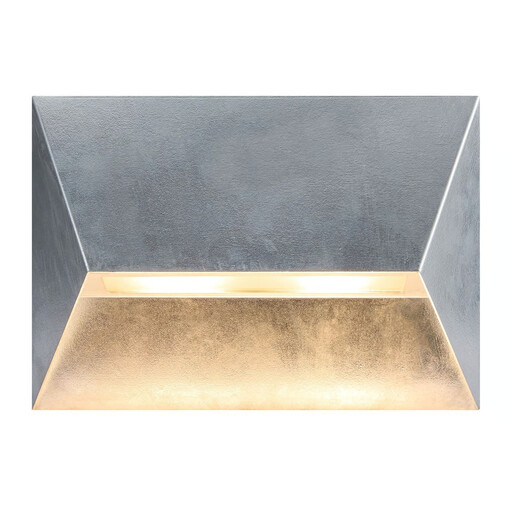
Why this choice suits this profile: It is designed for exposed façades, particularly by the coast, and incorporates two GU10 sources to strengthen the lighting presence.
The galvanised steel and the “Designed For Seaside” label address a well-known corrosion risk. However, you will need to rinse off salt deposits regularly and take care to preserve the seals.
IP54 rating, hot-dip galvanised steel, two GU10 holders, dimmable with compatible bulbs and a stated 15-year surface guarantee.
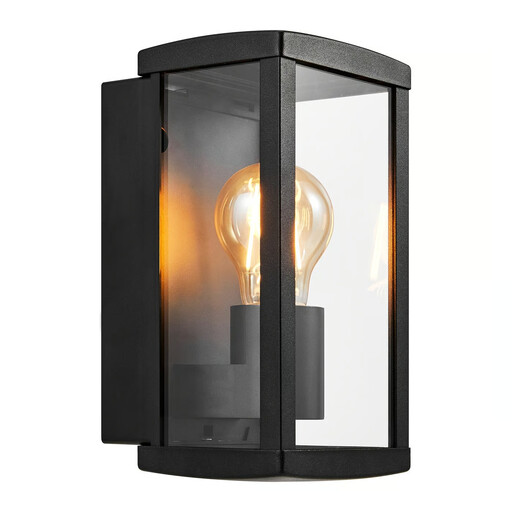
Why this choice suits this profile: Its lantern look fits equally well with older homes and contemporary architecture. Its decorative E27 bulb is easy to replace.
The E27 holder lets you change the bulb without replacing the fitting. Thanks to its Class II rating and double insulation, the model does not require an earth connection, provided you follow the instructions and installation rules.
IP44 rating, glass and black metal, E27 holder up to 10 W, dimmable and parallel connection.
We have compiled a comprehensive, real-time list of products that fully meet these demanding selection criteria and European safety regulations.
The maximum wattage depends on the holder and is stated on the product datasheet. For lighting an entrance, a low-wattage LED bulb may be sufficient. For a façade or a walkway area, focus on the direction, the number of light sources and the light output in lumens, rather than just the watts.
A mains-powered model must be installed in accordance with French electrical regulations. Class I products require an earth connection. To avoid any risk, it is best to call in a qualified electrician. A solar wall light simplifies installation, but it must be securely fixed and placed in a spot that gets enough sunlight.
The cost depends on the wattage, the hours of use and the price of electricity. An LED bulb generally consumes less than an equivalent, more energy-hungry light source. To keep your bills down, choose an appropriate wattage, use a compatible timer or sensor, and avoid over-lighting areas that are rarely used.