
Same-day & Next-day Delivery

Quality Guaranteed

Unlock Your Welcome Offers: FREE Delivery | Up to 80% OFF | Free 30-day JoyPlus trial
Download the APP
Finding the perfect non-stick induction pan can be a daunting task. Between promises of "scratch-proof" coatings that wear out in months and "all-hob" labels that hide poor performance on induction, it's easy to get lost. Our guide is here to help you navigate the marketing traps and identify the criteria that truly matter for a smart, long-lasting purchase.
As the Head of Product Selection at Joybuy, my mission is to sift through the noise to provide you with clear, objective buying advice. Let's review the essential pitfalls to avoid before diving into our top picks.
To make an informed decision, focus on these three parameters that make all the difference in the quality and longevity of your future pan.
The choice of coating is crucial for your cooking experience and maintenance.
For a non-stick induction pan, the quality of the base is non-negotiable. Look for a thick, encapsulated base that is perfectly flat. This structure (often a layer of aluminium sandwiched between two layers of stainless steel) guarantees two essential things:
Finally, think about your daily use.
Here is a selection of products that meet specific needs, taking into account the quality and safety criteria we've discussed.
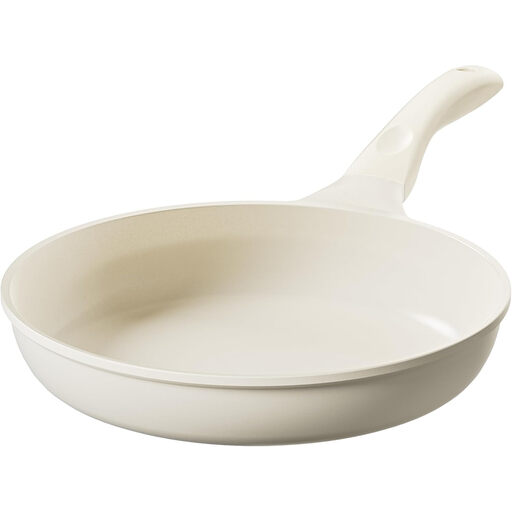
Why it's a great choice: Ideal for those who want a healthy and hassle-free pan for daily use. Its 28 cm size is perfect for families, and its ceramic coating allows for healthy cooking with little fat.
Its ceramic coating is guaranteed free of PTFE, PFOA, and PFAS, meeting the standard for a truly healthy pan. It cleans with a simple wipe, avoiding the trap of coatings that get damaged by washing.
Its thick base ensures fast, even heating on induction. We also appreciate its ergonomic Bakelite handle that stays cool to the touch.
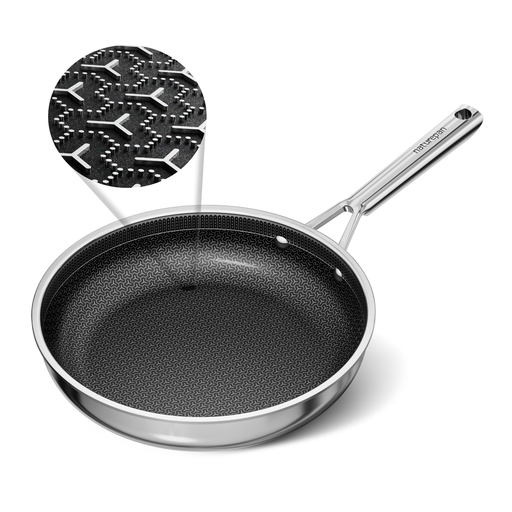
Why it's a great choice: For those who love to sear meat to perfection while still enjoying a non-stick surface. Its 5-ply construction and stainless steel handle make it oven-safe for maximum versatility.
The hexagonal hybrid technology solves the "perfect sear vs. non-stick" dilemma. The stainless steel grid allows you to achieve a great sear on meats, while the ceramic coating in the recesses prevents food from sticking.
Its 5-ply construction ensures exceptional heat distribution. Compatible with all hobs and oven-safe up to 260°C.
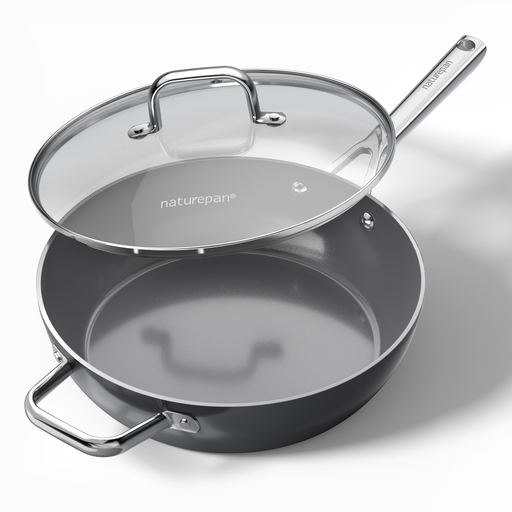
Why it's a great choice: Perfect for families and fans of saucy dishes, stews, or generous sautés. Its high sides and lid make it an ultra-versatile sauté pan.
This model ends the frustration of standard pans, which are often too small or shallow. Its sauté pan design reduces splatter and lets you cook larger quantities, a must-have for family meals.
Its ceramic coating is reinforced with titanium and diamond particles for enhanced durability. Oven-safe up to 260°C.
We've curated a full selection of pans that meet our strict quality criteria and European safety standards.
The lifespan of a ceramic pan depends on its manufacturing quality and, most importantly, its care. A good, reinforced coating that is treated well (no overheating while empty, use of wood or silicone utensils, gentle cleaning) can remain non-stick for several years. Conversely, entry-level models often show signs of wear after just a few months.
A raw stainless steel pan, by definition, has no coating. Its non-stick secret lies in the cooking technique: you must heat it gradually, then add your fat. When small ripples form on the surface of the oil, the temperature is perfect for searing without sticking. This is the famous Leidenfrost effect. For those who don't want the hassle, hybrid models (stainless steel and non-stick) are an excellent compromise.