
Livraison le jour même ou le lendemain

Qualité garantie

Débloquez vos offres de bienvenue: Livraison GRATUITE | Jusqu'à -80 % | 30 jours d'essai gratuits à JoyPlus
Téléchargez l'application
Choosing a new stainless steel induction pan can quickly become a headache. Faced with a jungle of marketing promises, it's easy to feel lost. As the Head of Product Selection at Joybuy, my mission is to cut through the noise for you. Let's forget the advertising jargon; I'm here to give you the keys to making a truly informed choice.
Investing in a good stainless steel pan is a choice for durability and healthy cooking. But be warned, a few common pitfalls can turn what should be an excellent investment into a real disappointment. Let's review the most frequent mistakes to help you avoid buyer's remorse.
The "Multi-Ply" Construction Mirage: Many pans boast of being "multi-ply" or having a "sandwich bottom." The catch? Most of the time, only the base of the pan is actually multi-layered (stainless steel-aluminium-stainless steel). The sides, however, are just a single sheet of stainless steel. The result: heat pools at the bottom, the sides struggle to heat up, and cooking becomes uneven. It's mission impossible to get a good sear on a piece of meat or reduce a sauce properly. A true tri-ply (or 5-ply) pan is constructed this way across its entire surface, including the base and sides, guaranteeing perfectly even heat distribution.
The "Everything Always Sticks" Myth: Many people banish their uncoated pan to the back of the cupboard, convinced it's defective because everything sticks. In reality, cooking with stainless steel just requires a short adjustment period. Unlike a non-stick pan, it's essential to preheat it properly over medium heat with a little fat. The famous water drop test is the foolproof trick you need to know: if the drop rolls around in the form of beads, the time is right. Once you master this technique, stainless steel reveals its superpower: an unmatched searing capability.
To be sure of the quality and longevity of your future pan, there are two technical points you absolutely must check.
Induction compatibility is a prerequisite, but it's not the whole story. Heat distribution is THE criterion that makes all the difference.
Fully Clad Multi-Ply Construction: For a stainless steel induction pan that lives up to its promises, demand a fully clad construction (base AND sides) in tri-ply (3 layers) or 5-ply (5 layers). The principle is simple: a core of aluminium, an excellent heat conductor, is sandwiched between two layers of stainless steel. On the inside, 304 (or 18/10) grade stainless steel ensures food neutrality and corrosion resistance. On the outside, 430 grade stainless steel is ferromagnetic, which ensures compatibility with induction hobs. It's this architecture that allows heat to travel uniformly up the sides for perfectly controlled cooking.
Material Thickness: A substantial thickness is a sign of better thermal inertia (the pan retains heat) and greater long-term resistance to warping. This is often what distinguishes a professional stainless steel pan: its ability to withstand thermal shocks and maintain a stable temperature.
A good pan is also one that fits perfectly into your daily kitchen routine.
Hob Compatibility and Oven Safety: Make sure the pan is compatible with all hobs, including induction. One of the biggest advantages of stainless steel is its ability to go from the hob to the oven. Double-check that the handle can withstand high temperatures (usually up to 220-260°C or 425-500°F).
The Standard Diameter: A 28 cm stainless steel pan is the ultimate all-rounder, ideal for cooking for 2 to 4 people. Its size is perfect for searing a nice piece of meat, sautéing vegetables, or preparing a saucy dish.
The Handle Design: A riveted handle is a hallmark of durability. It's the standard on quality models. So-called "cool-touch" or stay-cool handles, which are often hollow, are designed to limit heat transfer on the hob. Be careful, though, as they will still be scorching hot when coming out of the oven!
To help you see how these criteria apply in practice, here are a few models that meet specific needs.
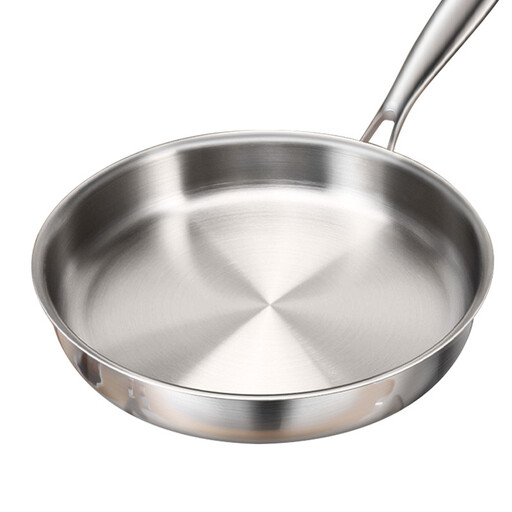
Why we chose it: Ideal for those who want the essentials: a robust, healthy, and high-performance pan without unnecessary frills. It's the perfect entry point for equipping your kitchen with durable gear that never disappoints on the cooking fundamentals.
This model features a true, fully-clad tri-ply structure (base and sides), not just a bonded base. This guarantees uniform heating without hot spots.
Its 100% 304 stainless steel construction, with no coating whatsoever, makes it a perfectly healthy and virtually indestructible utensil that isn't afraid of metal spatulas.
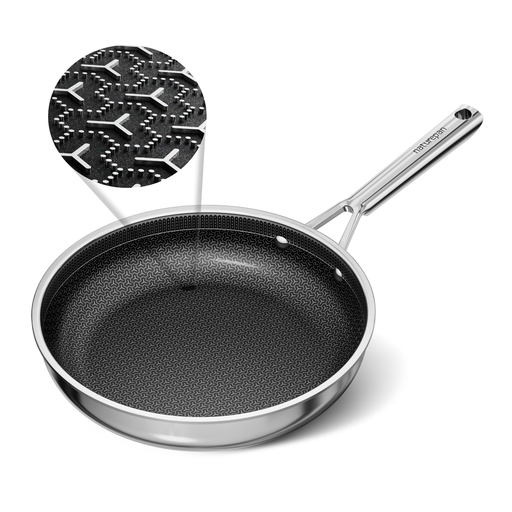
Why we chose it: For those who want the best of both worlds: the searing power of stainless steel and the ease of non-stick, all without compromising on health (guaranteed PFAS/PFOA-free). Perfect for intensive daily use.
It solves the sticking dilemma with its textured honeycomb surface. The raised stainless steel pattern ensures a perfect sear, while the valleys with a ceramic coating prevent delicate foods from sticking.
Its 5-ply structure and reinforced hybrid ceramic coating offer durability far superior to conventional non-stick pans. Bonus: it's oven-safe up to 260°C (500°F).
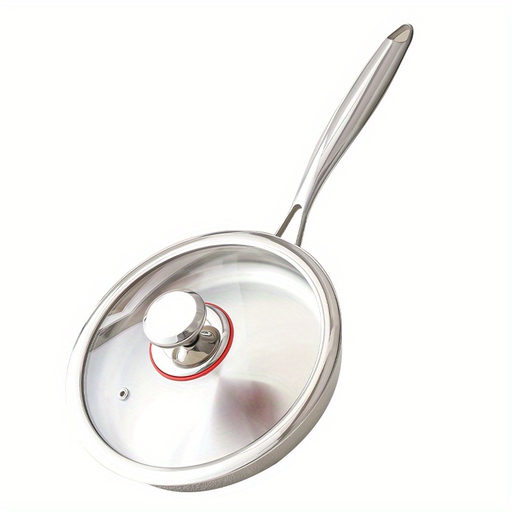
Why we chose it: Ideal for families and fans of simmered dishes, sauces, or recipes that require moisture retention. The lid transforms it into a truly multi-functional tool.
It combines a tri-ply construction for even heat with a smart glass lid, rimmed with silicone for better insulation and safer handling. Perfect for monitoring cooking without lifting the lid.
Versatility. Thanks to its lid, you can switch from searing to simmering in an instant, locking in flavour and moisture. Its multi-ply construction ensures a lifespan far beyond that of basic pans.
Discover our complete selection of pans that meet our demanding criteria for performance and durability.
The secret is temperature control. Here is the foolproof method:
A good stainless steel pan is practically a lifetime investment. Unlike pans with non-stick coatings that wear out and scratch, stainless steel is a raw, ultra-durable material. It is resistant to metal utensils, warping, and rust. With minimal care, it will serve you for decades without losing its qualities.
The vast majority of modern stainless steel pans are compatible with all hobs. For induction, the essential condition is that the outer layer must be made of ferromagnetic stainless steel (type 430). This information is always specified by the manufacturer. The trick to check? If a magnet sticks to the bottom of the pan, you're good to go.