
Livraison le jour même ou le lendemain

Qualité garantie

Débloquez vos offres de bienvenue: Livraison GRATUITE | Jusqu'à -80 % | 30 jours d'essai gratuits à JoyPlus
Téléchargez l'application
Want to organise your home better without drilling holes in the walls? No-drill adhesive hooks are a practical solution, especially in a rental property, a student room or a recently renovated home. They let you hang towels, keys, utensils or small decorations without reaching for the drill.
But be warned: not all models suit every surface or every item. A claim like "strong adhesion" doesn't necessarily tell you about the maximum weight, the curing time or the conditions of use. Here are the points to check before you place your order.
The stated capacity usually applies when the hook is fitted to a compatible, clean, dry surface. It can drop significantly on a dusty, damp, textured or freshly painted wall.
A hook rated for 2.2 kg shouldn't be used to hang a fragile or heavy object above a bed. For a substantial load, also consider how the weight is distributed and allow a safety margin.
Adhesive strips generally perform well on smooth, clean, non-porous surfaces: tiles, glass, metal, painted wood or a perfectly dry painted wall. However, they are not recommended on wallpaper, rough surfaces, crumbly walls or freshly painted surfaces.
For a hook for plasterboard walls, two options should be distinguished: the self-adhesive hook, suitable for a painted surface and light loads, and the claw hook, designed to penetrate slightly into the plasterboard. The latter isn't adhesive, even though it's installed without tools.
A bathroom hook needs a fixing system that copes with moisture. Standard models can lose their grip when exposed to steam or water splashes. For a shower, mirror or tiled wall, look for a water-resistant strip and stick to the limits stated on the packaging.
For outdoor use, choose a product designed to withstand temperature changes, UV rays and rain. A hook made for indoors doesn't magically become suitable for an external window.
Start by assessing the weight of the item you want to hang:
The shape of the hook also matters. A towel hook needs a wide enough hanging area. On a door, a model that hangs over the top edge can be more practical than a wall hook. However, check the door thickness and the available clearance.
Before fitting a repositionable hook or a robust self-adhesive hook:
To remove it, go slowly by pulling the tab in the direction intended. Don't pull the hook straight towards you: you risk peeling off the paint or the adhesive strip.
Plastic works well in the bathroom and for discreet uses. Nickel-plated metal or stainless steel offer a more refined finish, while polished brass adds a stronger decorative touch. A decorative metal hook should, however, be chosen based on its fixing system: some models need a separate adhesive strip or a specific installation.
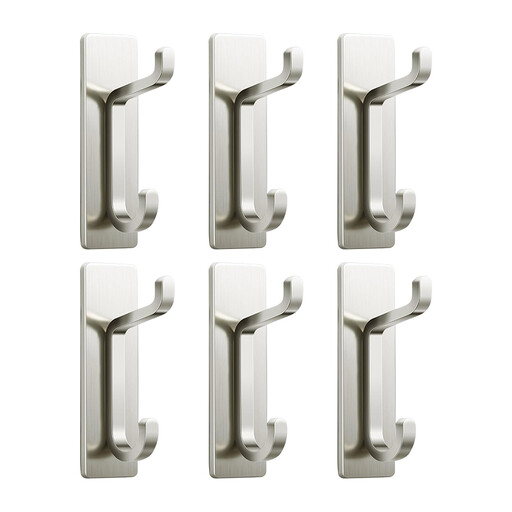
Why this choice suits this profile: This pack of six steel hooks lets you kit out a hallway, kitchen or bedroom without buying multiple items.
The multi-pack stops you overloading a single hook. Still check the capacity stated on the packaging.
Pack of 6, silver finish and no-drill installation as stated by the manufacturer.
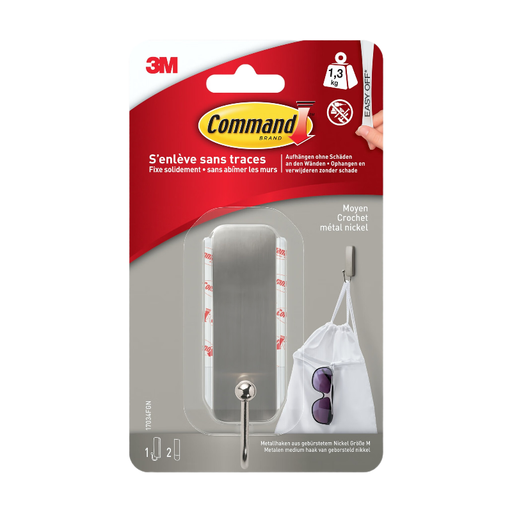
Why this choice suits this profile: Its nickel-plated metal finish blends easily into a hallway, bathroom or bedroom where the hook also plays a decorative role.
Its stated capacity of 1.3 kg gives you a clearer idea of its use than a model simply described as "robust".
Nickel-plated metal, tool-free installation and removal claimed without holes or residue on compatible surfaces.
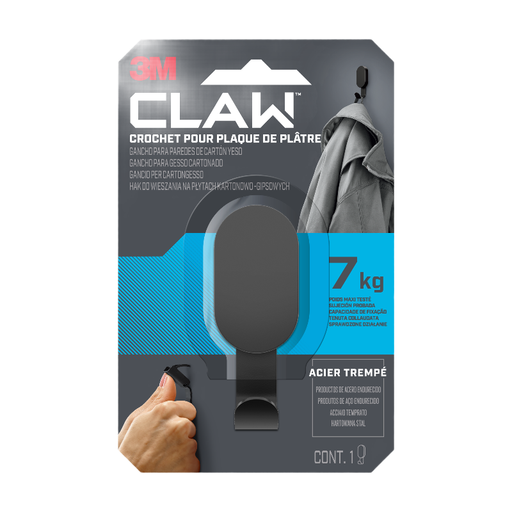
Why this choice suits this profile: On a plasterboard wall, this claw system meets a different need from a standard adhesive hook when you need to hang a heavier item.
It avoids entrusting a heavy load to a simple adhesive strip on plasterboard. The fixing works by pushing the claws into the surface.
Stated capacity up to 7 kg and tool-free installation on plasterboard.
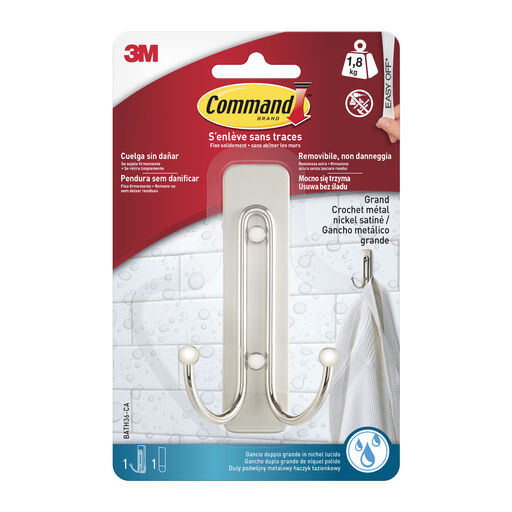
Why this choice suits this profile: This adhesive wall hook is designed to hold towels and accessories in a damp room, on a smooth, compatible surface.
Its water and rust resistance is stated for humid environments. It is still not recommended on textured, wet or freshly painted surfaces.
Two hanging points, satin nickel finish and stated capacity up to 1.8 kg.
We've listed the products that best meet these selection criteria and European safety requirements, in a complete list updated in real time.
Yes, provided the plasterboard is painted, smooth, clean and perfectly dry. However, the load should be kept moderate. For a heavy item, it's better to choose a claw hook specially designed for plasterboard and stick to its maximum capacity.
It all depends on the quality of the strip, the weight it's supporting, the temperature, the humidity and the surface. A correctly installed hook will hold much better. In a bathroom or near a heat source, check the hook regularly and replace the strip as soon as it starts to peel or loses its elasticity.
Start by removing the item, then hold the hook in place and slowly pull the tab in the direction indicated by the manufacturer. Avoid jerky movements and metal tools. On fragile paint or an old surface, no adhesive fixing can guarantee no damage at all.