
Livraison le jour même ou le lendemain

Qualité garantie

Débloquez vos offres de bienvenue: Livraison GRATUITE | Jusqu'à -80 % | 30 jours d'essai gratuits à JoyPlus
Téléchargez l'application
Whether you're a renter, a homeowner protective of your walls, or simply someone who loves to update your decor, the thought of pulling out a drill just to hang a picture can be daunting. The drill-free adhesive hook emerges as the perfect solution. The problem: the market is flooded with products making unrealistic promises, leading to classic disappointments like a picture frame crashing to the floor or a chunk of paint peeling off upon removal.
As a product expert for Joybuy, my mission is to help you see things more clearly. Let's forget the marketing jargon and focus on what really matters. Here are the three most common pitfalls to avoid and the essential criteria for making the right choice, with no unpleasant surprises.
The 3 Common Pitfalls When Buying an Adhesive Hook:
To avoid these disappointments, a quick look at three technical criteria is all it takes to ensure you get a bond that is both reliable and removable.
The weight displayed on the packaging corresponds to a maximum static load. In plain terms, the hook can support that weight if it's motionless and installed perfectly. For dynamic use (like a bag or coat that's constantly hung up and taken down), the rule of thumb is simple: aim for an advertised capacity of at least double the object's weight. For valuable items or anything over 2?kg, a heavy-duty hook with a dedicated fastening system isn't an option—it's a necessity.
Not all adhesives are created equal when it comes to surfaces. An adhesive wall hook designed for smooth tile is likely to fail miserably on a painted wall with a matte or slightly textured finish.
For a bathroom or kitchen hook, water resistance is non-negotiable. It's the number one criterion. Check that the packaging is clearly marked "Water-Resistant" or "For Humid Areas." The choice of material is just as crucial: stainless steel or high-quality plastic are your best allies against rust and premature wear.
Instead of an endless list, we've selected targeted solutions for different needs. Each one was chosen for its ability to deliver on its promises and avoid the pitfalls we've just discussed.
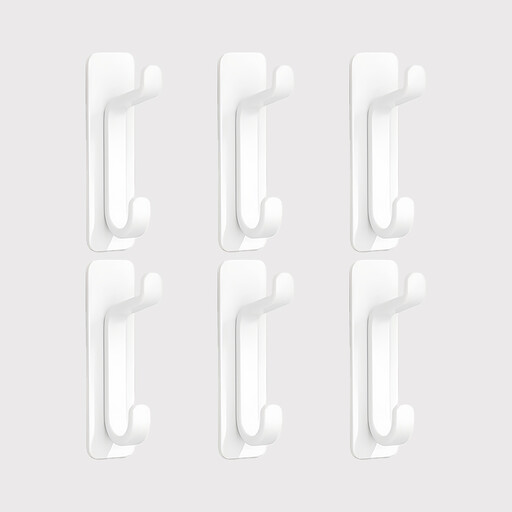
Why we love it: This set of six hooks is the perfect, cost-effective solution for tidying up an entryway, kitchen, or office. It's unbeatable for keys, tea towels, small utensils, and other daily accessories.
Its stainless steel construction eliminates the risk of rust, even in a kitchen. Designed for light loads, it prevents any risk of overloading and thus accidental falls.
An unbeatable value for organizing multiple spots around the house. Its simple and discreet metallic design fits in anywhere.
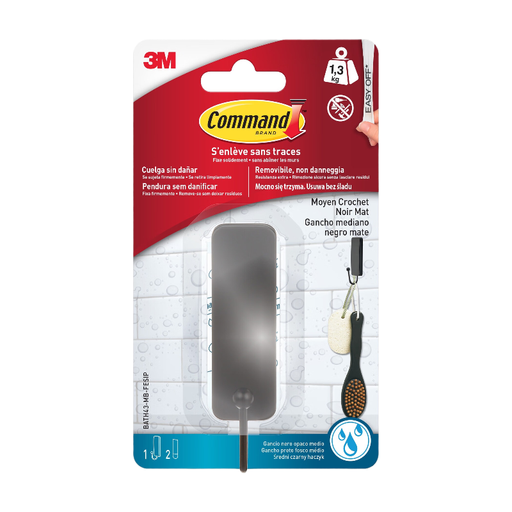
Why we love it: Specially designed for wet areas, this hook combines a trendy matte black finish with a proven adhesive. It's perfect for hanging a towel (up to 1.3 kg) or a bathrobe with peace of mind.
Thanks to its water-resistant adhesive strips, it neutralizes the main enemy: detachment due to humidity. Its stretch-release technology is designed to protect smooth surfaces like tile or painted walls, even in a damp environment.
Its winning combination: foolproof moisture resistance and a modern design. Its 1.3 kg capacity is perfectly calibrated for bathroom needs.
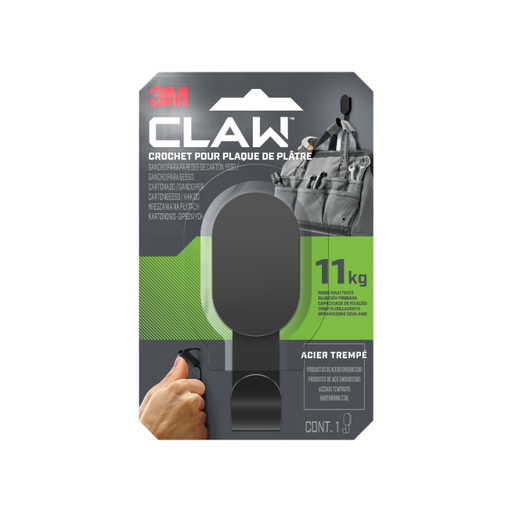
Why we love it: The solution for anyone who wants a heavy-duty hold without pulling out the drill. Note, this isn't an adhesive but a mechanical system: its claws anchor into drywall with a simple push of your thumb. Ideal for hanging a heavy mirror, a large frame, or even a small coat rack.
It radically bypasses the pitfalls of adhesives. By anchoring into the wall with its hardened steel claws, it offers a purely mechanical and ultra-reliable solution to the weight problem, supporting up to 11 kg.
An impressive load capacity (11 kg) for an installation that requires no tools. It's the ultimate no-hole wall fastener (for screws) for heavy objects on drywall.
Discover our full selection of tested and approved products, all of which meet our criteria for performance and safety.
For systems with a stretch-release strip (like Command), hold the hook and pull the tab very slowly straight down, flat against the wall, until it releases completely. Most importantly, never pull the tab towards you. For other adhesives, the trick is to gently heat the base with a hairdryer to soften the glue. Then, slide a piece of dental floss behind the hook and gently "saw" through the adhesive.
It all depends on the quality of the adhesive, adherence to the weight limit, and the environment. A good hook, properly installed on a compatible surface and not overloaded, can last for several years without issue. In a bathroom, constant exposure to moisture will reduce its lifespan if it's not specifically designed for that use.
Generally, the adhesive part is for single use only. However, some systems, particularly those from the Command brand, are cleverly designed: you can reuse the hook (plastic or metal) by simply buying replacement adhesive strips. It's a more sustainable and economical solution in the long run if you like to change your decor regularly.