
Livraison le jour même ou le lendemain

Qualité garantie

Débloquez vos offres de bienvenue: Livraison GRATUITE | Jusqu'à -80 % | 30 jours d'essai gratuits à JoyPlus
Téléchargez l'application
A multifunctional pull-up bar can sometimes turn a door frame or a corner of your living room into a proper workout space. But some models disappoint from the very first use: an unstable structure, incompatible dimensions, uncomfortable handles, or a load capacity that’s hard to interpret.
Before you place an order, it’s worth sorting the useful information from the marketing promises. Here are the criteria to consider when choosing a door pull-up bar, a dip station, or a power tower that suits both your home and your fitness level.
A stated capacity of 200 kg or 400 lb doesn’t guarantee the equipment will suit every situation. The load it can actually support depends on the user’s weight, the movements performed, the fixing system, and the condition of the mounting surface.
A dynamic pull-up, with swinging or explosive movement, puts more strain on the structure than a slow, controlled one. To minimise risk, check the following points:
A drill-free pull-up bar isn’t universal. The width of the frame, the depth of the door surround, the thickness of the wall, and the sturdiness of the door frame all directly affect the overall stability.
Before choosing a door pull-up bar, measure the available space carefully. Avoid fragile door frames, sliding doors, and surfaces that could warp. A drill-free installation avoids DIY work, but it doesn’t mean you can skip checking the support before each session.
A multifunctional bar can offer multiple grip positions, incorporate resistance bands, or include a dedicated plank position. However, these extras won’t make up for a structure that’s poorly suited to your home.
Start by deciding which exercises you’ll actually do: pull-ups with an overhand or underhand grip, dips, leg raises, or assisted strengthening. A simpler model that’s stable and well-sized will often be more practical than a complicated piece of equipment to install.
For occasional use or in a rented home, a drill-free pull-up bar can be a good option. It usually fixes onto a compatible door frame and can be removed without leaving a permanent installation. However, the contact points need to be wide enough and padded to avoid marking the surface.
An adjustable pull-up bar lets you change the height or width to suit different users. Examine the locking mechanism carefully and check that there’s no play once the adjustment is made.
For sessions that include dips or more varied exercises, a freestanding power tower works on a different principle. It takes up more space and requires initial assembly, but its frame typically combines a pull-up bar and a dip station. The floor needs to be flat, stable, and clear enough.
The phrases “pull-up bar 200 kg” and “pull-up bar 400 lb” are not the same. 400 lb is roughly 181 kg, while 200 kg is nearly 441 lb. Always compare the units and check whether the product page distinguishes between the maximum recommended load and the structural load.
The Pooboo model shown below states a maximum capacity of 480 lb and a recommended load of 400 lb. It’s worth understanding this distinction before you buy: for daily use, the recommended load is the safer benchmark.
An alloy steel frame, padded handles, and non-slip areas can make exercises more comfortable. However, these features don’t replace regular inspection.
To keep your home fitness equipment in good condition:
Any regulatory marking or mention should be confirmed on the product page and in the official documentation. A simple marketing claim isn’t enough to establish the equipment’s compliance.
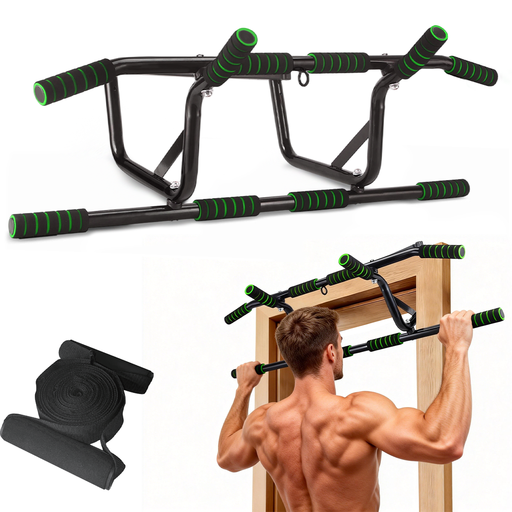
Why this choice suits this profile: This bar is designed for those who want to start doing pull-ups at home without installing a fixed structure. Its door-mounted design and resistance bands can support a gentle progression, provided the door frame is compatible.
The model requires no permanent drilling. However, you must measure the door and respect the stated 200 kg load.
Drill-free installation, ergonomic non-slip handles, resistance bands included, and a stated 200 kg capacity.
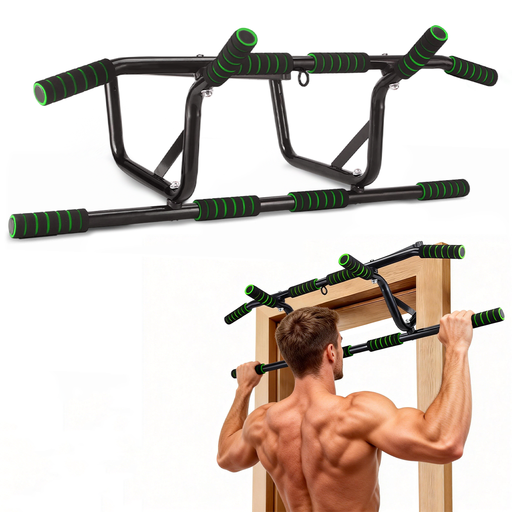
Why this choice suits this profile: This variant keeps a compact format, practical in a flat or shared room. It suits users looking for a removable piece of strength training equipment for short but regular sessions.
The product page highlights a drill-free installation. This feature must still be accompanied by a check of the door frame and contact points.
Door-mounted format, non-slip handles, resistance bands, and a stated 200 kg capacity.
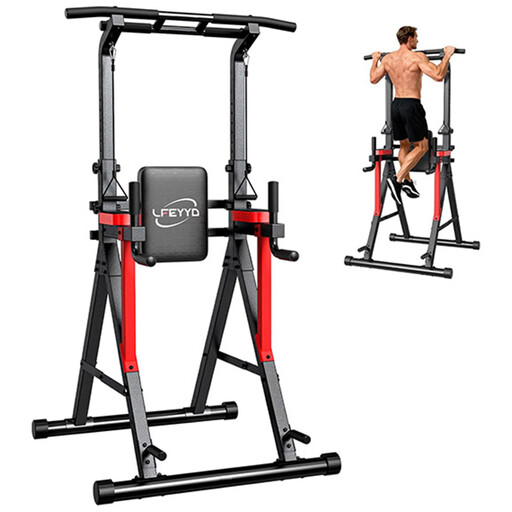
Why this choice suits this profile: This freestanding station is aimed at those who have a dedicated space and want to vary their exercises. Its 13 height adjustment levels allow it to be adapted for several users.
The product page distinguishes a maximum capacity of 480 lb from a recommended load of 400 lb. This clarity helps you stick with the safer usage value.
Alloy steel frame, 13 height levels, integrated pull-up bar and dip station.
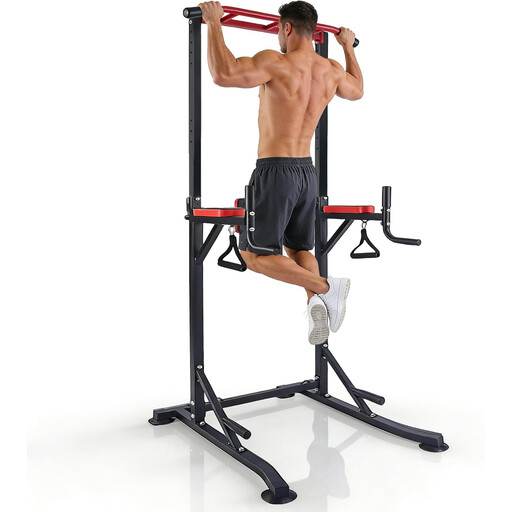
Why this choice suits this profile: This freestanding support is suitable for users who don’t want to rely on a door frame and prefer to set up their equipment in a dedicated fitness room.
Its floor-standing design avoids depending on a door, but it requires a flat surface, enough space, and careful assembly.
Freestanding structure, multifunctional design, and two resistance bands included.
We’ve selected a comprehensive, real-time updated list of products that meet these demanding criteria, as well as European safety regulations.
No. You need to check the width, depth, and sturdiness of the door frame. A sliding door, a narrow frame, or a lightweight partition may not be suitable. Always consult the dimensions stated on the product page and check the stability before completing a full session.
A freestanding dip station requires more space than a bar fixed to a door. Allow a clear area around the frame so you can move without hitting furniture or a wall. Compare the overall dimensions and adjustable height with the space you have available.
The lifespan depends on how often you use it, the load applied, the quality of assembly, and maintenance. Regularly checking the screws, welds, handles, end caps, and resistance bands helps you spot signs of wear earlier. Sticking to the recommended load and avoiding sudden movements also helps preserve the structure.