
Livraison le jour même ou le lendemain

Qualité garantie

Débloquez vos offres de bienvenue: Livraison GRATUITE | Jusqu'à -80 % | 30 jours d'essai gratuits à JoyPlus
Téléchargez l'application
Installing a multifunctional pull-up station at home lets you work your back, arms, shoulders, chest and core with a single piece of equipment. But with models marketed as “sturdy”, drill-free pull-up bars and gear boasting high weight capacities, it pays to look at the details before making a decision.
Before buying a pull-up bar, power tower or Roman chair, three common pitfalls keep cropping up:
The weight capacity needs to be considered alongside your own body weight, as well as the forces generated during a pull-up, dip or swinging movement. For regular use, go for a steel or steel alloy structure with a sufficiently wide base and non-slip contact points.
A unit rated for 200 kg, 400 lb or 480 lb should never be used beyond the stated limit. These figures alone aren’t enough to judge the stability of the setup. Also check the unit’s own weight, the recommended floor type and whether anchoring is required.
An adjustable height makes it easier for several people to use the station and lets you adapt it for different exercises. For a power tower, compare the maximum height against your ceiling height, leaving enough clearance above your head.
Multi-level models can be handy in a household where users are different heights. They also make assisted exercises with resistance bands easier. Before each session, make sure the adjustment is properly locked.
A versatile station may include a pull-up bar, dip station, push-up handles, an abdominal support or even a bench. These features are worthwhile if they match your training programme. If not, they mainly add bulk.
Pay particular attention to:
For a home strength-training device, ease of use matters just as much as the number of exercises it claims to offer.
The options below cater to different needs. The specifications come from the product listings – always check the dimensions, included accessories and safety instructions before placing your order.
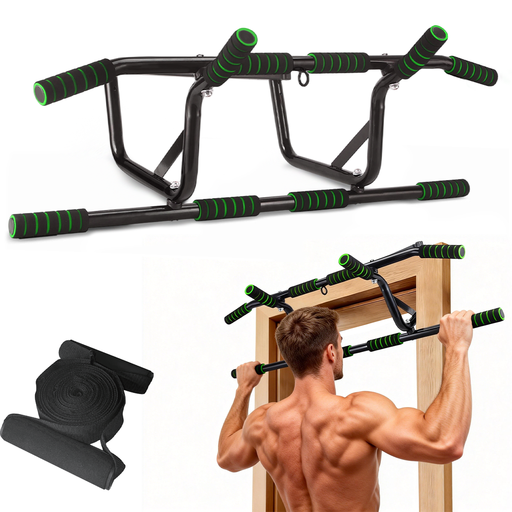
Why this suits this profile: This pull-up bar is aimed at people who want to start home training without installing a freestanding unit. Its over-door design makes it easy to store and set up, provided you have a compatible door frame.
The model is marketed as drill-free and has a maximum load of 200 kg. It is still essential to check your door frame and follow the instructions: no drilling doesn’t mean you can skip proper installation.
Ergonomic non-slip handles, resistance bands included according to the product listing, and a compact design.

Why this suits this profile: This setup suits users who want to combine several exercises in a dedicated space, with a dip station, a climbing-style grip bar and a bench.
The listing states a steel structure, adjustable height and a rated load of 480 lb. These details help you compare the model, but you still need to check floor stability and that all joints are tightened.
Integrated bench, adjustable height and multifunctional design to vary your workouts.
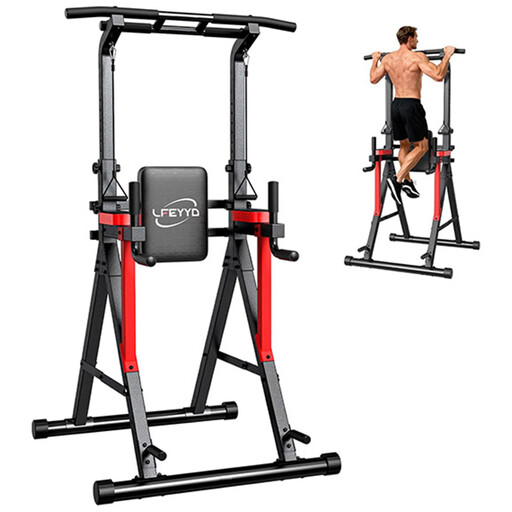
Why this suits this profile: With 13 height adjustments and a built-in dip station, this model is aimed at households with a dedicated training room who want precise adjustment.
The steel alloy structure and freestanding base mean you don’t rely on a door fitting that might not be suitable. The listing mentions a recommended maximum load of 400 lb and a maximum capacity of 480 lb.
13 height levels, padded handles and a station combining pull-ups and dips.

Why this suits this profile: This multifunctional model can work for several users thanks to its adjustable design and dimensions of approximately 106 × 106 × 239 cm. It will fit in a home gym that is spacious enough.
The listing states a steel alloy structure, adjustable height and a rated load of 440 lb. Full assembly and periodic checks of all connections are still essential.
Dip station and pull-up bar combined in an adjustable steel alloy structure.
We’ve put together a comprehensive, real-time updated list of products that meet these strict selection criteria as well as European safety regulations.
Leave a clear area around the station, especially above the bar and in front of the dip station. The floor must be flat and stable. A suitable mat can help reduce slipping and protect the flooring, but it will never make up for a poorly assembled base.
After assembly:
A pull-up bar used with resistance bands can add variety to your exercises. However, inspect the bands before each use and only attach them to a designated anchor point.
Yes, provided you choose an appropriate height and start with controlled movements. Resistance bands can help you adjust the difficulty, while an adjustable model makes it easier for several people to use. Progress should be gradual, and you should never exceed the manufacturer’s guidelines.
Measure the width, depth and height of the product, then allow enough free space for your movements. Some freestanding models are over a metre tall and need a stable surface. Also check the width of doorways before delivery and assembly.
The two formats suit different constraints. A drill-free bar takes up less space but depends heavily on door frame compatibility. A freestanding station offers more possibilities, particularly dips, but needs a dedicated area and full assembly. The choice therefore depends on your home, the space available and the exercises you plan to do.