
Livraison le jour même ou le lendemain

Qualité garantie

Débloquez vos offres de bienvenue: Livraison GRATUITE | Jusqu'à -80 % | 30 jours d'essai gratuits à JoyPlus
Téléchargez l'application
In a studio flat, a small kitchen or a campervan, a mini tabletop dishwasher stops the washing-up from piling up, without the need to install a built-in appliance. But not all models meet the same needs: some require a water supply, others have a built-in tank, and the stated capacity can vary significantly depending on the size of your plates and the layout of the baskets.
Before you buy, there are three pitfalls that deserve your particular attention.
An appliance advertised as suitable for several place settings can still struggle to fit large plates, saucepans or tall glasses. Check the capacity in place settings, the maximum plate diameter and the basket configuration. For a single person or a couple, three to four place settings may be enough. If there are more of you, it's better to look for a model with two levels.
The term "portable" doesn't necessarily mean "no installation required". Some appliances must be connected to the tap and the drain. If you're a tenant, a student or living in a campervan, choose a mini dishwasher with a water tank and manual filling. A hose for direct connection is still handy, but it shouldn't be the only option.
A very quick cycle isn't necessarily the most economical. Compare the water consumption per cycle, the European energy rating from A to G, the programme durations and whether you can run a half-load. Delayed start lets you run the appliance at a time that suits you, but it doesn't necessarily reduce the total consumption of the cycle.
Measure the available width, depth and height, allowing enough space to open the door, connect the hoses and vent hot air. A countertop dishwasher must be placed on a flat, stable surface that is resistant to moisture. Avoid installing it under a flimsy shelf or near a heat source.
Sizes can vary noticeably: some compact models are around 37 to 42 cm wide, while others approach 45 cm. Depth is also worth watching, especially when the door is open.
For a dishwasher without a water supply, check the tank capacity and how you fill it. A 5-litre tank is common on tabletop appliances, but you'll also need a container or hose to drain the waste water. Direct connection to the tap can save time day-to-day, provided you have a compatible adaptor for your plumbing.
In a studio flat or office, the noise level often matters more than the number of programmes. For reference, the Heinrich's HTG 8840 is rated at 47 dB, compared to 56.3 dB for the HTG 8855. These figures come from the manufacturer's data; the actual noise you hear also depends on the worktop and where the appliance is placed.
Focus on the features you'll actually use: quick cycle, eco programme, intensive wash, drying, automatic door opening, child lock and delayed start. For maintenance, an easily accessible filter and a dedicated salt compartment make upkeep simpler, especially in hard water areas.
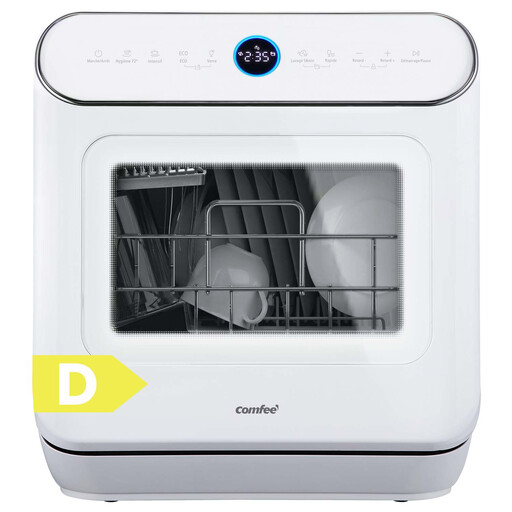
Why this choice suits this profile: With its 3-place-setting capacity and manual filling, it's ideal for single people, couples and tenants who want to avoid any plumbing modifications.
The tank is filled using the supplied jug, with no mandatory water supply. The stated capacity and dimensions give you a clearer idea of what to expect before buying.
7 programmes, delayed start from 1 to 24 hours, child lock and automatic door opening at the end of the cycle.
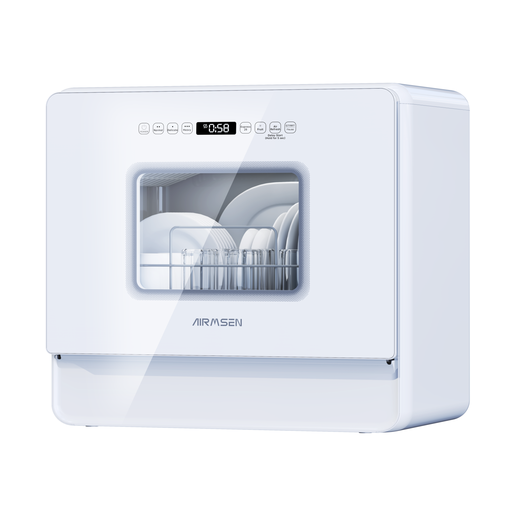
Why this choice suits this profile: Its two-level organisation and stated 5 place settings are aimed at households looking for more capacity without moving to a standard 60 cm appliance.
The choice between the built-in 5-litre tank and tap connection avoids confusing a compact format with mandatory installation.
3 spray arms, 5 cycles, hot air drying and delayed start from 2 to 12 hours.
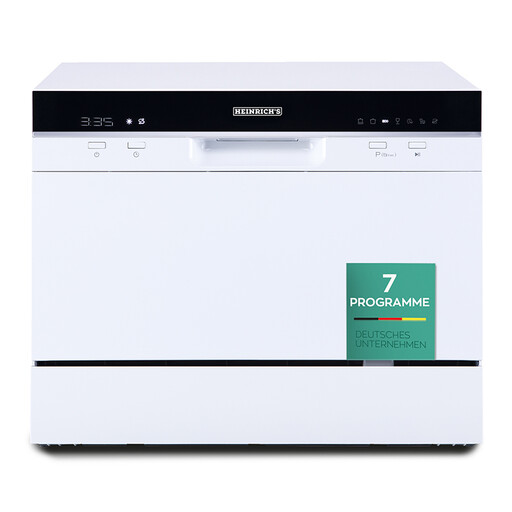
Why this choice suits this profile: With 6 stated place settings, seven programmes and a water connection supplied, this model is suitable for small families, offices and second homes with regular use.
The stated water consumption of 6.5 litres per cycle and noise level of 47 dB give you concrete benchmarks for assessing everyday use.
Eco, quick, intensive, glass and self-cleaning programmes, with delayed start up to 24 hours and automatic door opening.
Yes, some models have a built-in tank that you fill manually. However, you'll still need to drain the waste water, usually into the sink or a suitable container. Check the procedure in the manual before choosing your appliance.
An appliance with 3 to 4 place settings is generally enough for the daily washing-up of a single person or a couple. If you cook a lot or want to wash saucepans, go for a 5 or 6 place setting model and check the maximum plate diameter the basket can take.
The cost depends on the water and electricity consumption, the programme you select and the price of detergent. For a realistic estimate, note the consumption per cycle shown on the spec sheet, then multiply it by the number of washes you do each month. The eco programme is often longer, but its duration alone doesn't tell you the total cost.