
Same-day & Next-day Delivery

Quality Guaranteed

Unlock Your Welcome Offers: FREE Delivery | Up to 80% OFF | Free 30-day JoyPlus trial
Download the APP
A mini compact dishwasher can make daily life easier in a studio flat, a small apartment, an office or a motorhome. But between the theoretical capacity, the stated energy consumption and the installation constraints, product specs don't always tell the full story. Before you place an order, it's worth checking a few practical details.
A compact appliance can also throw up a few surprises: a water tank you need to fill by hand, a drain hose you have to place in the sink, baskets that won't take large plates, or a noise level that's irritating in an open-plan space. Here are the criteria to examine so you don't end up with a purchase that doesn't suit your needs.
The phrase "3 place settings" doesn't guarantee you'll be able to load three full meals with large plates, saucepans and tall glasses. In a mini dishwasher, the interior layout often matters just as much as the stated capacity.
Before buying, make sure you check:
For a single person or a couple, a 3-place-setting dishwasher can work perfectly well. For three or four people, a model advertised as four or five place settings will generally be more practical.
A dishwasher without a water inlet can run using a built-in water tank. This is a handy solution for a tenant or a student, as it avoids having to modify the plumbing. However, the waste water still needs to be drained via a hose into a sink, basin or suitable outlet.
So check the hose length, how stable the setup is, and whether you can prevent water from flowing back. An appliance described as portable doesn't necessarily mean you can use it without any preparation at all.
A consumption of 2.9 or 5 litres per cycle needs to be looked at in the context of the programme used. The intensive mode, hot-air drying and extended ventilation functions can all affect total consumption.
To compare different models, note down:
Measure the available width, depth and height. Also allow enough space around the appliance for ventilation and access to the hoses. A model that's 34 to 37 cm wide will be easier to fit into a small kitchen, while a deeper appliance often offers more interior storage space.
Weight is also worth considering if you plan to move the dishwasher regularly between the kitchen and a motorhome. The worktop needs to be stable and able to support the appliance when it's full of water.
Models with a built-in water tank are easy to install. However, you'll need to fill the tank for every cycle and find a suitable spot for the drain hose. A direct connection to the tap is more convenient day to day, but may require an adaptor.
In a rented apartment, an appliance that offers both modes gives you more flexibility. In all cases, use an earthed socket that's compatible with the voltage specified by the manufacturer. Also follow the instructions in the manual: extension leads and multi-socket adaptors should be avoided if they're not recommended.
In a studio flat, the noise level can quickly become a deciding factor. A spec sheet quoting 43 to 47 dB may point to a quiet compact dishwasher, but the actual noise you hear also depends on where the appliance is placed, the floor surface and any vibrations.
An easy-to-access filter, spray arms that are simple to clean and a salt compartment are real plus points for everyday use. In areas with hard water, the water softener system and using the right salt can help reduce limescale build-up. However, promises about saving detergent or extending the appliance's lifespan are manufacturer claims, not guaranteed results.
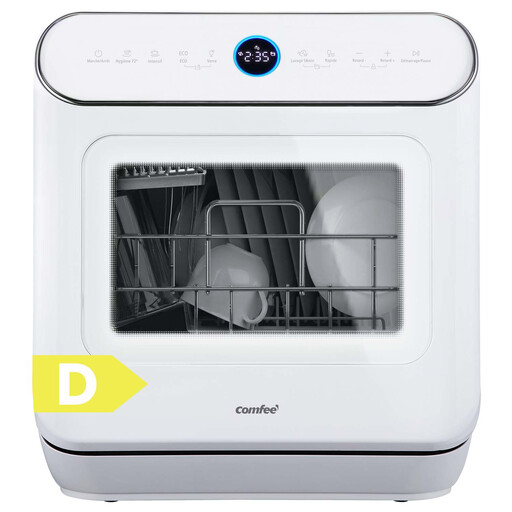
Why this model suits you: its stated capacity of 3 place settings is ideal for single people, couples and small kitchens. The manual water tank filling means you don't need a fixed plumbing connection.
The capacity, dimensions of 420 × 436 × 465 mm and the stated maximum plate diameter of 270 mm are all listed on the product page, so you can easily check compatibility with your crockery.
7 programmes, delayed start from 1 to 24 hours, automatic door opening and touch controls, according to the product page.
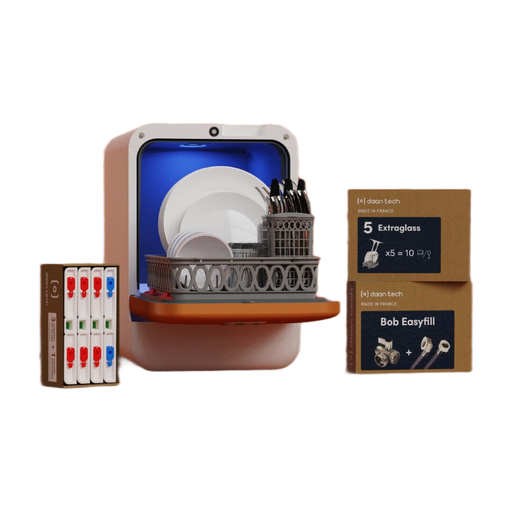
Why this model suits you: it focuses on a compact footprint of 49 × 34 × 49 cm, touch controls and a set of included accessories.
The stated consumption of 1.9 litres per cycle and the 5 programmes should be compared taking into account the specific usage conditions given by the manufacturer.
Stated noise level of 43 dB, touchscreen, 2-year warranty and a white and copper finish.
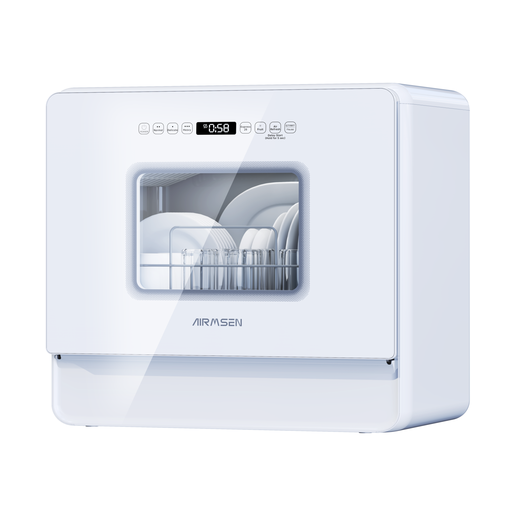
Why this model suits you: its two levels and stated capacity of 5 place settings are aimed at households that build up more washing-up, while still keeping a worktop-friendly size.
Its built-in 5-litre water tank means you can use it without a fixed plumbing connection. However, you'll still need to arrange drainage to a suitable point.
Three spray arms, five stated cycles, delayed start from 2 to 12 hours and hot-air drying.
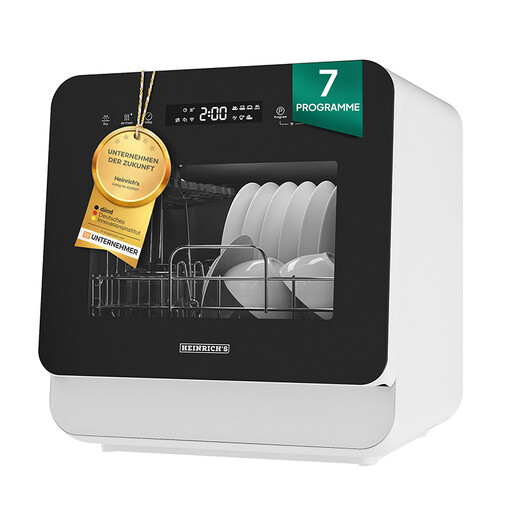
Why this model suits you: its 5-litre water tank and the option to connect it directly meet the needs of an office, a motorhome or a rented property.
Both water supply modes are listed, with a stated water consumption of 4.2 litres per cycle. You'll still need to check the available space and ventilation.
7 programmes, water softener, 24-hour delayed start and an additional drying function.
We've put together a full, real-time updated selection of products that meet these strict criteria and European safety requirements.
To avoid unpleasant surprises, place the dishwasher on a flat, stable surface near a suitable socket. Position the drain hose correctly before each cycle. Remove large food residues, but don't rinse all the crockery if the programme and manual don't require it.
Clean the filter and spray arms regularly. Use a detergent designed for dishwashers: washing-up liquid meant for hand washing creates too much foam and can cause leaks. Always unplug the appliance before carrying out maintenance, and don't open the door suddenly at the end of a cycle, as hot steam may escape.
It depends on the amount of crockery, the programme you choose and how you wash up by hand. Product pages often state a consumption of a few litres per cycle, but the figures vary between models and programmes. Compare the data for the eco mode and load the basket properly to avoid running extra cycles.
Yes, as long as you choose a model with a built-in water tank. You'll need to fill it manually and place the drain hose in a sink or a stable container. Also check the weight your worktop can support and the electrical requirements specified in the manual.
It varies depending on how often you use it, the water quality, how well you maintain the filter and whether you stick to the recommended load. To keep the appliance in good condition, avoid overloading it, use the right salt if the model requires it, and check the connections regularly. The warranty stated on the product page doesn't replace the statutory legal guarantees that apply in France.