If your priority is choosing a lower-salt pasta sauce, compare the ‘salt’ value per 100 g. A tomato base with no added salt lets you season your meal yourself, but takes a little preparation. A ready-made sauce saves time between lectures; just check its salt content, ingredients, pack size and availability, as ‘no added salt’ does not mean ‘salt-free’.
Who are these options for?
Students keeping an eye on salt
If you want to decide how your pasta is seasoned, a tomato base with no added salt lets you make your own sauce. Just compare the ‘salt’ value per 100 g. The French Agency for Food, Environmental and Occupational Health & Safety (Anses) notes that sauces and condiments contribute to sodium intake.
Students in a hurry with access to a microwave
A ready-made sauce can mean less preparation between lectures. Check the salt content and allergens in your chosen recipe, as well as the reheating instructions. Panzani provides these for some pack sizes of its Tomates Cuisinées sauce.
Students preparing several portions
If you’re cooking lunch for several days, choose a pack size that suits the amount you’ll use, and check the instructions for storing it after opening. Barilla, for example, offers a 400 g pack of its cooked tomato sauce; pack size alone doesn’t tell you how much salt it contains.
What should you look for?
Tomato base with no added salt
Choose this if: you can add herbs or other ingredients to your pasta yourself and want to control the seasoning.
Bear in mind: this option requires some preparation, and ‘no added salt’ is no reason to skip checking the ‘salt’ value.
Ready-made sauce to heat up
Choose this if: you have a way to heat up your lunch and want to cut down on preparation.
Check: salt content and allergens vary by recipe; also make sure the product you want is available.
| What to consider |
What to check before buying |
Who it matters to |
| Salt content |
Compare the ‘salt’ value per 100 g for products intended for the same use, then take into account how much you’ll serve. |
If I want to season my pasta myself, the value on the label matters more than a claim on the front of the pack. Around 50% of consumers put having this control over salt first among their needs. |
| Quick lunch |
Check the pack size, reheating instructions, allergens and availability of the exact recipe. |
Between lectures, I’m mainly looking for a meal that takes little preparation, but I won’t choose a sauce based on convenience alone. For nearly 30% of consumers, speed is the main priority. |
| Preparing several portions |
Check the pack weight and storage instructions after opening. |
When I’m preparing several lunches, I want to season the tomato base to my taste and use what I open within the time stated. This flexibility comes first for around 20% of consumers. |
Mistakes to avoid
-
Confusing ‘no added salt’ with ‘salt-free’
A recipe with no added salt may still show salt in its nutrition information. According to its product listing on Auchan, Jardin BiO étic’s coulis with no added salt contains 0.03 g of salt per 100 g.
Compare the ‘salt’ value per 100 g for the products you’re considering, and think about how much you plan to spoon over your pasta.
-
Planning lunch around a product without checking it’s available
When checked, Carrefour listings for an organic tomato sauce with no added salt and a Heinz garlic and onion sauce showed both products as unavailable. A product listing doesn’t guarantee you’ll be able to buy the sauce for your next meal.
Check availability at the shop or through the service you use, then find another tomato base whose label meets your needs.
-
Opening a large pack without planning what you’ll eat next
Auchan’s listing for Jardin BiO étic coulis says to keep it chilled and use it within three days of opening.
If you’re eating alone, match the amount you open to the meals you have planned and follow the instructions on the product you buy.
Any amount you can’t use within the stated time may go to waste.
-
Assuming organic or Nutri-Score tells you how much salt is in it
These claims answer different questions from how much salt is in a particular recipe. Panzani, for example, gives its Tomates Cuisinées sauce a Nutri-Score A, but that alone doesn’t show that it’s a lower-salt sauce.
Start with the ‘salt’ value, then read the ingredients list and allergen information for the exact product you’re considering.
Brands and retailers to know
Panzani
Panzani offers ready-made cooked tomato sauces, with microwave reheating instructions for some pack sizes.
- Worth considering if you want to spend less time preparing lunch.
- A Nutri-Score or a claim about the origin of the ingredients doesn’t replace comparing the ‘salt’ value for your chosen recipe.
Barilla
Barilla offers a 400 g pack of its cooked tomato sauce, made to serve with pasta, among other dishes.
- The pack size may suit you if you’re preparing more than one meal.
- Claims about the tomatoes or added preservatives don’t tell you how much salt the sauce contains. Check the nutrition information for the exact product.
Carrefour
A Carrefour listing features an organic tomato sauce with no added salt, intended in particular for pasta.
- This description can help you identify a recipe to compare with other tomato sauces.
- The product was listed as unavailable when checked. Check what your local shop stocks and the information on the product you buy.
E.Leclerc
The retailer offers tomato sauces and preparations under its own-label brands, including Turini.
- The different pack sizes give you options to suit the number of meals you’re planning.
- The Turini recipe made with fresh tomatoes that was checked lists salt as an ingredient, so don’t assume it has no added salt.
Auchan
Auchan offers Jardin BiO étic coulis with no added salt, sold in a pack of three 200 g cartons.
- Its product listing gives a salt content of 0.03 g per 100 g and says to use a carton within three days of opening and keep it chilled.
- Another Auchan listing, for Mutti purée, pairs the claim ‘no added salt’ with an ingredients list that includes salt. Check the packaging for the exact product rather than assuming the details apply to another one.
Lidl
Lidl’s range includes own-label brands; the recipes and pack sizes available depend on what your local shop stocks.
- You can compare the tomato sauces on the shelf by checking their labels.
- For your needs, look for the ‘salt’ value per 100 g on each product rather than assuming an entire range meets the same criteria.
Tomato bases available on Joybuy
These tomato purées are the sort of base you can season yourself to serve with pasta. Check the pack size and label depending on whether you’re making one lunch or several meals; these aren’t ready-made sauces that you can simply pour over.
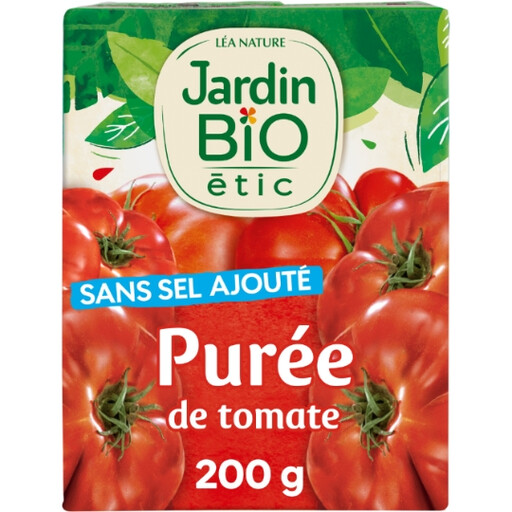 Image unavailable
Jardin BiO étic organic tomato purée 200 g
A base to season yourself for pasta; check the ‘salt’ value on the packaging before choosing your recipe.
Pack size: 200 g.
View on Joybuy
 Image unavailable
Mutti Zero Pesticides tomato purée 500 g
A base to consider if you’re planning several meals; check the salt content and storage instructions after opening for this exact product.
Pack size: 500 g.
View on Joybuy
Frequently asked questions
Does ‘no added salt’ mean ‘salt-free’?
No. A sauce or tomato base with no added salt may still contain some salt, as shown in its nutrition information. For example, Auchan’s listing for Jardin BiO étic coulis gives a salt content of 0.03 g per 100 g. Compare this value across the products you’re interested in.
What should I choose if I want to spend less time preparing lunch?
A ready-made cooked sauce takes fewer steps than a base you need to season, but check its salt content before choosing it for this reason. If you’d rather use a coulis or purée with no added salt, plan what you’d like to serve it with.
How should I heat up sauce at university?
Follow the instructions for your chosen product, and use a microwave-safe container if the instructions say to heat it in a microwave. For its 200 g pot of Tomates Cuisinées sauce, Panzani specifies heating it under a microwave cover for one minute at 900 W. Don’t apply these instructions to another product or pack size.
Should I check the allergens in tomato sauce?
Yes. Check the ingredients list and allergen information for the exact recipe, even if tomato appears in its name. A cooked sauce may contain other ingredients or flavourings, so don’t assume it has the same ingredients as plain coulis.


