
Livraison le jour même ou le lendemain

Qualité garantie

Débloquez vos offres de bienvenue: Livraison GRATUITE | Jusqu'à -80 % | 30 jours d'essai gratuits à JoyPlus
Téléchargez l'application
Konjac jelly has carved out a prime spot among snacks for those looking to combine indulgence with a light touch. Hailing from Asia, particularly Korea and Japan, this uniquely textured treat promises a flavourful break with a negligible calorie count. However, with a booming market, it's easy to fall for marketing traps and turn what should be a healthy pleasure into a real disappointment.
As the Head of Product Recommendations at Joybuy, my mission is to help you navigate this landscape. Let's break down the pitfalls to avoid and the criteria that truly matter for making the right choice.
Navigating the healthy snack aisle can sometimes feel like a minefield. Here are the three most common mistakes that can cost you dearly, both in money and disappointment.
To ensure you make the right choice, focus on a few fundamental parameters. These are the true guarantors of a quality konjac drink or jelly.
First instinct: dissect the composition.
Korean jelly) or steviol glycosides (stevia extracts). Their advantage: they have little to no impact on blood sugar levels.A good benchmark: aim for products with less than 20 kcal per 100g. The best options often even flirt with the 10 kcal mark. Always check the "Carbohydrates" and "of which sugars" lines. Ideally, the sugar content should be close to zero. This guarantees a product aligned with weight management goals or a low-sugar diet.
Konjac jelly mainly comes in two formats:
Brands like Jelly B have become benchmarks thanks to their successful texture and ultra-light formulas, contributing to the success of Korean jelly.
To guide you, we've matched user profiles with specific products that meet our selection criteria.
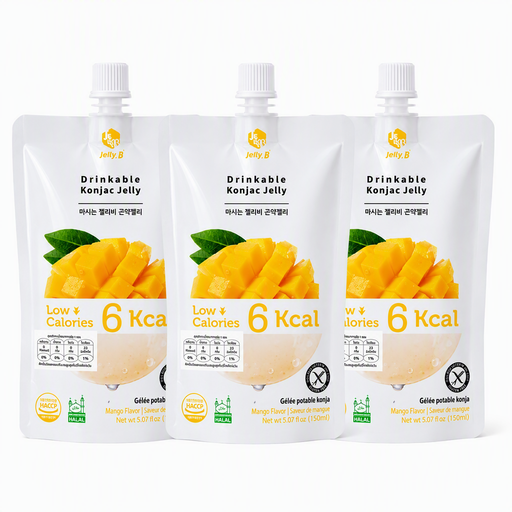
Why it's the right choice: Perfect for those following a strict diet (including vegan) who tolerate no compromises on sugar. It's the choice for peace of mind.
This product tackles the "hidden sugar" trap head-on by using erythritol, a zero-calorie sweetener, for a sugar content that is simply nil.
Just 4 kcal per 100 ml and a clear vegan formula. The mango flavour comes simply from a fruit puree concentrate.
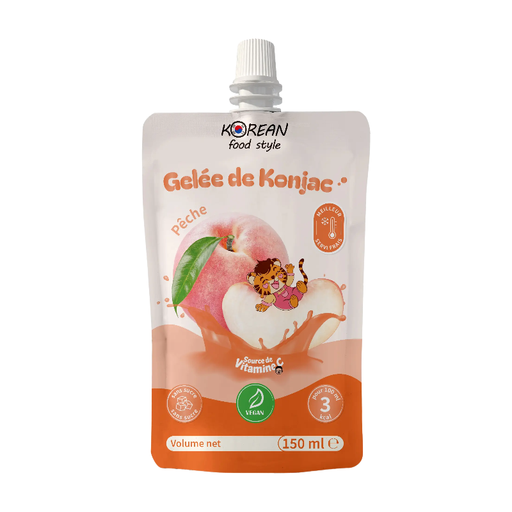
Why it's the right choice: Perfect for an on-the-go snack, with no risk of spills on public transport, at the office, or after a workout. The pouch format is the ultimate in convenience.
This product ticks all the boxes: a convenient format that prevents any texture disappointment, and a formula with no added sugar. Two of the main pitfalls are thus avoided.
Ultra-light (3 kcal/100 ml), sugar-free, and enriched with vitamin C. The konjac drink format is tailor-made for on-the-go consumption.
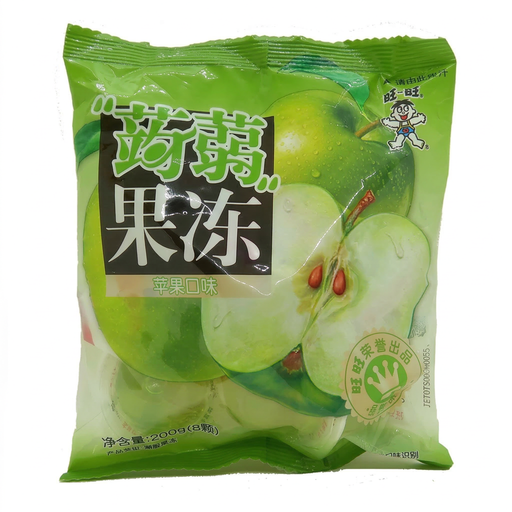
Why it's the right choice: For those who prioritise the pleasure of a melt-in-your-mouth texture and an intense fruity taste, while still keeping an eye on calories. Far more reasonable than a classic dessert!
This product is transparent about its sugar content. It embraces its status as an indulgent snack and focuses everything on taste and texture, thus avoiding the disappointment trap.
A melt-in-your-mouth texture and a very successful fresh apple flavour. Its generous 200g format makes it a truly filling snack.
We have put together a complete selection of products that meet our selection criteria and current regulations.
Konjac jelly is made from glucomannan, a soluble fibre that swells on contact with water to form a gel in the stomach. This mechanical effect contributes to a feeling of fullness. This is why konjac is often seen as an effective appetite suppressant for curbing small cravings between meals, all while being enjoyable and very low in calories. Please note, it is in no way a substitute for a balanced meal.
Most individually sealed jellies can be stored without issue at room temperature, away from light. There's no need to refrigerate them before opening. However, many fans agree that they taste much better when chilled. Once opened, the golden rule is: refrigerate and consume quickly, ideally within 24 to 48 hours.
It all comes down to the composition and, consequently, the nutritional profile.