
Livraison le jour même ou le lendemain

Qualité garantie

Débloquez vos offres de bienvenue: Livraison GRATUITE | Jusqu'à -80 % | 30 jours d'essai gratuits à JoyPlus
Téléchargez l'application
So, your new induction hob is installed, but you can't get your old pan to heat up. Worse, it's warping, and food sticks every time. Choosing a new induction pan seems simple, but the market is saturated with marketing promises that often lead to disappointment: a coating that wears out in a few months, advertised compatibility with mediocre performance, or concerns about the materials used.
As the Head of Product Recommendations at Joybuy, my role is to help you cut through the noise. This article breaks down the common pitfalls and essential technical criteria to help you make an informed, durable purchase that truly suits your cooking style.
Before looking at specific models, it's crucial to recognise the false promises that can end up being costly.
To make the right choice, focus on these three non-negotiable technical aspects.
On an induction hob, the base of the pan is what generates heat. It must be perfectly flat for optimal contact and made of a ferromagnetic material.
The choice of coating is often a trade-off between ease of maintenance and longevity.
Beyond materials, size and shape play a crucial role. A small 20 cm pan is perfect for fried eggs, while a 28 cm model will suit a family. An induction sauté pan, with its high sides, will prove more versatile for saucy dishes or large quantities of vegetables.
Rather than searching for a single perfect model, it's better to find the one that matches your habits. Here is our selection for three distinct profiles.
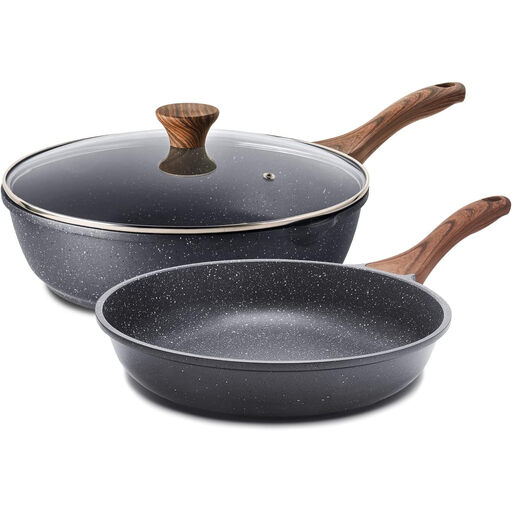
Why we love it: This set is all about versatility and simplicity. Perfect for those who cook daily and want reliable, easy-to-clean equipment suitable for everything from morning eggs to slow-cooked evening meals.
The Swiss ILAG granite coating is designed for better durability than standard non-sticks, thus avoiding the pitfall of a pan becoming unusable after just a few months.
Its die-cast aluminium body ensures fast, even heating, while its stainless steel base guarantees excellent performance on induction.
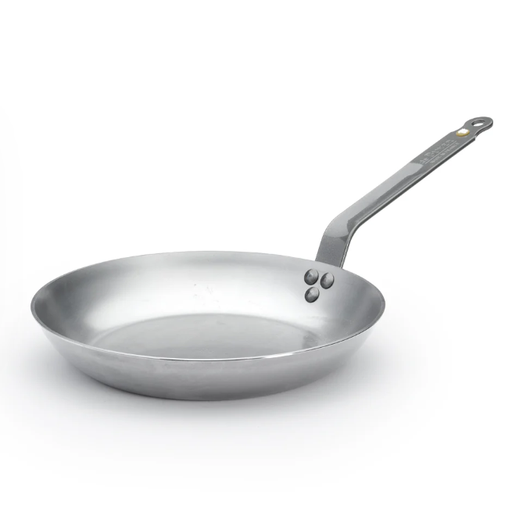
Why we love it: For those who see cooking as a craft and are looking for a tool that gets better with time. It's a lifetime investment, the opposite of throwaway culture.
This pan has no artificial coating that could degrade. Its natural non-stick property is built up through seasoning: goodbye to coating obsolescence!
Made of 99% iron, it is exceptional for searing meats at high temperatures (the famous Maillard reaction) and offers unparalleled robustness. Compatible with all hobs, including induction.
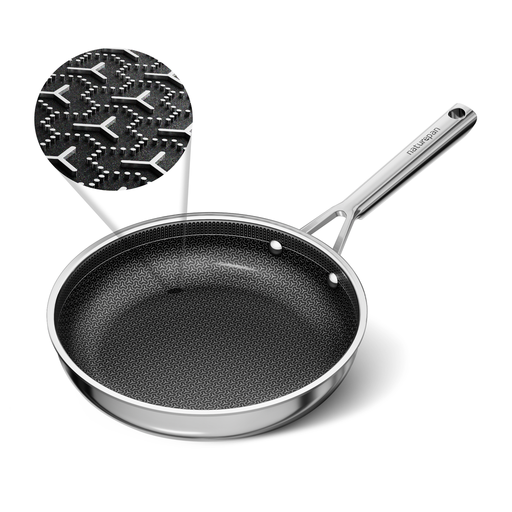
Why we love it: Ideal for those seeking the latest innovations for healthy cooking without sacrificing performance. It combines the robustness of stainless steel with the safety of an advanced ceramic.
This model avoids the labelling trap by guaranteeing a composition that is PFAS, PFOA, and PTFE-free. Its hybrid structure protects the ceramic coating from scratches, thereby extending its lifespan.
Its hexagonal surface technology combines stainless steel ridges for a perfect sear with non-stick ceramic "valleys". It is also oven-safe up to 260°C.
We have selected a complete list of products for you that meet our strict selection criteria and European safety regulations.
A slight buzzing or whistling sound is not uncommon, especially at high power settings. It is usually caused by the high-frequency vibrations of the hob's magnetic field interacting with the different layers of material in the pan's base. This phenomenon is normal and harmless, but it is often less pronounced on pans with a thick, high-quality base.
Seasoning creates a 100% natural protective and non-stick layer.
It all depends on the quality of the coating and how it's maintained. An entry-level model can lose all its effectiveness in less than a year. Conversely, a good quality non-stick pan, used over moderate heat, without metal utensils, and washed by hand, can retain its properties for 3 to 5 years. For maximum durability, uncoated options like carbon steel or cast iron remain unbeatable.