
Livraison le jour même ou le lendemain

Qualité garantie

Débloquez vos offres de bienvenue: Livraison GRATUITE | Jusqu'à -80 % | 30 jours d'essai gratuits à JoyPlus
Téléchargez l'application
Whether it's cases of water, gardening supplies, or all the gear for a day at the beach, hauling heavy loads can quickly become a chore. The foldable utility wagon emerges as the perfect solution. But be warned: the market is flooded with models making tempting marketing claims that often hide deal-breaking flaws. Make the wrong choice, and you're guaranteed to be disappointed: a wagon ready for the scrap heap after just a few months, wheels that jam on the first patch of gravel, or a frame that buckles under a weight it was supposedly designed to support.
To avoid falling into these traps, here are the 3 pitfalls you absolutely must watch out for:
To avoid these disappointments, forget the marketing hype and focus on the technical specifications that truly matter. These are the true arbiters of your future foldable utility wagon's performance and durability.
These two values are inextricably linked. A heavy-duty foldable wagon is only effective if it offers enough volume to distribute the weight evenly. One without the other is meaningless.
This is the feature that will determine where your wagon can (or cannot) go.
The lifespan of your foldable hand cart depends directly on the quality of its frame and how easily it can be stored.
To move from theory to practice, here are three models that meet very specific needs.
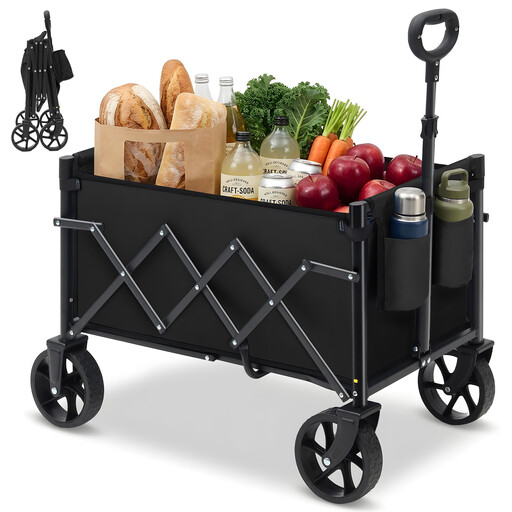
What's it for? Perfect for weekly grocery runs, carrying cases of water, or trips to the park. Its light weight and ultra-compact folded size make it a discreet yet formidable ally in the city.
Its reinforced steel frame is well-calibrated for its 80 kg capacity, avoiding the undersized frame trap. The one-step folding is genuinely simple and effortless.
Its feather-light weight (4.8 kg) and the fact that it stands upright when folded make it incredibly easy to store in an entryway or closet. Bonus: the wheels are removable for maximum space-saving.
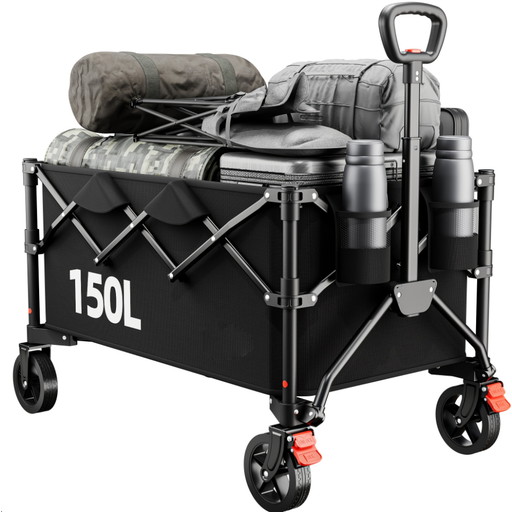
What's it for? The perfect companion for camping, gardening, or large family picnics. It combines a serious load capacity and generous volume with excellent mobility on varied terrain.
It tackles the problem of inadequate wheels head-on with its all-terrain PVC wheels equipped with brakes. Enjoy stable traction on grass, gravel, or gentle slopes.
Its perfect balance between a 120 kg load capacity, 150 L volume, and all-terrain wheels makes it a champion of versatility. The removable fabric and wheels simplify cleanup after a muddy adventure.
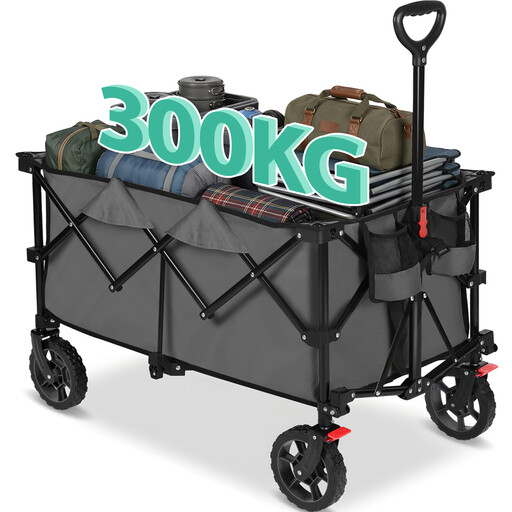
What's it for? Designed for those who are serious about weight: DIY materials, bags of cement, camping gear for the whole crew... This is a true workhorse, far more than just a recreational accessory.
It shatters the fragile-frame trap with a powder-coated steel structure and reinforced welds, built for a colossal 300 kg load. Its 200 L volume ensures this capacity is genuinely usable.
Its exceptional load capacity and volume put it in a class of its own. Despite its robustness, the one-handed folding system remains disarmingly simple.
For professional needs or job sites, industrial-grade solutions are available. Discover our selection of products that meet the most demanding specifications.
It all depends on your typical terrain. If you only plan to use it on smooth surfaces (pavements, car parks, supermarkets), standard wheels will do the job. However, for a foldable garden cart or a beach wagon, all-terrain wheels aren't an option—they're a must. They prevent jamming and save you considerable effort on soft or uneven ground.
It's simple, but crucial. After each use, especially outdoors, a wipe-down of the fabric with a damp cloth (and a mild detergent if needed) is recommended. Make sure everything is completely dry before storing it, particularly the frame and joints, to prevent rust. Also, remember to periodically check that the screws on the wheels and frame are tight.
The vast majority of models are pulled with a telescopic handle. This is the most versatile format, especially for manoeuvring on difficult terrain. A few more compact, grocery-oriented models are pushed with a stroller-style handlebar. The choice depends on your comfort and primary use. For heavy loads and long distances, pull-style models remain unbeatable for manoeuvrability.