
Livraison le jour même ou le lendemain

Qualité garantie

Débloquez vos offres de bienvenue: Livraison GRATUITE | Jusqu'à -80 % | 30 jours d'essai gratuits à JoyPlus
Téléchargez l'application
Moving house, heading to the beach, bringing home groceries, or tackling a gardening session? The foldable utility cart has become an indispensable tool. The problem: the market is flooded with models that make lofty claims but are a bitter disappointment in practice. A poorly chosen cart isn't just a bad investment; it's a source of frustration and entirely avoidable risks.
Before you make a decision, it's crucial to understand the common pitfalls so you don't end up with a product that won't go the distance. Here are the most frequent design flaws:
To avoid falling into this trap, focus on the technical specifications that truly make a difference.
Instead of relying on marketing claims, scrutinize these three technical points. This is your guarantee of finding a cart that will reliably meet your needs for years to come, whether you need a foldable hand truck for packages or a garden cart for bags of soil.
The frame is the backbone of your cart. Its material and design are what guarantee its sturdiness and longevity.
Editor's Tip: Inspect the design of the joints and weld points. A frame that's reinforced at stress points is a true sign of durability.
The wheels are arguably the most critical component. Your choice should directly depend on your intended use.
The key advantage of a foldable cart is its small footprint. Check that its folded dimensions are compatible with your storage space (car trunk, closet). A "one-click" or one-handed folding mechanism is a much-appreciated convenience for daily use.
Ergonomics should not be overlooked. An adjustable telescopic handle allows you to adapt the cart to your height and prevent back pain when transporting heavy loads.
To help you see how these criteria apply in practice, here are a few models that stand out for specific user profiles.
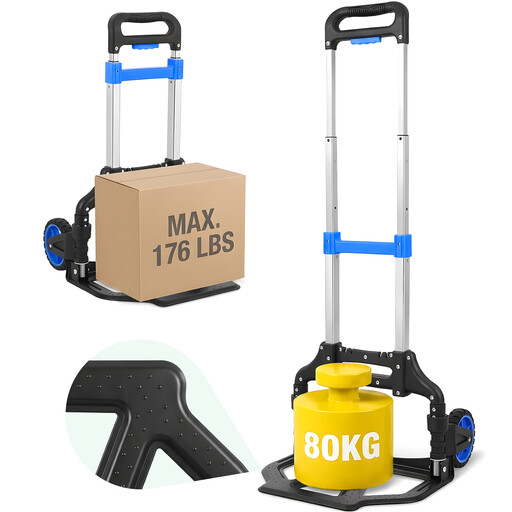
Why this model? Perfect for occasional help: carrying water bottle cases, a few packages, or the week's groceries. Its feather-light weight and extreme compactness make it a discreet ally that fits anywhere.
Its TPR wheels with ball bearings ensure a smooth and silent roll on hard floors, a far cry from the typical jamming of low-end plastic wheels. The aluminum frame is well-sized for its stated 80 kg load capacity in domestic use.
Ultra-compact: Folds down to a thickness of just 5.7 cm. Adjustable handle: 3 height settings (63, 90, and 100 cm) for optimal comfort.
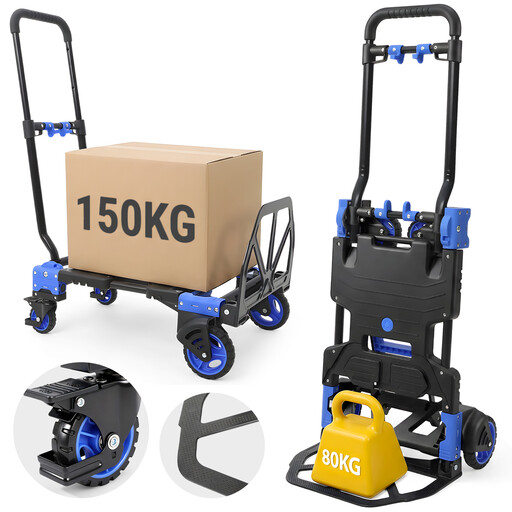
Why this model? The solution for those who juggle various needs: transport moving boxes in hand truck mode, then switch to platform mode for bulky items (furniture, plants). A true Swiss Army knife that adapts to the situation.
Its reinforced aluminum frame is designed for two load types (80 kg as a hand truck, 150 kg as a platform), avoiding the trap of a single, vague capacity rating. The 360° wheels with integrated brakes are a guarantee of safety and maneuverability.
2-in-1 convertible: Switches from hand truck to platform cart in seconds. High capacity in platform mode: Supports up to 150 kg for the bulkiest items.
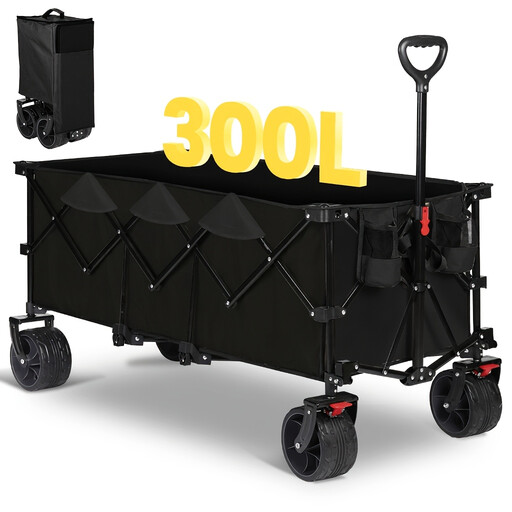
Why this model? Designed for the most demanding users: campers, gardeners, or large families at the beach. Its 200 kg load capacity and large volume allow you to haul everything in a single trip, regardless of the terrain.
It avoids the flimsy wheel trap with its wide 7-inch tires and quiet bearings, which ensure stable traction on grass, gravel, or sand. The 200 kg capacity is supported by a robust frame and a highly durable 600D Oxford fabric.
200 kg capacity: For the heaviest tasks. All-terrain wheels: Wide tires with brakes for perfect stability and control.
Discover our complete, up-to-date selection of carts that meet our selection criteria and safety standards.
What's the difference between a foldable hand truck and a utility cart? A foldable hand truck is a vertical, two-wheeled structure, ideal for stacking boxes or tall items. A utility cart, often with four wheels and a "wagon" format, is more versatile for carrying loose or irregularly shaped items (camping gear, garden tools, etc.).
How do I maintain my foldable cart to maximize its lifespan? Maintenance is very simple. After each use, wipe down the frame and wheels with a damp cloth to remove dirt or sand. Make sure it is completely dry before storing it to prevent rust on any steel parts. Also, remember to periodically check that the screws are tight and the folding mechanism is working properly.
Can a beach wagon be used for gardening? Yes, not only is it possible, it's an excellent idea. A beach wagon is by nature equipped with wide wheels designed to avoid sinking into soft ground. This feature makes it just as effective on a lawn, dirt, or the gravel paths of a garden. The only point of caution: ensure the fabric is sturdy enough to resist being punctured by sharp tools.