
Livraison le jour même ou le lendemain

Qualité garantie

Débloquez vos offres de bienvenue: Livraison GRATUITE | Jusqu'à -80 % | 30 jours d'essai gratuits à JoyPlus
Téléchargez l'application
Transporting groceries, camping equipment, gardening tools or festival essentials can quickly become cumbersome with ordinary bags. A folding wheeled cart can make these tasks far easier, provided you check its actual capacity, wheel quality and the space it occupies when stored.
Product listings sometimes highlight impressive capacities and load limits, but these figures alone are not enough to make the right choice. Here are the key criteria to assess before buying, along with a selection of models suited to different user profiles in France.
A 200 L folding cart can hold a large volume of items, but that does not automatically mean it can support 200 kg. Capacity refers to the available space, while the maximum load depends on the frame, stitching, wheels and pulling system.
For transporting blankets or lightweight bags, a large capacity is highly practical. For bags of compost, firewood or bottles, the stated maximum load takes priority. Avoid exceeding this limit and distribute items evenly across the base of the cart.
Small all-purpose wheels may perform well on smooth surfaces but become difficult to manoeuvre across wet grass, mud or sand. An all-terrain cart fitted with wide wheels generally provides better traction and is less likely to sink.
Also assess the cart’s stability when loaded. Wide wheels cannot always compensate for an unevenly distributed load or a handle that is too short.
A high-capacity folding wagon can take up considerable space in a car boot or storage area. Check its dimensions when open, the handle height and the clearance required to fold it away. A tool-free mechanism and a compact folded profile make regular use much more convenient.
For light everyday use, a folding utility cart rated for 80 kg may be sufficient. Models with a 200 L capacity are better suited to families, gardeners and campers who regularly move several bags or pieces of equipment.
Whether painted or alloyed, a steel frame provides a rigid structure. Several models featured here use 600D Oxford fabric. Its stated water resistance makes it suitable for outdoor use, but it is best to dry the cart before folding it to minimise odours and lingering moisture.
For a garden cart used on grass, uneven paths or sand, look for 7-inch wide wheels or a comparable size. 360° swivel wheels make changes of direction easier, particularly in confined spaces.
A cart with a brake provides additional control when stopping on a gentle slope or taking a break. However, the brake does not replace supervision of the load and should not be treated as a mechanism capable of holding a load on a steep incline.
An adjustable handle allows the pulling position to be adapted to the user’s height. Make sure it is long enough to prevent you from kicking the back of the cart while walking.
For storage in an apartment, garage or car boot, prioritise a quick-folding system. Some models fold in multiple directions and require no assembly. Also compare the unloaded weight before choosing: higher capacities are often accompanied by a heavier frame.
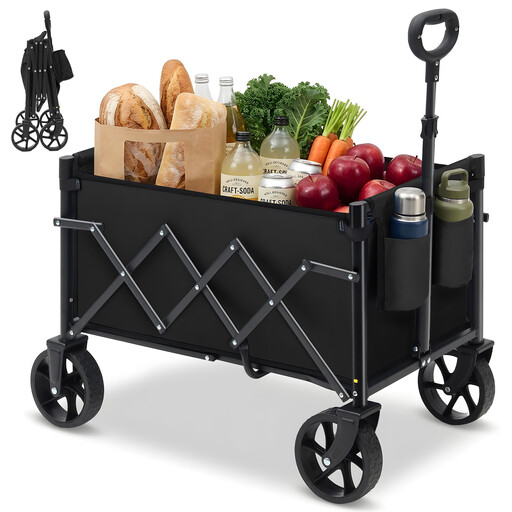
Why this model suits this profile: Weighing 4.8 kg and folding down compactly, it is well suited to grocery shopping, picnics and occasional trips.
The stated 80 kg load limit is clearly distinguished from the unloaded weight, making it easier to compare with a higher-capacity model.
Three-position adjustable handle, removable wheels and good stability when stationary.
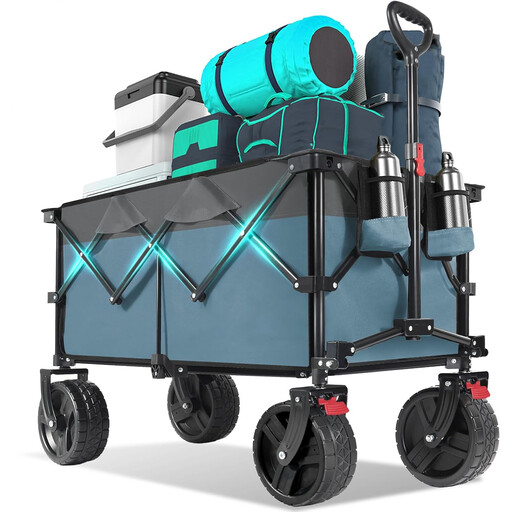
Why this model suits this profile: Its 200 L capacity and 7-inch wide wheels are ideal for transporting bulky equipment across grass or paths.
The brake and securing straps help prevent the load from shifting and make temporary stops easier.
Alloy steel frame, stated waterproof 600D Oxford fabric and adjustable retractable handle.
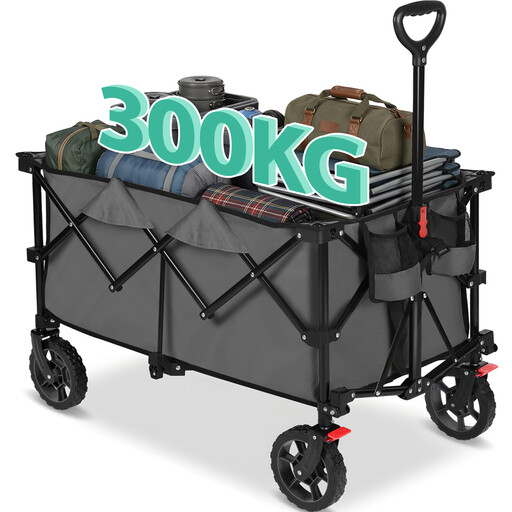
Why this model suits this profile: It is designed for users who regularly transport heavy loads for gardening, camping or household projects.
The listing distinguishes a 200 L capacity from a stated maximum load of 300 kg. These two specifications must be respected independently.
Powder-coated steel frame, stated one-hand folding mechanism and adjustable handle to suit different users.
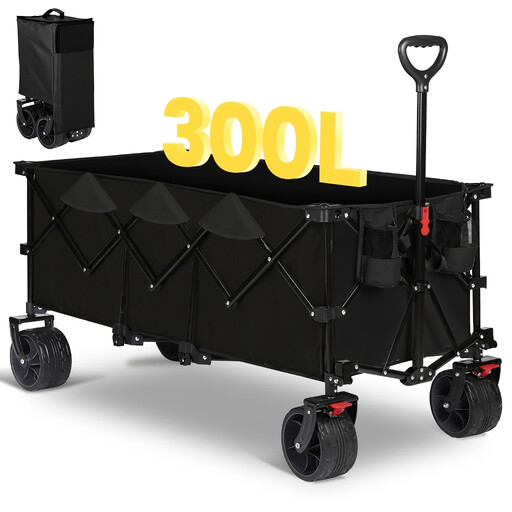
Why this model suits this profile: Its stated 300 L capacity is suitable for outdoor equipment, tools and bulky items.
The dimensions, stated 200 kg load limit, 7-inch wheels and brakes are listed separately.
600D Oxford fabric, stated silent bearings and two integrated cup holders.
A robust folding cart requires little maintenance, but a few good habits can help minimise wear:
Service life depends in particular on how frequently the cart is used, the terrain and the weight carried. Repeated use on sand or mud requires more frequent cleaning than use on paved surfaces.
Explore an up-to-date selection of products that meet these capacity, storage and mobility requirements for outdoor use in France.
A 200 L capacity is suitable for tents, blankets, bags and outdoor accessories. If you mainly transport groceries or a few personal belongings, a lighter, more compact model will be easier to store and pull.
Yes. Some models feature wide wheels designed for a range of surfaces, including grass, mud and sand. Ease of movement nevertheless depends on the weight, terrain texture and load distribution. On deep sand, reduce the carried weight as much as possible.
A brake can be useful for temporarily securing the cart on a gently sloping surface or while loading it. However, remain mindful of the incline and never exceed the maximum load stated by the manufacturer.