
Livraison le jour même ou le lendemain

Qualité garantie

Débloquez vos offres de bienvenue: Livraison GRATUITE | Jusqu'à -80 % | 30 jours d'essai gratuits à JoyPlus
Téléchargez l'application
Preparing several meals in advance, storing soup in the fridge or taking your lunch to work all call for a container suited to the task. Stainless steel food storage containers with glass lids are popular for their durability and clear design, but not every model will suit your needs.
Before buying a set, watch out for these three common pitfalls:
Here are the key points to consider when choosing practical containers for everyday use, whether you’re meal prepping, taking food with you or organising your fridge.
For stainless steel food containers, food-grade 304 stainless steel is a good starting point. This grade is commonly used for utensils and containers intended for food contact. It’s generally described as corrosion-resistant and suitable for storing a wide range of foods.
A seamless design with no interior coating also reduces the areas where grease and food residue can build up. Smooth sides are easier to clean, but it’s still essential to follow the manufacturer’s instructions and avoid abrasive products.
Stainless steel must not go in the microwave. Even if a product listing appears to suggest otherwise, always follow the safety instructions. To reheat food, transfer it to a suitable container.
A borosilicate glass lid lets you check what’s inside without opening the container. The silicone seal should run all the way around the lid and remain flexible. When choosing airtight stainless steel containers, check for:
It’s worth testing a leakproof lunch box with a small amount of liquid before putting it in your bag. Don’t fill it beyond its capacity. Close it on a flat surface, then gently tilt it over the sink. This test doesn’t replace the information in the product listing, but it can help you spot a lid that isn’t fitted correctly.
A set of three food containers in different sizes is often more versatile than a set of identical ones. A small container is handy for a salad or side dish, while a larger model can hold soup, a family-sized meal or several portions.
Stackable or nestable containers make storage easier in a standard fridge. Compare their external dimensions rather than relying on the stated capacity alone: a very deep container may be difficult to fit on a low shelf.
The PURECOOK products featured below have capacities of 1,000 ml, 1,800 ml and 3,000 ml in their detailed specifications. The product title also lists other capacities for a shallow variant. So check the listing carefully for the model you’ve selected before ordering.
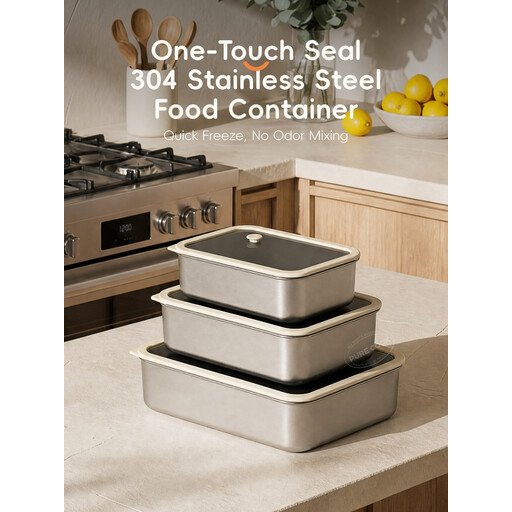
Why this suits you: This set of three sizes is a good starting point for organising your meals. The containers are designed to nest and stack in the fridge.
The uncoated 304 stainless steel body and silicone-sealed lid cover the main points to check before you buy.
Three stated capacities, clear borosilicate glass lids and, according to the product listing, dishwasher compatibility.
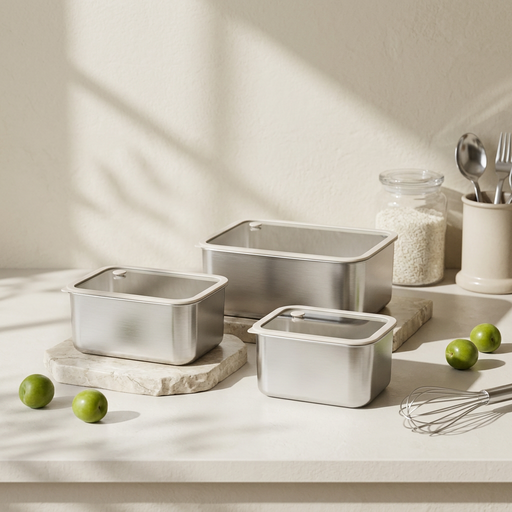
Why this suits you: Their deep design and generous capacities are ideal for households that cook in bulk or want to store complete meals.
The capacities are clearly listed, and the stackable design helps save space. Both are worth checking when a product listing lacks detail.
304 stainless steel, a smooth interior, a borosilicate glass lid and stated compatibility with the fridge, freezer and indirect bain-marie heating.
Why this suits you: Whether you’re active, sporty or cooking for a family, these containers make it easy to portion out generous servings and prepare several meals in advance.
The sealed closure and stackable design are handy for transport, as long as you don’t fill the container beyond its intended capacity.
Generous 1,000 ml, 1,800 ml and 3,000 ml sizes, 304 stainless steel sides and stated dishwasher-safe cleaning.
We’ve brought together a comprehensive, regularly updated selection of products that meet these demanding criteria and European safety standards.
To help your containers last longer:
The containers are listed as dishwasher-safe, but check the instructions to see whether this also applies to the lids and seals. When carrying liquids, let food cool in line with standard food storage guidance and keep the container upright in a suitable bag.
They can be, as long as the lid, seal and container rim fit together properly. How leakproof they are also depends on how full the container is and the condition of the seal. It’s a good idea to test it over the sink before carrying it in a bag.
Not the stainless steel body. Metal must never be placed in a microwave. Even if a product listing suggests general compatibility, follow the manufacturer’s detailed warnings and transfer the food to a container specifically designed for microwave use.
For an individual portion, a capacity of 700 to 1,000 ml may be suitable, depending on the meal. Sizes from 1,800 ml to 3,000 ml are better suited to family cooking, meals with sauce or storing several portions. Always check the external dimensions and the space available in your fridge.