
Livraison le jour même ou le lendemain

Qualité garantie

Débloquez vos offres de bienvenue: Livraison GRATUITE | Jusqu'à -80 % | 30 jours d'essai gratuits à JoyPlus
Téléchargez l'application
A screwdriver that leaves your wrist aching, pliers whose jaws slip or a power tool supplied without the right accessories can quickly turn a minor repair into an unexpected expense. Whether you enjoy DIY at home or work as an electrician, maintenance technician, plumber or network installer, your choice of DIY tools should primarily reflect how you actually use them, rather than the superlatives printed on the packaging.
A tool kit packed with dozens of bits is only useful if the sizes match your screws and devices. For electronics repairs, Phillips, flat-head, Torx, hexagonal or Y-shaped bits will often be more useful than a long list of accessories you will never use.
Take a look at the storage too: a magnetic or compartmentalised case helps prevent small bits from getting lost and makes it quicker to find the right size.
Chrome vanadium steel, Cr-Mo and hardened steel do not all indicate exactly the same construction. Beyond the material name, look for the information that really matters: heat treatment, maximum cutting diameter, tool length and the type of cable it is compatible with.
Cutting pliers designed for thin wire should not be used to cut through a thick metal cable. Similarly, a cable cutter intended for flexible cables is not necessarily suitable for steel cable.
A non-slip handle, return spring or quick adjustment can make a real difference to comfort during use. A compact tool slips easily into a maintenance case and is easy to carry around a worksite. However, a model that is too short may not provide enough leverage.
A safety lock is also invaluable for blade tools and cutting pliers that you carry around regularly.
Start by identifying your main requirement:
A multi-tool can be perfectly adequate for an occasional job. If you carry out DIY work regularly, several specialist tools will generally reduce compromises.
For an electric screwdriver, compare the torque, rotational speed, battery life and charging method. Small precision models sometimes offer torque ranging from 0.05 to 0.35 N·m, which is suitable for screws in phones, laptops and cameras. A model designed for furniture assembly may offer considerably more torque.
For pliers or a cable cutter, the maximum capacity should be clearly stated. It varies depending on the material being cut: flexible wire, solid wire, brake cable, metal cable or chain. Do not exceed it, even if the tool feels particularly robust.
For electrical or rechargeable products sold in France, check the compliance information, whether instructions in French are provided when required and the identity of the responsible person established in the European Union. Where applicable, the CE marking represents a declaration of conformity by the manufacturer or importer; it does not replace checking the technical specifications.
Before carrying out any electrical work, switch off the power, check that no voltage is present using a suitable device and use only a tool designed for the job. Always point a blade away from your body, then lock it or put it away as soon as you have finished.
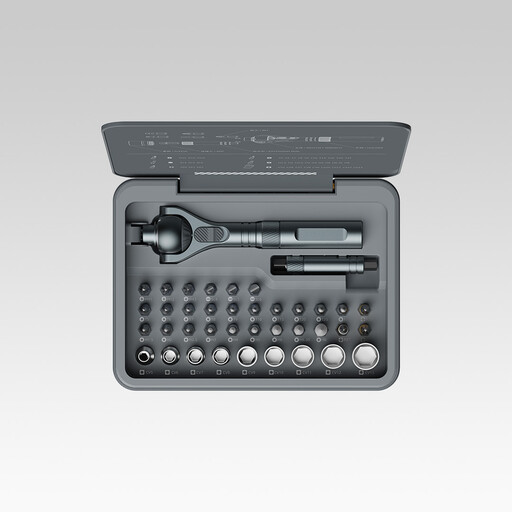
Why it suits this user profile : With its 40 pieces, this kit covers household repairs, furniture assembly and everyday maintenance without requiring you to buy several separate tools.
The retractable handle and magnetic bits reduce clutter and save you from having to buy an additional set of accessories straight away.
40 pieces, ratchet handle and a compact format that is easy to store in a toolbox.
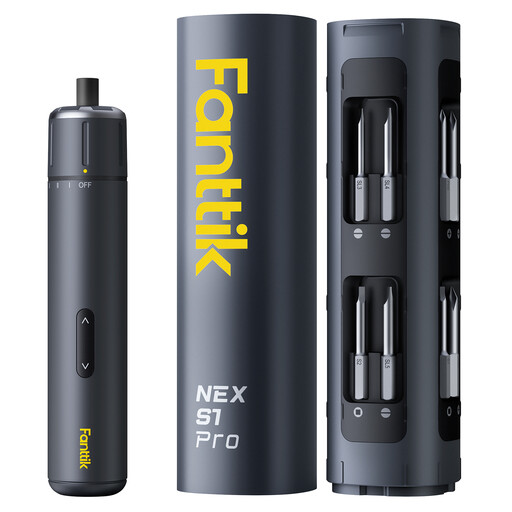
Why it suits this user profile : Its three-level adjustment and magnetic case make it ideal for anyone looking for a versatile electric screwdriver for both assembly and precise work.
The different torque levels let you adapt the power to assembly work or more delicate tasks, instead of handling everything with a single setting.
Stated maximum torque of 6 N·m, 2,000 mAh battery, 16 S2 bits and USB-C charging.
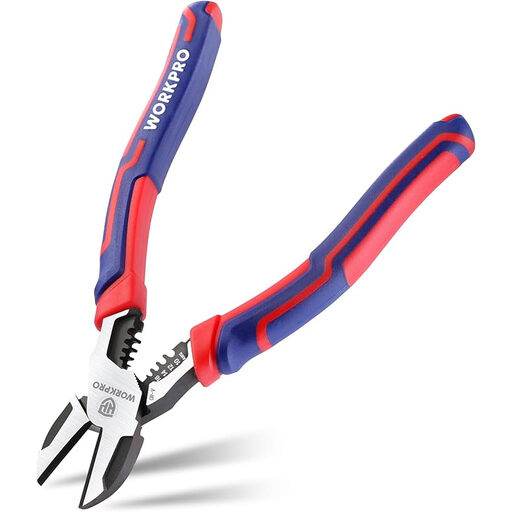
Why it suits this user profile : These wire-stripping and cutting pliers are designed for recurring electrical work and maintenance tasks that require a two-in-one tool.
The stated 10, 12, 14 and 16 AWG sizes, together with the 2 mm cutting capacity, clearly define the jobs it can handle.
Chrome vanadium steel, TPR handles and a design that combines stripping and cutting.
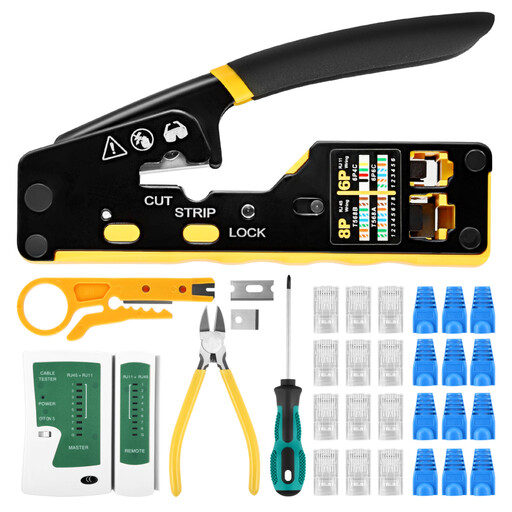
Why it suits this user profile : This type of kit brings together useful accessories for network installation, IT maintenance and certain troubleshooting tasks.
The stated inclusion of crimping pliers, a cable cutter, a wire stripper and a tester means you do not need to buy multiple tools for a one-off installation.
A dedicated networking kit that combines several functions in a compact case.
We have selected a complete, real-time updated list of products that meet these exacting criteria, while also taking European safety regulations into account.
Even professional tools require simple, regular maintenance:
For an electrician’s knife, Zenitech models include features such as a hardened steel blade and a folding design measuring 10 cm when closed and 17.2 cm when open. The 165 mm Jokary model also has a screw for adjusting the cutting depth. These features can be useful for stripping wires, but you must still adjust the depth to match the thickness of the insulation.
For household repairs, start with a ratchet screwdriver, an electric or precision screwdriver, water-pump pliers, cutting pliers, an adjustable spanner and a tape measure. If you work with cables, add wire strippers suitable for the gauge you use. A kit that you can expand as your needs develop will help you avoid building up a collection of unnecessary accessories.
Yes, provided you choose a model with low torque, precision bits and variable-speed control. Electronic devices often contain small screws that can be damaged by excessive tightening. For phones, laptops, watches and cameras, a manual precision screwdriver can also give you better control during delicate tasks.
It depends on how often it is used, the material being worked on, whether the maximum capacity is respected and how well it is maintained. Check the composition, surface treatments, availability of replacement parts and stated warranty. Pliers used within their specified limits and stored in a dry place can remain operational for years. Conversely, excessive use can quickly damage the jaws or mechanism.