Families new to dark chocolate
For a cake or cookies made with children, baking bars with around 52% cocoa can offer a milder flavour. Compare the sugar content per 100 g too: the cocoa percentage doesn’t tell you how much sugar the bar contains.


For a dessert to share with children who are new to dark chocolate, a baking bar with around 52% cocoa can be a milder place to start. Options with 64–70% cocoa are better suited to those looking for a more pronounced cocoa flavour, though they won’t necessarily appeal to everyone. In either case, check the sugar content per 100 g and the allergen information on the bar you choose.
For a cake or cookies made with children, baking bars with around 52% cocoa can offer a milder flavour. Compare the sugar content per 100 g too: the cocoa percentage doesn’t tell you how much sugar the bar contains.
If your children already enjoy dark chocolate, a baking bar with 64% or 70% cocoa may be closer to the flavour you’re looking for. This level of intensity is a matter of personal preference, so consider the recipe and who’ll be sharing the dessert.
If the dessert is for someone with an allergy or intolerance, check the ingredients and any precautionary allergen statements on the packaging you buy. These can vary between dark baking chocolate products.
| What to consider | What to check | Who is it for? |
|---|---|---|
| An approachable dark chocolate flavour | Look for a dessert or baking bar and check its cocoa percentage, particularly options around 52%. | For a cake to share with children who aren’t used to dark chocolate, I want to avoid a flavour that’s too strong. Around 33% of consumers would prioritise this more approachable intensity. |
| A pronounced cocoa flavour | Compare baking chocolate with 64–70% cocoa against the flavour you’re looking for in your recipe. | If the children already enjoy desserts with a strong cocoa flavour, I might look for something more intense. Around 20% of consumers would make this their priority. |
| Ingredients and allergens | Read the ingredients list and any precautionary allergen statements on the packaging of the specific bar. | If someone with an allergy will be sharing the dessert, I need to check the ingredients before choosing the intensity. Around 27% of consumers would prioritise this check. |
| Bar size and availability | Check the net weight you need for your recipe and whether the product is available from your chosen retailer. | To get ready for a baking session, I want to have the quantity specified in the recipe. Around 20% of consumers would put size and availability first. |
A high cocoa percentage doesn’t guarantee that the flavour will suit the children, and it doesn’t tell you how much sugar the bar contains.
Start with the flavour you want for your dessert, then compare the nutritional information per 100 g for the options you’re considering.
In France, the Ministry for the Economy says that displaying Nutri-Score is optional. The “sugar tax” described by the ministry applies to sugary drinks, not to choosing a solid chocolate bar.
To compare packaged chocolate, check the nutrition declaration, ingredients and allergen information.
Ingredients and precautionary allergen statements can vary from one baking bar to another. The product category alone isn’t enough to tell you whether a bar is suitable for someone with an allergy.
Check the packaging every time you buy, even if you already know the brand.
The products listed by Lindt France, Carrefour France and E.Leclerc include 200 g packs, while Carrefour France lists the Nestlé DESSERT Noir bar in a 205 g pack.
Check the net weight and work out how many bars you’ll need before you start preparing your recipe.
Lindt France presents its 200 g DESSERT Noir Intense 70% bar for both baking and eating.
Carrefour France lists a 205 g Nestlé DESSERT Noir bar for sweet recipes.
Carrefour France lists a 200 g organic dark chocolate dessert bar with at least 52% cocoa.
Auchan France lists an organic dark baking bar with at least 52% cocoa, as well as a stronger 64% baking option.
E.Leclerc lists a 200 g dark chocolate bar for desserts and baking.
This selection features a dark chocolate dessert bar to consider for a recipe that involves melting or baking with children. Check the packaging to make sure the flavour and allergen information are right for you before choosing.
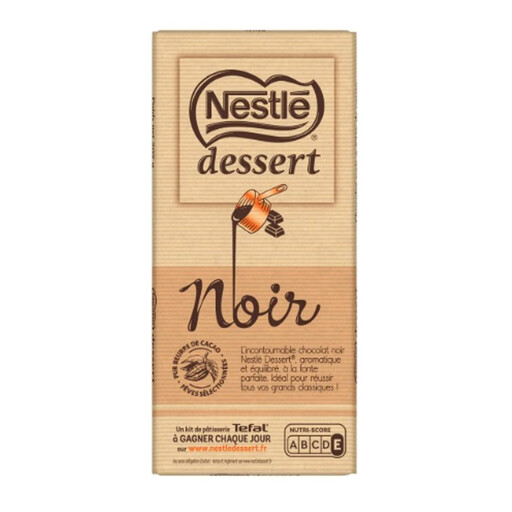 Image unavailable
This dark chocolate dessert bar could be a good choice for a recipe that calls for melted chocolate. It weighs 205 g. To decide whether its intensity will suit the children, check the cocoa percentage on the packaging. If you need to take an allergy into account, also check the information about milk and nuts.
No. In France, the Ministry for the Economy describes this levy as applying to sugary drinks. To compare dark chocolate bars, check the sugar content per 100 g in their nutritional information instead.
No. The Ministry for the Economy says that displaying it is optional in France. Packaged foods covered by the rules must include a nutrition declaration, which lets you compare sugar and fat content per 100 g, with or without Nutri-Score.
Read the ingredients and any precautionary allergen statements on the bar you buy. Depending on the product, these may mention soya, milk, nuts or cereals containing gluten. Anses reminds consumers that substances that can cause allergies or intolerances must be highlighted in the ingredients list.
Follow the instructions on the packaging. For its 52% organic dark baking bar, Auchan France recommends storing it in a cool, dry place between 18 °C and 20 °C. This guidance applies to that specific product.