
Livraison le jour même ou le lendemain

Qualité garantie

Débloquez vos offres de bienvenue: Livraison GRATUITE | Jusqu'à -80 % | 30 jours d'essai gratuits à JoyPlus
Téléchargez l'application
A children’s toy kitchen can quickly become a must-have play area at home, in nursery or at preschool. But appealing photos and a long list of features do not necessarily guarantee an experience suited to your child’s age, the space available or the way they like to play.
Before you buy, three common pitfalls are worth bearing in mind:
The right choice therefore depends less on the number of items shown on the box and more on the balance between safety, sturdiness, dimensions, accessories and your child’s personality.
For a kitchen intended for children aged 3 and over, check the age recommendation from the manufacturer, along with any warnings about small parts. A statement such as “choking hazard” means that small components must be kept out of reach of younger children.
The models featured here are recommended for children aged 3 and over. Adult supervision is still required, particularly during group play, when using metal accessories and when playing with battery-operated toys. For models with sound or lights, the battery compartment should be opened by an adult, and used batteries should be removed.
A wooden children’s kitchen can offer a stable structure and a durable look, but it is worth checking the exact material used. MDF, for example, does not have the same characteristics as solid wood. Rounded edges, careful assembly and a stable base are often more important than the furniture’s overall appearance.
For plastic models, check the available information about composition and care. The Bosch breakfast set featured below is advertised as being made from plastic free from BPA and phthalates, and compliant with the EN 71 standard, according to the product information provided. In all cases, clean toys with a damp cloth, then leave them to dry before putting them away.
A fully equipped toy kitchen should fit the space you actually have available. The Theo Klein Miele 7199 model measures 70 × 30 × 91 cm when assembled. This is useful information when checking how much room is needed in front of and around the unit, whether it is in a bedroom, playroom or classroom.
Also remember to check:
Realistic features are most useful when they help create a play scenario. A hob with sound and light effects, a coffee maker with simulated water flow or a toaster with mechanical pop-up action can enrich kitchen-themed imaginative play, without attempting to replicate a genuinely usable appliance.
The following models meet different needs. To make the right choice, consider the space available, how many children are likely to play together and the kinds of stories they enjoy making up.
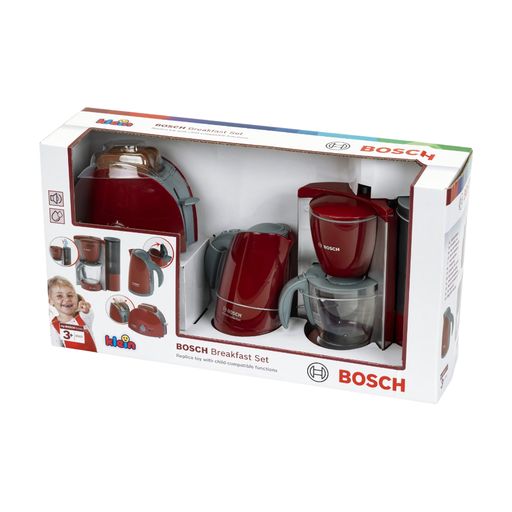
Why this choice suits this profile : This compact set is an easy introduction to imaginative play, with three toy kitchen appliances: a kettle, a toaster and a coffee maker. It is ideal for children who prefer playing at breakfast time rather than looking after a bulky unit.
It avoids investing in a large structure when your child is just starting out. The features are mechanical or simulated; however, make sure you have the batteries specified on the packaging and keep an eye on the small parts.
Three Bosch-licensed replicas, a refillable kettle, a toaster with mechanical toast pop-up action and a coffee maker that simulates water flow.
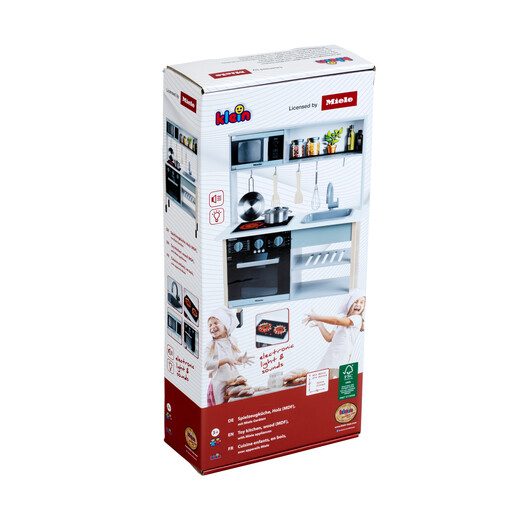
Why this choice suits this profile : Made from FSC-certified MDF, this kitchen is aimed at families looking for a proper play unit, with several areas for cooking, washing up and storage.
Its dimensions are clearly stated, making it easy to check that it will fit in your chosen space. Integrated storage also stops accessories from being scattered around the kitchen.
Hob with sound and light effects, oven, microwave, sink and hanging rail, plus metal and wooden accessories.
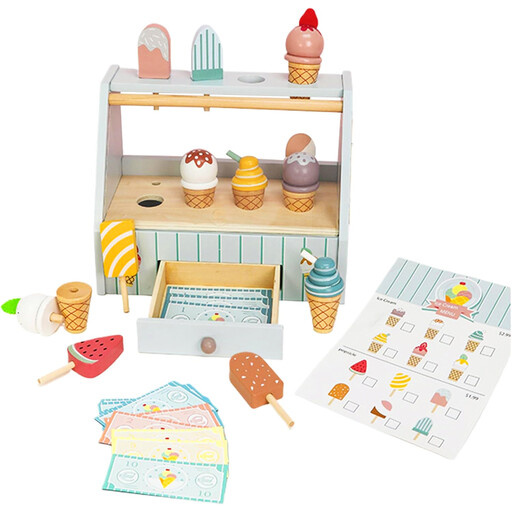
Why this choice suits this profile : This ice cream stand is ideal for children who enjoy welcoming customers, taking orders and playing together. It can also complement a fully equipped kitchen in a playroom or early-years setting.
The scenario is clear: run a shop, serve customers and keep track of orders. This avoids building up a collection of accessories without really knowing what to do with them.
Wooden structure, counter, shelves, drawer and an assortment of ice creams, cones and ice lolly sticks for a variety of orders.
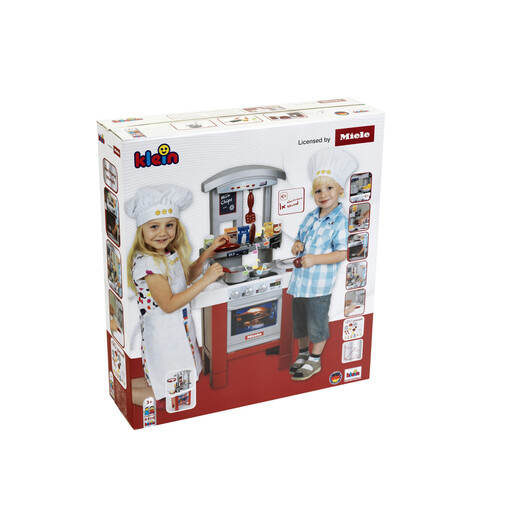
Why this choice suits this profile : With its many modules and accessories, this model is designed for extended play sessions and group scenarios: playing chef, waiter or family mealtimes.
The equipment is clearly listed: sink, oven, sound-effect hob, coffee maker, extractor hood, radio and dining area. This lets you check that every feature has a clear role in the intended play.
90 cm high when assembled, with lots of pretend-cooking accessories and a design advertised as being made in Germany.
We have selected a comprehensive, real-time updated list of products that meet these demanding criteria while complying with European safety regulations.
Accessories have a direct impact on how long the toy lasts. A saucepan with a lid, a few utensils, cups or pretend food are often all you need to refresh play scenarios without replacing the unit. To create a little grocery shop, you can add pretend boxes, a basket and a toy till.
After each play session:
A toy kitchen can make a particularly successful birthday present for a child when it suits the available space and their play habits. In a nursery, prioritise storage, sturdiness and supervision of the accessories. At home, a compact set may be perfectly sufficient if your child mainly plays at a table or on the floor.
Most of the models featured are recommended for children aged 3 and over. Always check the product labelling, as accessories and features vary from one model to another. Small parts require appropriate supervision.
It depends entirely on how it will be used. Wood or MDF is generally suitable for a permanent set-up, while plastic is often easier to move and clean. Compare stability, dimensions, finish quality and safety information rather than focusing solely on the material.
Not necessarily. Start with accessories that match your child’s favourite play scenarios. A breakfast set, pretend tea set or ice cream stand can gradually complement a kitchen, without taking over the space from day one.