
Livraison le jour même ou le lendemain

Qualité garantie

Débloquez vos offres de bienvenue: Livraison GRATUITE | Jusqu'à -80 % | 30 jours d'essai gratuits à JoyPlus
Téléchargez l'application
A miniature kitchen can quickly become the heart of playtime at home. But not every model meets the same needs : some take up a considerable amount of space, others include lots of small pieces that are unsuitable for younger children, while water functions and sound effects bring their own practical considerations.
Before buying a children’s toy kitchen, it is therefore worth looking beyond the design and marketing promises. Here are the criteria to consider, the pitfalls to avoid and some options suited to different types of child.
A set may contain dozens of pieces yet prove impractical for everyday use : food items get mixed together, there is nowhere to store them, or the utensils are too small to handle easily. To ensure play remains enjoyable, check the variety and size of the pieces, along with whether a bag, shelf or storage compartment is included.
A children’s toy kitchen advertised for ages 3 and over is not necessarily suitable for a 2-year-old. Detachable food items, miniature cutlery and small accessories may present a choking hazard. The age stated by the manufacturer, the warnings and adult supervision should all be taken into account when making your decision.
A wooden kitchen or a large model accessible from both sides needs a stable, uncluttered area. A children’s toy sink with a water function, meanwhile, requires a space that is easy to clean, as well as dry storage. Measure the available space before ordering and check the care instructions, particularly if the toy runs on batteries.
Check for the CE marking, warnings in French and the contact details of the manufacturer or responsible person in the European Union. A reference to the EN 71 standard may also appear on the packaging or product page for applicable toys. These details do not replace carefully reading the instructions : a toy containing small parts should remain reserved for the stated age group.
For a gift for a 3-year-old, choose pieces that are large enough, with rounded edges and intuitive handling. Younger children can start with a simple, uncluttered toy kitchen set. Between the ages of 4 and 6, children often enjoy more elaborate scenarios : playing restaurant, preparing a meal or organising a toy shopping basket.
Compare the height of the worktop with the child’s height. A kitchen that is too low can become uncomfortable, while a bulky model may obstruct movement in a bedroom or living room. Models accessible from several sides are better suited to group play, but they require more floor space.
Storage also deserves your attention. A toy food cutting set supplied with a bag or box can be tidied away much more easily than an assortment with no compartments. This is especially useful when the toy is used every day.
Wood provides a sturdy structure and often has a more decorative appearance, but check the quality of the finish, make sure there are no splinters and follow the cleaning recommendations. Plastic is generally lighter and easier to wipe clean, provided the surfaces are smooth and the corners are rounded.
Sound, light and water functions make play scenarios more engaging. In return, they require batteries, additional care or closer supervision. An effect designed to look realistic must never be mistaken for a heat source or for a real cooking appliance.
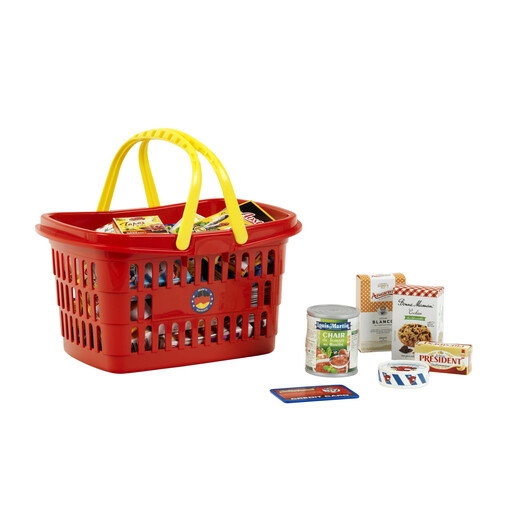
Why this choice suits this profile : Measuring 26.5 × 17.5 × 14 cm, this toy shopping basket offers a simple introduction to imaginative kitchen play without taking up the space of a large piece of furniture.
The basket keeps all the items together in one container, helping to prevent accessories from being scattered once playtime is over.
Suitable from age 2, with a basket and pretend food boxes under licence from French brands.
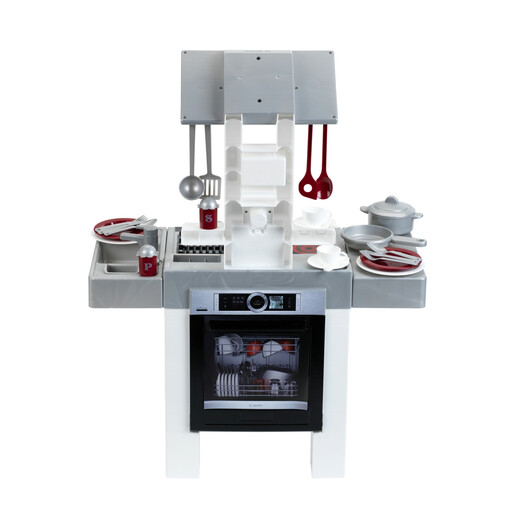
Why this choice suits this profile : Measuring 69 × 33 × 95 cm, this double-sided kitchen is designed for families looking for a complete set that supports hours of role play.
Its access from both sides makes group play easier and prevents one child from monopolising the worktop.
Oven, pump-operated sink, espresso machine, tableware for two, sound and light effects with no actual heat. Four AAA batteries are required but not included.
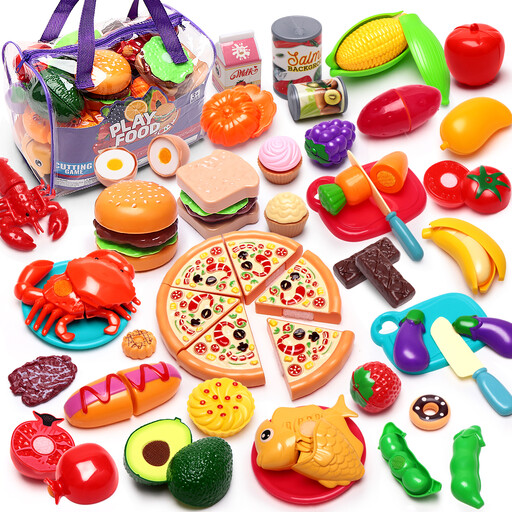
Why this choice suits this profile : Children who enjoy preparing, cutting and sorting have a comprehensive assortment for creating new play scenarios time and again.
The storage bag helps solve the problem of having lots of accessories, while the hook-and-loop fastenings allow food items to be separated with the toy knife.
BPA-free plastic according to the product page, smooth edges and a recommended age of 3 years and over. The presence of small parts means adult supervision is required.
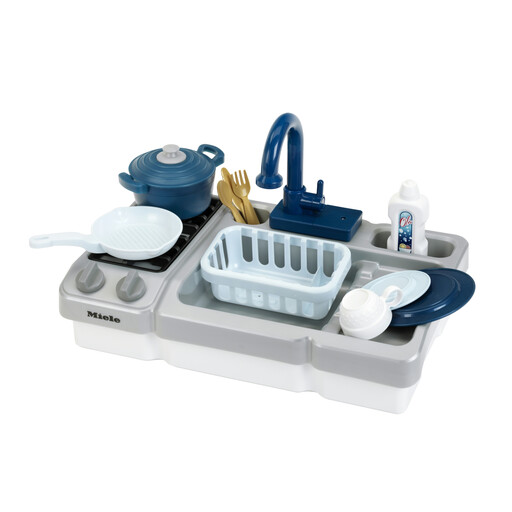
Why this choice suits this profile : This compact unit is ideal for children who enjoy washing, pouring and tidying up, without taking up the space of a complete kitchen.
It combines a sink, drainer and two hobs in one unit, helping to reduce the space needed compared with a full-size toy kitchen.
Working tap, drainer, saucepans, tableware and accessories included. Suitable from age 3 and requires three AA batteries, not included.
We have brought together a complete, real-time selection of products that meet these demanding criteria and European safety requirements.
To enhance a children’s toy kitchen, start with the items that genuinely support imaginative play scenarios :
However, leave aside kitchen accessories genuinely intended for adults. The Bosch MUZ45PS1 slicing disc, for example, has sharp metal blades and is explicitly designed for a food processor : it is not a toy and must be kept out of children’s reach.
The same applies to CHIAKI Ebi Fry breaded prawns : this is a frozen food intended for consumption, not a toy food item. The distinction is essential when search results mix food products with toy kitchen accessories.
At 2 years old, choose a model that clearly states this recommended age, with few small parts and components that are easy to grasp. A shopping basket or simple toy kitchen set can be a good starting point before moving on to a more complete kitchen from age 3.
It all depends on the strength of the materials, how often it is used and how it is stored. Wipe surfaces with a soft cloth, remove the batteries before any damp cleaning and avoid leaving the toy in contact with water for long periods. For a wooden kitchen, regularly inspect the corners, paintwork and assembly components.
These functions can renew children’s interest in play, but they are entirely optional. A water function requires supervision and regular drying, while sound effects need batteries. If you are short on space or want to minimise maintenance, a kitchen without mechanisms will often be simpler to live with day to day.