
Livraison le jour même ou le lendemain

Qualité garantie

Débloquez vos offres de bienvenue: Livraison GRATUITE | Jusqu'à -80 % | 30 jours d'essai gratuits à JoyPlus
Téléchargez l'application
A children’s toy kitchen can quickly become a daily play space: your child prepares imaginary meals, serves family members, tidies away accessories and invents all sorts of stories. But some models lose their appeal fast. Too bulky, poorly suited to the child’s age or fitted with fragile parts, they often end up in the cupboard after just a few weeks.
Before buying a wooden children’s kitchen, a toy small-appliance set or an ice-cream shop, it’s worth checking a few concrete criteria. The idea isn’t to pile up accessories, but to choose a pretend-play set that works with the space you have, your child’s habits and the level of supervision required.
A toy kitchen with sounds and lights naturally catches the eye, but these effects aren’t everything. Check where the controls are, how the functions are activated and whether there’s a switch that lets you turn them off easily. Overly bright lighting or a repetitive sound can eventually become tiresome, or even disrupt playtime.
Batteries also deserve careful attention: the compartment must stay closed, used batteries should be removed promptly and your child must not be able to access them alone.
In a photo, a toy kitchen can look compact but turn out to be much larger in a bedroom or living room. Measure its width, depth and height, and don’t forget to allow space for opening the oven, reaching the sink and playing with others.
Wooden models are generally heavier and less easy to move. This stability is a real advantage, but it means finding a permanent, well-cleared spot for them.
Metal utensils, working doors or small parts make play more immersive. However, they can pose a choking hazard for children under 3. Always follow the recommended age, even if your child seems particularly independent.
A toy kitchen remains a pretend-play item: it should never be used to prepare real food or to handle actual heating appliances.
For an educational toy from age 3, make sure the recommended age is clearly stated. Warnings should mention the risks associated with small parts and the supervision required. For battery-operated models, the compartment must be openable and closable by an adult.
From age 3, children start copying the actions they see at home: setting the table, pouring, mixing, serving or tidying away. Simple, easily recognisable accessories encourage language development and the invention of scenarios, without overcomplicating play.
A wooden children’s kitchen can be made from MDF, solid wood or a mix of materials. The material alone isn’t enough to judge the toy’s quality: also look at the finish, the edges, the overall stability and the strength of the hinges.
According to the information provided, the Theo Klein model shown below uses FSC-certified MDF. For plastic toys, check the manufacturer’s details about the materials used and the applicable standards. The product sheet for the Bosch set mentions compliance with the EN 71 standard.
A kitchen measuring 70 × 30 × 91 cm, like the Miele model featured later, works well in a room where the toy can stay set up. In a flat or a shared bedroom, a separate accessory set may be easier to store.
Built-in storage, shelves and a rail for hanging utensils aren’t just minor details: they help your child put everything back in its place and stop accessories from being scattered all over the room.
Compare the number of items actually included rather than relying on the accessories shown in photos. Some kitchens display lots of decorative objects when only a few utensils are supplied. In particular, check for a saucepan, a frying pan, a spoon, pretend food or play money, depending on the type of scenario you’re after.
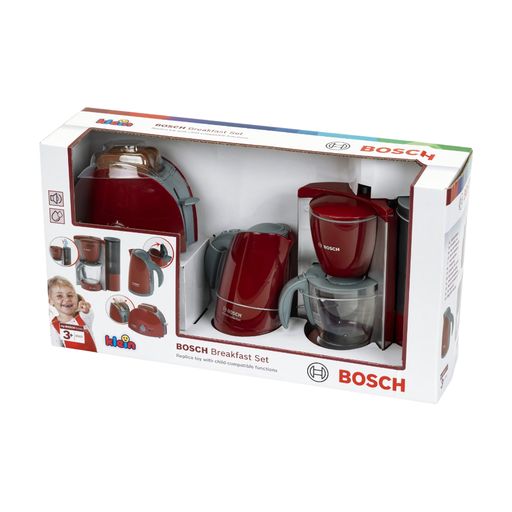
Why this choice suits this profile: This set offers a more focused entry point than a full kitchen. It’s ideal for families who want to introduce pretend play around cooking or to complement an existing play area.
It takes up little space and focuses play on three appliances. As the product dimensions aren’t listed on the sheet, check the available space before ordering.
Fillable kettle, mechanical toast ejection and water flow from the coffee maker. The set is recommended from age 3.
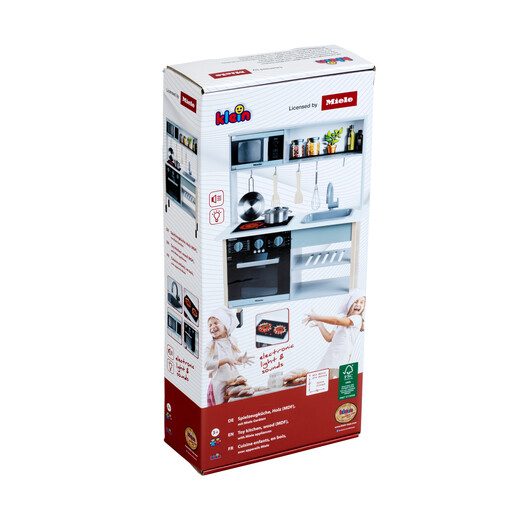
Why this choice suits this profile: This medium-sized kitchen is aimed at families who want to set up a permanent play area, with several zones for inventing meals and hosting other children.
Its stated dimensions of 70 × 30 × 91 cm let you check the exact space needed. The built-in storage also helps keep accessories from being scattered.
FSC-certified MDF, hob with sounds and lights, oven, microwave, sink, shelves and hanging rail. Metal and wooden accessories are included.
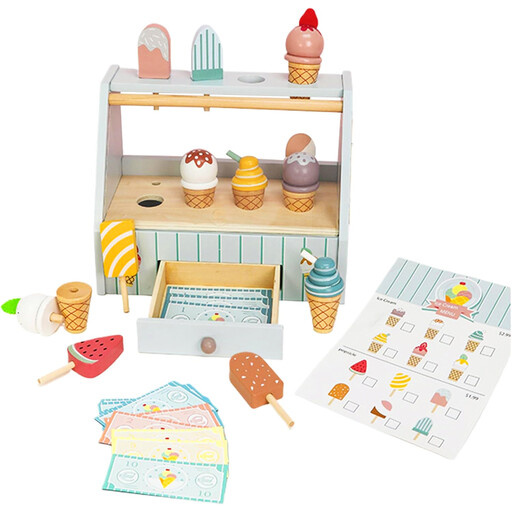
Why this choice suits this profile: This ice-cream shop is great for children who love playing shopkeeper, taking orders and welcoming several players. It complements an existing kitchen or opens the door to a completely different scenario.
Its play scenario is clearly defined and doesn’t rely on sounds or batteries. However, the pieces should be stored and used under adult supervision where necessary.
Counter, shelves, drawer and an assortment of pretend ice creams. The sheet mentions wood, rounded edges and water-based paint.
We’ve put together a comprehensive, real-time selection of products that meet these demanding criteria and comply with European safety regulations.
The toy’s lifespan depends mainly on the strength of its assembly, the quality of its storage and the variety of scenarios you can create. To keep it in good condition for longer:
For a gift for a 3-year-old, go for a model clearly marked “from age 3”, with pieces that are easy to grip and a scenario that’s immediately understandable. A small kitchen or a toy small-appliance set works well if space is tight. A full kitchen is more suitable when your child often plays in the same room and enjoys pretend-play activities that last.
Sound and light functions usually require batteries, and how long they last depends on how often the toy is used and the type of mechanism. Check the product sheet or packaging for the type and number of batteries needed. Models without electronics avoid this ongoing cost, while a toy with sounds and lights can add extra depth to certain scenarios. In any case, batteries must be kept out of reach of young children.