
Same-day & Next-day Delivery

Quality Guaranteed

Unlock Your Welcome Offers: FREE Delivery | Up to 80% OFF | Free 30-day JoyPlus trial
Download the APP
The aroma of freshly ground coffee filling your kitchen as you wake up... an experience that more and more enthusiasts are treating themselves to every day. Making the switch from your old drip coffee maker to a bean-to-cup coffee machine is a game-changer. But faced with technical jargon and an overwhelming number of models, it can be hard to know where to start. This guide is here to demystify the market and help you find the machine that will truly transform your mornings.
Before diving into our selection, let's review the key criteria that will make all the difference in your daily use.
The choice between these two philosophies primarily depends on how much control you want over your espresso preparation.
Pressure, expressed in bars, is a marketing point often touted by manufacturers. It's important to know that a pressure of 9 bars at the brew group is the recognised standard for a proper espresso. Machines that advertise a higher pump pressure, like 20 bars, don't deliver this pressure directly onto the coffee. Instead, it indicates the power of their pump, which is capable of ensuring a stable and optimal pressure throughout the extraction.
The heating system is just as crucial. A dual boiler model allows you to brew espresso and froth milk simultaneously. This is a precious time-saver for fans of cappuccino machines who don't want to wait.
The freshness of the grind is the core promise of a bean-to-cup machine. A good grinder, typically conical and made of stainless steel, should offer multiple adjustment levels. This allows you to tailor the grind fineness to the type of bean used, directly influencing the acidity, bitterness, and body of your drink.
After analysing dozens of spec sheets, here is our selection of three models from HiBREW that stand out for very different uses.
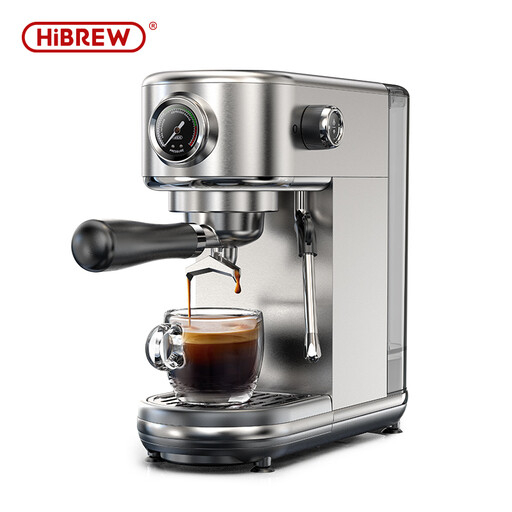
What sets it apart
The HiBREW H10B is a semi-automatic machine that offers an advanced level of customisation in a compact design. It allows you to adjust the extraction temperature, water volume, and even the pre-infusion time—features usually found on much more expensive models.
Key Features
Who is it for?
For the enthusiast who wants to get started with the espresso ritual and master every step of the preparation, from grinding (with a separate grinder) to extraction, without having to invest in complex professional equipment.
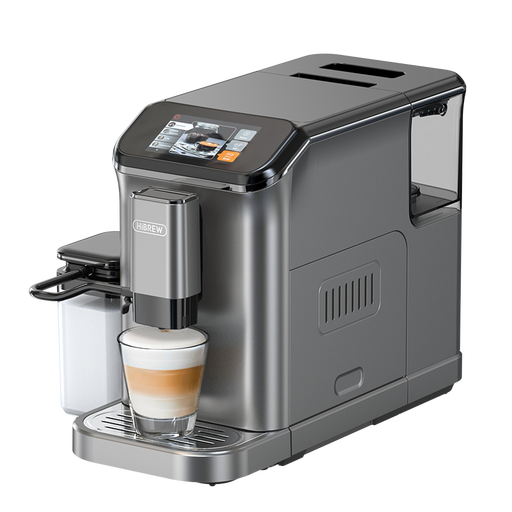
What sets it apart
This fully automatic coffee machine is all about simplicity. Its large 4.3-inch colour touchscreen and 6 pre-programmed drinks make coffee preparation completely intuitive. Even better, it remembers your preferences for a perfect coffee every time.
Key Features
Who is it for?
Perfect for families or rushed mornings, it offers a quality coffee experience without any hassle. It's the practical solution for getting a variety of drinks, including milk-based ones, at the touch of a button.
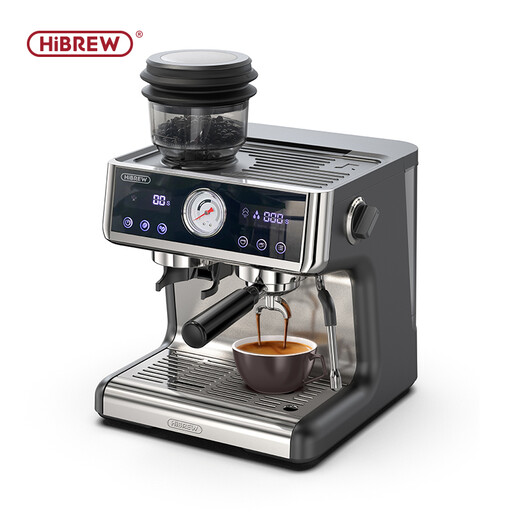
What sets it apart
The HiBREW H7A combines the best of both worlds: the convenience of an all-in-one ("bean-to-cup") machine and the performance of semi-professional equipment. Its dual boiler and dual pump system offers remarkable stability and power.
Key Features
Who is it for?
It is aimed at demanding enthusiasts who seek the performance of a dual boiler system and total control over grinding and extraction, without sacrificing the convenience of an integrated grinder.
If these three models don't check all your boxes, or if you're simply curious to explore other avenues, feel free to browse our full selection. You'll discover a wide range of machines for all budgets and preferences.
Discover All Our Coffee Makers
Pressure is crucial for extracting the oils and aromas from the coffee. While the standard for a perfect espresso is 9 bars at the brew head, machines advertising 15 or 20 bars have a pump powerful enough to ensure that this 9-bar pressure is reached and maintained stably. This is a guarantee of quality and consistency in the cup.
Maintenance is much simpler than it seems. Most automatic models include built-in cleaning and descaling cycles. On a daily basis, you just need to empty the used coffee grounds container and the drip tray, and refill the water tank. For machines with a removable brew group, a simple weekly rinse with clean water is sufficient. The grinder itself only requires occasional cleaning to remove residual coffee oils.
To make the right choice, ask yourself three questions: