
Livraison le jour même ou le lendemain

Qualité garantie

Débloquez vos offres de bienvenue: Livraison GRATUITE | Jusqu'à -80 % | 30 jours d'essai gratuits à JoyPlus
Téléchargez l'application
Are you looking for a 20-bar espresso machine to make a strong espresso, cappuccino or latte in a small flat? The advertised pressure catches the eye, but it isn’t enough to tell the models apart. A machine can claim 20 bars and still be impractical day to day if its water tank is awkward to fill, its steam wand lacks precision, or cleaning it becomes a chore.
Here are the criteria to consider before you buy, along with a selection of models suited to different needs.
The “20 bars” label usually refers to the maximum pressure the pump can deliver. It doesn’t mean the coffee is extracted at a constant 20 bars, nor does it guarantee a better result. Cup quality also depends on the grind, dose, tamp, temperature and flow consistency.
Where fitted, a pressure gauge lets you monitor the pressure during extraction. It’s a useful reference, but it will never make up for an unsuitable grind.
An espresso machine with a steam wand lets you heat and froth milk manually. It’s a versatile way to make cappuccinos, lattes or flat whites, but it does take a bit of practice. Check for a steam setting, the wand’s range of movement, and how easy it is to clean after each use.
A wand that’s difficult to remove or poorly positioned can quickly make preparing milky drinks a hassle.
In a small kitchen, a few centimetres can make all the difference. Measure the width, depth and height available, and don’t forget the space you’ll need to remove the water tank.
A removable water tank makes filling and rinsing simpler. A detachable drip tray cuts down on splashes and makes everyday cleaning easier. As for parts claimed to be dishwasher-safe, it’s best to check this in the manufacturer’s manual.
For a 20-bar espresso machine, don’t stop at the number on the pump. Also look at the heating power, the claimed temperature stability, and whether a pressure gauge is included. A model with separate thermostats for coffee and steam can be more practical when you’re making an espresso followed by a milky drink.
Machines with 15 bars can work perfectly well for home use. The 15 bars quoted by several De’Longhi and Krups models are therefore not, on their own, a reason to rule them out.
A manual machine typically works with ground coffee and, sometimes, ESE pods. It suits people who already own a grinder or prefer to buy ready-ground coffee.
If you’re looking for a coffee machine without a built-in grinder – in other words, a manual model – go for a compact machine like the De’Longhi Dedica or the IAGREEA. Automatic machines with a built-in grinder grind beans on demand, but they’re generally bulkier and require specific maintenance of the brew unit and grinder.
For one or two people, a water tank of 1 to 1.5 litres should be enough. A larger capacity becomes useful for a family or when making several drinks in a row. In any case, remember to change the water regularly.
A compact espresso machine also needs to leave enough room to place a cup, handle the portafilter and wipe the steam wand. These details matter more than a marketing promise of “professional results”.
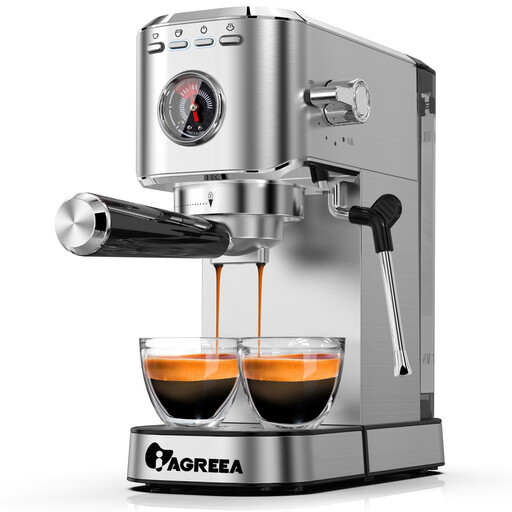
Why this choice suits this profile: This manual machine combines a claimed 20-bar pump, a pressure gauge and an adjustable steam wand, all in a format that fits small kitchens.
The 1.1 L water tank is removable and the pressure gauge lets you monitor extraction rather than relying solely on the “20 bars” label.
1350 W, one- and two-cup controls, cup warming tray and removable parts claimed to be dishwasher-safe.
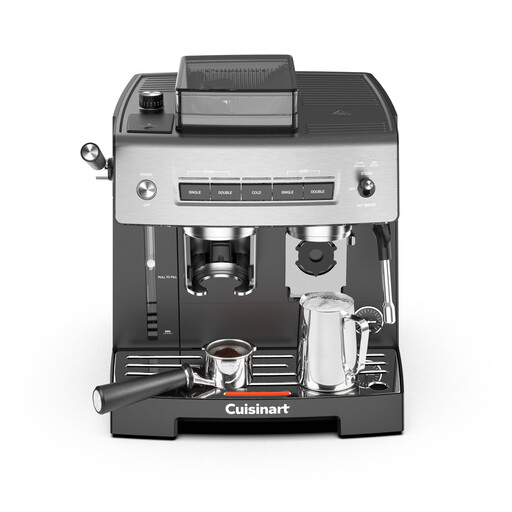
Why this choice suits this profile: Its built-in grinder and grind settings appeal to users who want more control over preparation using whole beans.
The 16 grind settings, assisted tamping and 20-bar pressure gauge give you several ways to fine-tune your preparation.
2.2 L water tank, 54 mm portafilter, steam wand, hot water and cold extraction function.

Why this choice suits this profile: With its built-in grinder, touchscreen and saved recipes, it’s ideal for households that make several drinks every day.
Coffee and milk volumes can be saved, while the integrated cleaning system cuts down on repetitive tasks.
Claimed 20-bar pressure, 1.5 L water tank, 15-level conical grinder and dual boiler heating system.
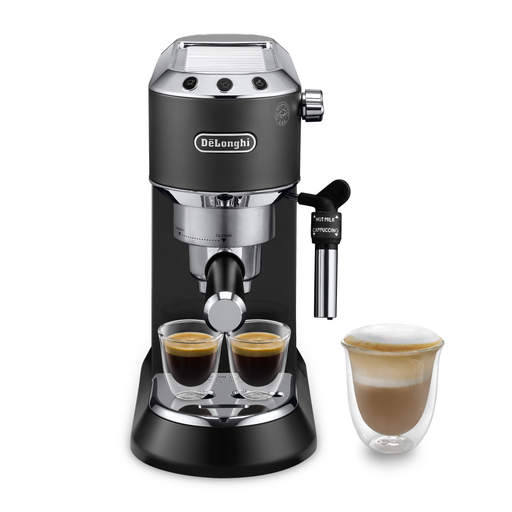
Why this choice suits this profile: At a claimed 149 mm wide, it slips easily into a studio flat, student accommodation or onto a narrow worktop.
Its dimensions are clearly stated and its 1 L water tank is suitable for moderate home use.
15-bar pump, three temperature settings, filters for one or two cups and ESE pods, adjustable steam wand.
We’ve put together a comprehensive, real-time updated list of products that fully meet these strict selection criteria and European safety regulations.
After every milky drink, wipe and purge the steam wand to stop milk from drying on. Empty the drip tray regularly and rinse the portafilter. How often you need to descale depends on the hardness of your local water: follow the instructions in the manual and use a compatible product.
The daily cost isn’t just about electricity. You also need to factor in ground coffee or beans, any filters, descaling products and, for pod machines, the regular purchase of capsules. A manual machine with ground coffee gives you more freedom, while an automatic model with a grinder cuts down on some steps, at the cost of more demanding maintenance of the grinder and brew unit.
No. The 20 bars refer to the maximum pressure the pump can deliver. When making your choice, also consider temperature stability, the portafilter, the quality of the steam wand, the water tank capacity and how easy it is to clean.
A removable water tank of 1 to 1.5 litres is usually enough for a few coffees a day. For multiple users or frequent drinks, a capacity of 1.8 litres or more cuts down on refills, but often increases the machine’s footprint.
Not necessarily. If you already have a suitable grinder or buy ground coffee, a manual machine can be more compact and simpler to use. A built-in grinder is mainly for those who want to use beans and automate part of the process.