
Livraison le jour même ou le lendemain

Qualité garantie

Débloquez vos offres de bienvenue: Livraison GRATUITE | Jusqu'à -80 % | 30 jours d'essai gratuits à JoyPlus
Téléchargez l'application
Want to update your kitchen or bathroom without getting into an endless, overpriced renovation? It's the dream! Adhesive tile has emerged as THE miracle solution for modernising your interior in the blink of an eye. But be warned: the market is a jungle where the best products sit right alongside the worst. It's easy to be tempted by an attractive promise only to end up with a disappointing result. To ensure your renovation project doesn't turn into a nightmare, let's review the three mistakes you must avoid.
So, how do you sort through the options and find a true gem? By focusing on concrete technical criteria, which are far more reliable than advertising slogans.
For your renovation to be a success, three technical points must be inspected closely before you check out. This is what will make all the difference between a short-lived covering and a solution that will last for years.
The "wow" factor (or lack thereof) of your wall depends entirely on the material. There are three main families:
This is the most critical factor. A powerful, professional-grade adhesive is essential, especially in "high-risk" areas. For a kitchen backsplash, it must handle heat and steam without failing. For a bathroom adhesive tile, it must withstand ambient humidity without ever peeling. The added bonus of a good adhesive? It often allows for repositioning during installation but guarantees a permanent bond once the surface is firmly smoothed down, without a single bubble.
A good adhesive wall tile is a product designed to face everyday life. Always check the manufacturer's specifications on these points:
To help you see more clearly, here are a few products that check all the boxes, suitable for different projects and budgets.
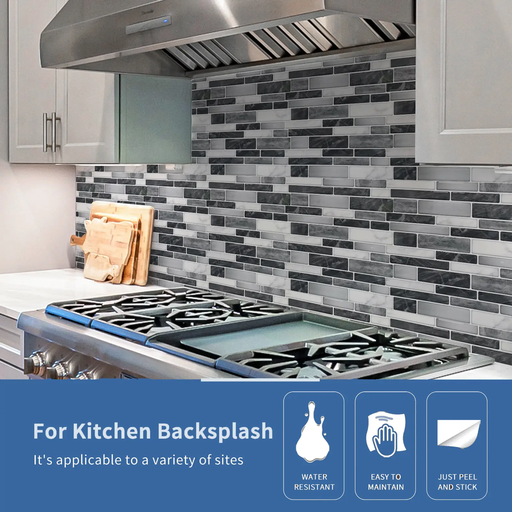
Perfect for renters or first-time buyers who want to freshen up a wall or backsplash without breaking the bank. Its ease of installation is a real plus for weekend DIYers.
The manufacturer highlights a reinforced adhesive and a thicker gel layer, which counteracts the lack of adhesion and the "plasticky" effect of entry-level models.
Unbeatable value for a quick makeover. The surface cleans with a wipe and holds up well against scratches and humidity.

For those who want to create an accent wall with a bold, architectural look. Here, aesthetics are paramount, with a textural effect that simple stickers can never match.
Made from high-density PVC, this 3D panel is rigid and offers real depth, which completely eliminates the risk of a cheap, "plasticky" finish. Its robust structure ensures much greater longevity than simple foam alternatives.
An immediate visual impact thanks to its geometric relief. It's a durable, water-resistant, and easy-to-maintain material that's equally at home in a living room or a bathroom.
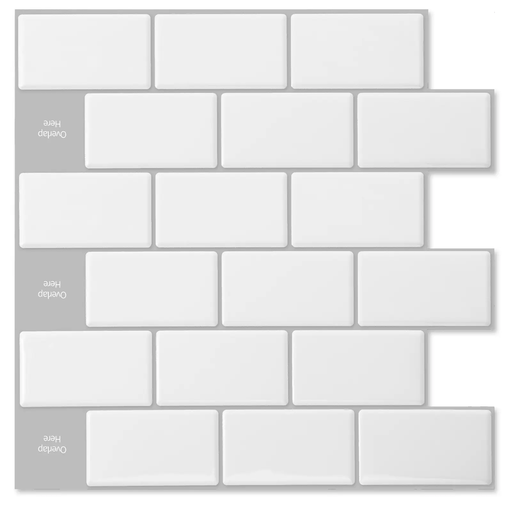
When tackling a kitchen or bathroom, performance is just as crucial as looks. This product is for those who demand a perfect imitation of traditional tile that can withstand the harsh conditions of these rooms.
This model checks all the boxes to avoid the common traps: it combines an extra-strong adhesive, a thick 3D gel texture for stunning realism, and a guaranteed anti-yellowing formula.
A very pronounced 3D texture that perfectly mimics ceramic tile. Specially designed to resist the heat of kitchen backsplashes and the humidity of bathrooms.
Explore our complete selection of products that meet our strictest criteria for quality and durability.
Absolutely, and that's one of its biggest advantages! The one non-negotiable condition for a flawless result is a perfectly clean, dry, and smooth surface. If the grout lines of your current tile are very deep, a light coat of smoothing compound will be necessary to prevent the old texture from showing through.
It all depends on the quality of the product, the care taken during installation, and its environment. An entry-level model in a humid room might show signs of wear after a year or two. Conversely, a high-quality adhesive wall tile, properly installed in a dry room, can stay looking like new for many years.
Some models are specifically designed for this, but reading the technical sheet is imperative. Manufacturers always specify the safety distance to be maintained between the heat source and the covering. With gas cooktops, caution is advised: a stainless steel or glass backplate remains the best protection.