
Livraison le jour même ou le lendemain

Qualité garantie

Débloquez vos offres de bienvenue: Livraison GRATUITE | Jusqu'à -80 % | 30 jours d'essai gratuits à JoyPlus
Téléchargez l'application
A storage shelf can quickly free up space in a garage, utility room or living room. Yet some purchases prove disappointing after just a few weeks: measurements were inaccurate, the load capacity was overestimated or the wall fixing was unsuitable. Before comparing styles and prices, it is worth reviewing a few practical criteria.
An advert may display an impressive load capacity without specifying whether it applies to the entire unit or to each shelf. For metal shelving intended for the garage, look for the maximum static load per tier, then check the total load capacity. Weight distribution also matters: heavy loads should remain centred and rest on a stable structure.
A shelving unit may look compact in a photograph but turn out to be too deep for a hallway or too tall for a basement. Measure the width, depth and available height, as well as the space needed to move around it. In a bedroom or hallway, a narrow bookcase may sometimes be more practical than a bulky unit.
A screwless system or concealed fixing is not automatically suitable for every wall. The type of surface — plasterboard, concrete, brick or wood — determines which wall plugs and screws to use. For a tall shelving unit, a wall-mounted anti-tip kit is an essential safety precaution. Never climb onto a shelf and never exceed the stated load capacity.
For a garage shelving unit or industrial shelving, choose a steel structure with a durable finish, well-positioned crossbars and shelves that are thick enough. MDF or chipboard panels are suitable for boxes, books and everyday items, but they are not designed to withstand the same demands as metal shelving.
An indication such as 175 kg per tier and 875 kg in total should be understood as a static load, generally distributed evenly. It does not mean that a very heavy object can be placed on its own at the edge. Always check the instructions and conditions of use.
A depth of 30 to 40 cm is generally suitable for books, boxes and everyday equipment. In a workshop, a depth of 40 cm provides room for tools and storage bins. Conversely, a very deep shelf can make items at the back difficult to reach.
Also check the available height between tiers. Adjustable shelves make it easier to store items in a range of sizes. This flexibility is particularly useful in a utility room, workshop or laundry room, where requirements regularly change.
A wall-mounted shelf or floating shelf requires a fixing suitable for both the load and the type of wall. Decorative models are generally designed for lightweight items such as frames, small plants or a few books. For a desk shelf, also allow enough space for cables and accessories.
For a freestanding model, check for adjustable feet, side braces and an anti-tip device. Interlocking assembly can be quick, but every part must be correctly secured before use.
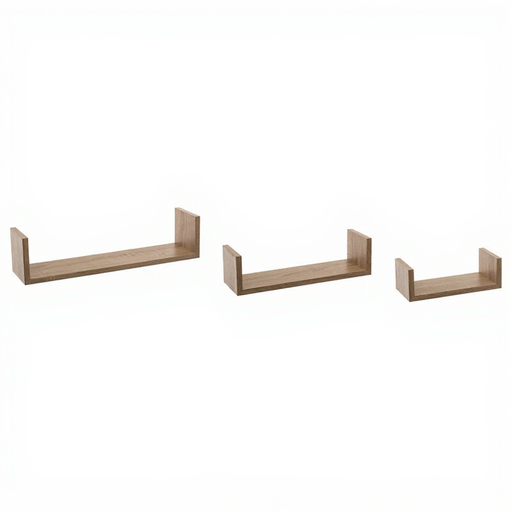
Why this choice suits this profile : This set of three shelves is ideal for creating your first decorative storage arrangement in a living room, bedroom, home office or hallway, without having to install a floor-standing unit.
The maximum load is clearly stated: 3 kg per shelf. This limit helps prevent them from being used accidentally for items that are too heavy.
Three sizes — 22, 32 and 42 cm — a light wood-effect finish and concealed fixings for a clean, minimalist look.
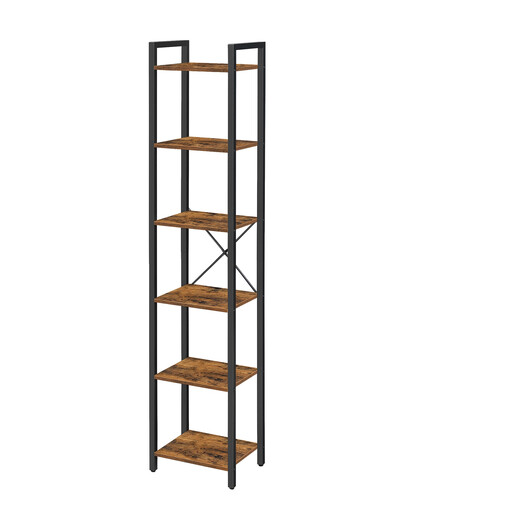
Why this choice suits this profile : This tall bookcase combines a metal frame with wood-effect panels to display books and ornaments in a living room, home office or bedroom.
Its dimensions of 30 × 40 × 187.5 cm are clearly specified, making it easy to check how much space it will occupy before buying. The anti-tip kit also highlights the importance of securing the unit to the wall.
Six tiers, a stated maximum capacity of 50 kg, adjustable feet and X-shaped bars for improved stability.
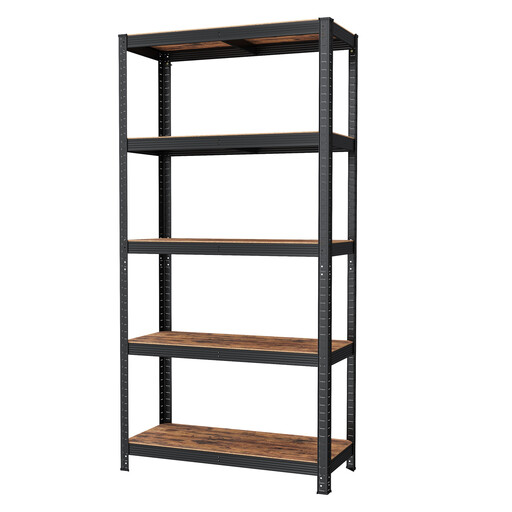
Why this choice suits this profile : With five tiers and a steel frame, this shelving unit is designed for garages, workshops, sheds and utility areas where items are often bulkier.
The product details state 175 kg per tier and 875 kg in total, with a recommendation to secure the unit to the wall. This provides a more precise guide than simply stating « high capacity ».
A 40 × 90 × 180 cm format, adjustable shelves, interlocking assembly and the option to split the structure into two units.
We have put together a complete, regularly updated selection of products that meet these demanding criteria and European safety standards.
Use wall plugs specifically designed for plasterboard and check the permitted load for each fixing. For a heavy object, locate a stud or reinforce the support where possible. The product instructions and the characteristics of the wall should guide your choice of hardware.
It depends entirely on the model, the number of support points and how the weight is distributed. A shelf rated for 3 kg should only hold lightweight items. For a workshop, compare the load per tier, the total load and the relevant conditions: weight evenly distributed, structure correctly assembled and unit securely fixed.
Respect the load limits, place heavy items on the lower tiers and regularly tighten or check the fixings. Avoid exposing MDF panels to moisture for extended periods and clean surfaces with a non-abrasive product. Periodic checks also make it possible to spot a warped shelf or a joint that has not been properly secured.