
Livraison le jour même ou le lendemain

Qualité garantie

Débloquez vos offres de bienvenue: Livraison GRATUITE | Jusqu'à -80 % | 30 jours d'essai gratuits à JoyPlus
Téléchargez l'application
Installing a solar outdoor security camera with no subscription lets you keep an eye on an entrance, garden, driveway or garage without running a power cable or paying monthly fees. However, solar power and no subscription alone do not guarantee that a product will meet your needs.
Some product listings state a theoretical battery life without explaining how much sunlight is required. Others highlight high resolution, even though the viewing angle or night-time image quality may not suit the intended use. Storage advertised as “free” may also be limited, require a memory card that is not included or depend on an additional base station.
Here are the key points to examine before choosing a Wi-Fi solar security camera for a home, rental property or small business in France.
A solar panel needs enough direct sunlight to recharge the battery. If it is installed facing north, beneath a balcony or in the shade of foliage, it will be significantly less effective. Check whether it is integrated into the camera or supplied separately, how long the cable is and whether it can be angled independently of the lens.
Manufacturers sometimes state that only a small number of hours of sunlight are needed. However, this figure, often highlighted in marketing materials, varies according to the season, weather, panel orientation and number of detections. An integrated battery remains essential for periods with little sunlight.
On paper, a 4K security camera offers more detail than a 2K model. In practice, the result also depends on the lens, video compression, lighting and the quality of the Wi-Fi connection. For monitoring a narrow driveway, carefully planned framing will often be more useful than a poorly positioned wide-angle lens.
Colour night vision generally requires a spotlight or sufficient ambient lighting. Otherwise, the image may switch to infrared or lose sharpness. Also check the stated range and the options for adjusting detection zones.
A camera with local storage helps you avoid recurring fees, but a microSD card is not always included. Check its maximum capacity, as well as whether a base station, hard drive or compulsory app is required.
The absence of monthly fees may be limited to basic recording. Some advanced features or cloud storage may still incur a charge. It is therefore best to read the product listing and the manufacturer’s terms carefully before making your decision.
To monitor a door or gate, a fixed camera with a sufficiently wide viewing angle may be perfectly suitable. On a larger property, a 360° security camera that can move horizontally and vertically may reduce the number of devices required. Automatic motion tracking is useful, but it does not remove the need to configure exclusion zones.
A camera with intelligent detection should specify which categories it recognises: people, vehicles, animals or faces. These features reduce unnecessary notifications, although they cannot eliminate them completely.
A wireless outdoor camera is not necessarily network-independent. Most models use 2.4 GHz Wi-Fi, which is better suited to longer distances, while some also support 5 GHz. Test the signal at the planned location before drilling into the wall or mounting the camera.
For an outbuilding or other location far from the house, a 4G model, such as some solar PTZ cameras, may be more suitable. You will then need to provide a SIM card and take mobile data costs into account.
The IP rating is a useful initial indicator: IP64 protects against dust and water splashes in certain conditions, while IP65 provides enhanced protection against water jets. Neither rating means that the camera can be submerged.
The solar panel connectors must also be properly protected. Clean the lens and panel surface regularly with a soft, dry cloth. For a high-level installation, choose a mount suitable for the wall or post and use a stable ladder.
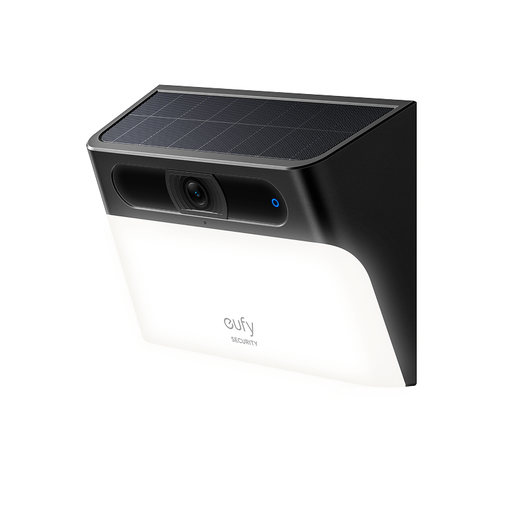
Why this product suits this profile : this camera combines wall lighting with video surveillance. It is particularly suitable for an entrance, patio or walkway close to the house.
Its integrated panel eliminates the need for a separate installation. The listing states that it offers local storage for event footage and no monthly fees.
2K resolution, colour night vision, 300-lumen lighting, two-way audio and a stated IP65 rating.
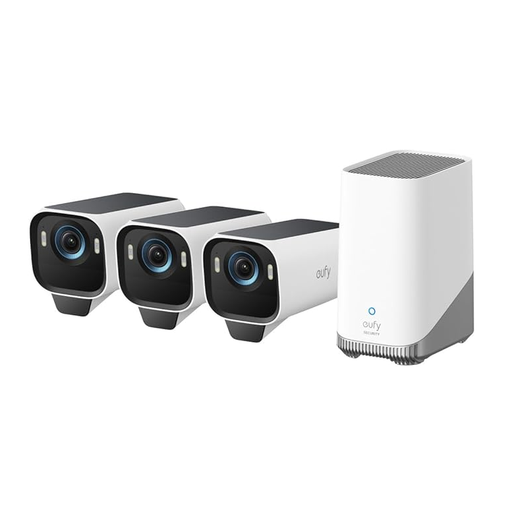
Why this product suits this profile : this kit is designed for properties that require several monitoring points and centralised management of recordings.
The HomeBase S380 centralises the system and allows local storage to be expanded to up to 16 TB, depending on the configuration.
4K video, MaxColor night vision, detection combining radar and passive infrared, and compatibility with several smart home assistants.
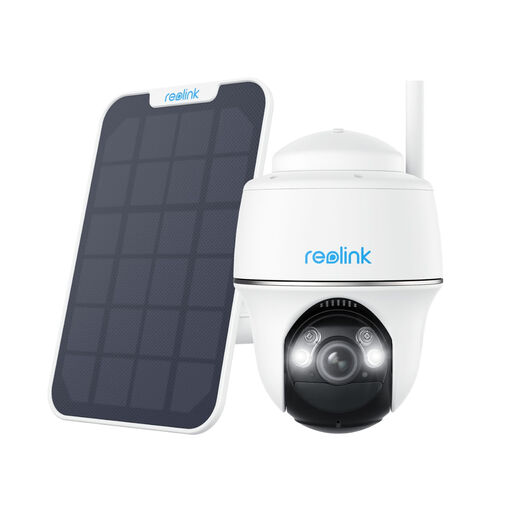
Why this product suits this profile : the choice between dual-band Wi-Fi and Ethernet is ideal for installations where network stability is the top priority.
The microSD card supports up to 128 GB, allowing footage to be stored locally without having to use the cloud. The supplied solar panel reduces the need for manual recharging.
3K resolution, person, vehicle and animal detection, colour night vision, siren, spotlight and 355° rotation.
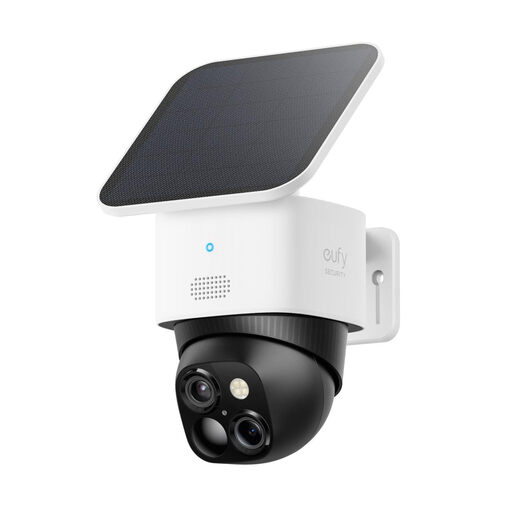
Why this product suits this profile : its motorised movement is well suited to a courtyard, garden or entrance where one camera needs to cover several directions.
The solar design and Wi-Fi connection eliminate the need to run a power cable. However, check the actual network coverage at the chosen location.
3K resolution, dual view, stated 360° rotation, 8× zoom and HomeBase 3 compatibility.
We have put together a complete, real-time updated list of products that meet these strict selection criteria and European safety regulations.
Before mounting a camera, clearly define the area to be filmed. Avoid pointing the lens towards the inside of a neighbour’s home or at a private space. Recording public roads and informing people who are being filmed are governed by French privacy protection rules.
For a reliable installation:
Most models marketed as Wi-Fi solar security cameras need a network for remote viewing and sending notifications. Some may continue recording locally if the connection is interrupted, but connected features will then be unavailable. For a site without a fixed network, a 4G camera with a SIM card is an alternative.
The purchase price includes the camera, solar panel and battery, and, depending on the model, a base station or memory card. A camera with no monthly fees can reduce recurring costs if local storage meets your needs. Nevertheless, check for any paid cloud storage options and essential accessories.
Service life depends on the battery, exposure to sunlight, temperatures, number of activations and the waterproofing of the connections. Regularly cleaning the panel, using a stable mount and setting alerts sensibly all help keep the system in good working order.