
当日/次日达

品质保障

开启新人专享福利: 全场免邮 | 低至 2 折 | 免费试用 30 天 JoyPlus 会员
下载 Joybuy
Autonomous, cost-effective, and easy-to-install garden lighting? The promise is appealing. Yet, the outdoor solar light market is a minefield of products with disappointing performance, which fail at the first downpour or as soon as the days get shorter. To avoid regretting your purchase, you need to learn how to decode spec sheets and see through marketing claims that are too good to be true. This guide gives you all the keys to making a truly enlightened choice, focusing on what really matters.
Too many buyers are duped by products that fail after just a few months. Here are the most common pitfalls and how to spot them to avoid throwing your money away.
To choose a powerful and reliable solar light, forget the marketing speak and focus on these few objective technical specifications.
The IP rating is an international standard that classifies a device's level of protection against solid objects (dust) and liquids (water).
For an outdoor installation in our climate, an IP65 rating is the absolute minimum. It guarantees your light is completely dust-tight and can withstand powerful water jets (like heavy rain). This is a non-negotiable criterion for an outdoor solar wall light or a wireless garden lamp that will spend the entire year outside.
Your light's performance directly depends on its ability to capture and store energy.
It all depends on your goal: security or decoration?
Here are a few models that meet specific needs and tick all the boxes for the criteria we've just discussed.
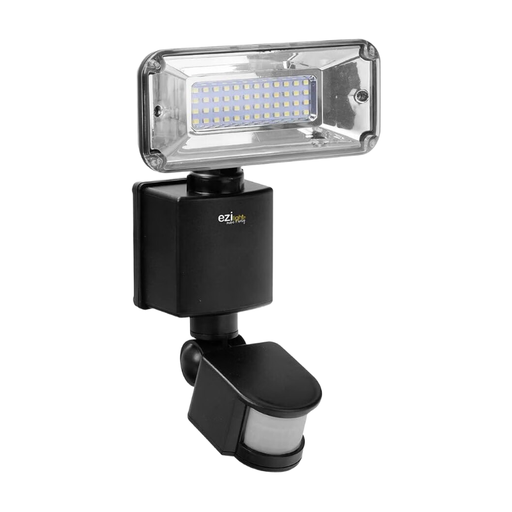
Why we chose it: Perfect for securing an entrance, garage, or driveway. Its purpose is 100% functional: to provide strong, on-demand light to deter and guide.
Its motion sensor preserves the battery by only activating full power when needed, thus avoiding the trap of unrealistic battery life claims. Its robust design is built to withstand the seasons.
It combines a powerful LED spotlight with a motion sensor for effective security and controlled energy consumption. Its adjustable head allows you to precisely target the area to be lit.
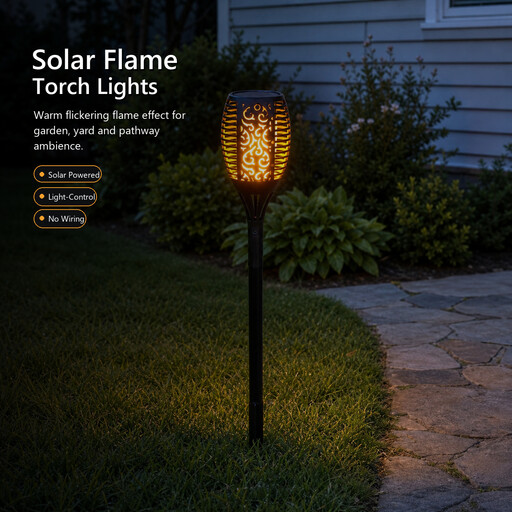
Why we chose them: Ideal for creating a warm atmosphere on a patio, balcony, or for marking out a flowerbed. The dancing flame effect is purely decorative and very well-executed.
These torches boast an IP65 rating, a real guarantee against heavy rain and dust. They thus avoid the "false waterproofing" trap, which means failure at the first storm.
The flickering flame effect is realistic and safe. The IP65 certification ensures excellent longevity against the elements. Automatic on and off.
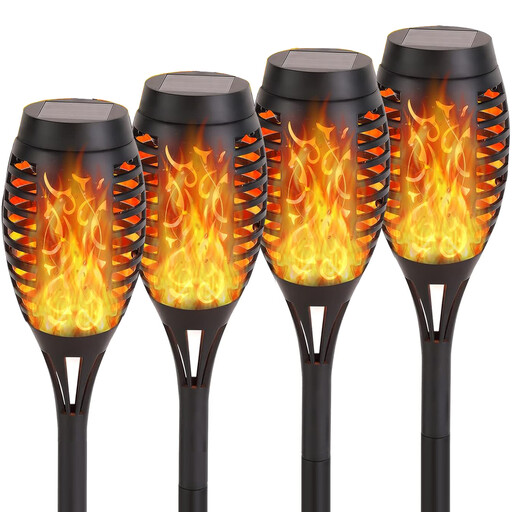
Why we chose it: Designed for those who want to line a long driveway, a large garden, or define a space. Sold as a set of four, this pack ensures a coherent and harmonious visual result.
At 51 cm tall with 12 LEDs per torch, they have a much more significant visual presence than typical mini-spots, avoiding the "lost glow in the garden" effect. The IP65 rating ensures the longevity of the entire set.
The set-of-four format is perfect for covering a large area uniformly. Their height is ideal for standing out amongst plants and effectively marking a path.
Explore our full selection of products that meet our criteria for quality and durability.
The lifespan depends on two key components: the battery and the LEDs. LEDs have a very long lifespan, often over 20,000 hours. It's the battery that wears out fastest, typically after 2 to 4 years depending on its quality and your usage. Good to know: some models allow you to replace the battery, which significantly extends their lifespan.
Yes, but with logically reduced performance. A solar panel continues to charge even on overcast days, but it obviously accumulates less energy than in direct sunlight. The nightly runtime will therefore be shorter. To compensate, opt for models with a good panel (monocrystalline), a generous battery, and ideally, a smart mode (motion sensor, eco mode).
Maintenance is minimal but essential for ensuring optimal performance. Simply remember to clean the solar panel's surface once or twice a year with a soft, damp cloth. Dust, pollen, or bird droppings can create a film that reduces charging efficiency. A clean panel is your guarantee of a maximum charge.