
Livraison le jour même ou le lendemain

Qualité garantie

Débloquez vos offres de bienvenue: Livraison GRATUITE | Jusqu'à -80 % | 30 jours d'essai gratuits à JoyPlus
Téléchargez l'application
Choosing a new frying pan can often feel like a daunting task. Between the promises of "revolutionary" coatings and the proliferation of compatibility logos, it's easy to end up with a non-stick induction pan that starts sticking after a few months or heats up completely unevenly. As the Head of Product Recommendations at Joybuy, my mission is simple: to help you cut through the noise and make a smart choice that's perfectly suited to your daily cooking routine.
This guide breaks down the pitfalls to avoid and the technical criteria that truly matter when choosing a high-performance, durable, and practical pan.
Cookware marketing is full of tempting claims that can hide critical weaknesses. Here are three things to check so you don't get caught out.
Forget the marketing hype and focus on the objective technical specifications.
The choice of material is crucial for both cooking and maintenance.
For an all-hob pan to be truly effective on an induction hob, its base must be ferromagnetic, thick, and perfectly flat. This guarantees fast, even heat transfer, saving you from the classic problem of food that's burnt in the centre and raw around the edges.
The size of the pan should match the size of your household and your cooking habits. A 28 cm pan is the ultimate all-rounder, perfect for 2 to 4 people. For a single person or for cooking a single fried egg, a 20 or 24 cm model will be more suitable and energy-efficient.
Rather than an endless catalogue, we've selected models that fit specific user profiles, always keeping our performance and reliability criteria in mind.
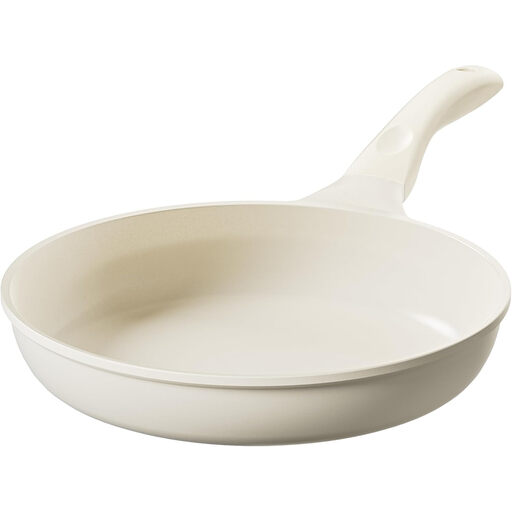
Why we recommend it: Perfect for everyday use, from morning fried eggs to evening stir-fried vegetables. It combines the peace of mind of a healthy coating with incredibly easy cleaning. The winning combination for busy cooks who don't want to compromise on health.
The manufacturer is upfront: it's guaranteed free of PTFE, PFOA, and PFAS. This total transparency puts an end to vague health claims.
Its ceramic coating ensures a perfect glide and lightning-fast cleaning (a quick wipe with a sponge is all it takes). On an induction hob, it heats up quickly and perfectly evenly.
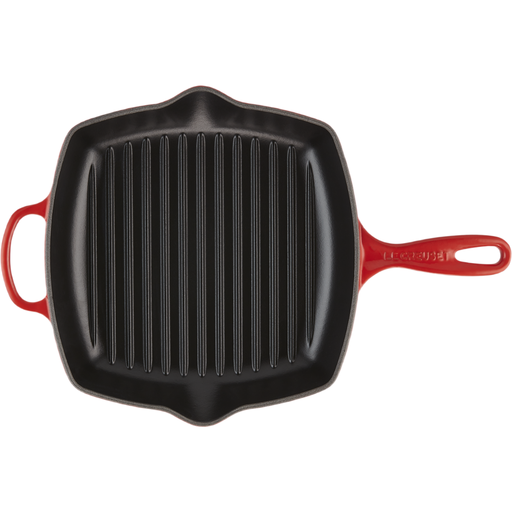
Why we recommend it: The ultimate tool for searing meat, fish, or vegetables and getting those coveted grill marks. It's the choice for purists who prioritise cooking performance and durability far above the "easy" non-stick convenience of the first few uses.
There's no fragile synthetic coating here. Its legendary durability comes from enamelled cast iron, a time-tested material whose performance lasts for decades with minimal maintenance.
Exceptional heat retention for a powerful, even sear. The bonus? It's oven-safe, which dramatically increases its versatility.
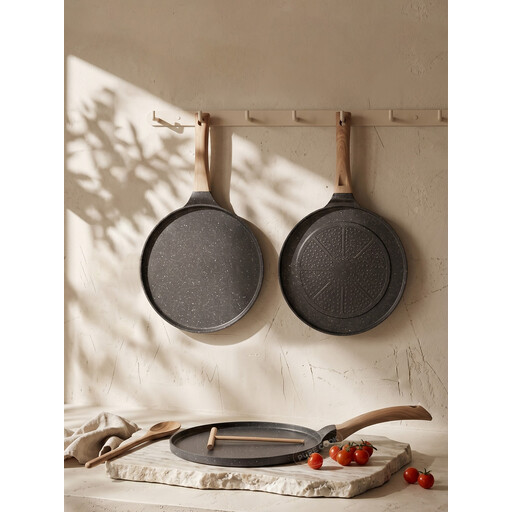
Why we recommend it: This is the quintessential all-rounder for daily meals, without breaking the bank. Lightweight and featuring a handle that stays cool, it's particularly pleasant to handle every day.
Unlike many entry-level models, its induction compatibility is reliable. Its aluminium body ensures it heats up quickly and efficiently.
Excellent value for money. Its light weight and stay-cool wooden handle are real everyday advantages, often missing from more expensive models.
The lifespan depends heavily on the material and how it's cared for. On average, a well-maintained pan with a synthetic (PTFE) or ceramic coating will last between 2 and 5 years. A cast-iron or carbon steel pan, which requires specific care (seasoning), can last for decades, with its properties improving over time.
To preserve the coating of a ceramic pan, a few simple steps are all you need:
No, and this is a common point of confusion. PFOA is a processing agent (a type of "glue") that was used to apply PTFE. Its use is now highly regulated or even banned. PTFE (polytetrafluoroethylene), better known by its trade name Teflon, is the non-stick material itself. Therefore, a pan can be "PFOA-free" while still having a PTFE coating. For those who wish to avoid PTFE entirely, the alternatives are ceramic, cast iron, or stainless steel.