
Livraison le jour même ou le lendemain

Qualité garantie

Débloquez vos offres de bienvenue: Livraison GRATUITE | Jusqu'à -80 % | 30 jours d'essai gratuits à JoyPlus
Téléchargez l'application
As a product expert at Joybuy, my job is to cut through the market noise and guide you to the best choices. The mixing bowl is a cornerstone of any kitchen. Yet, finding the perfect one can be a real challenge. It's easy to get caught between marketing hype and day-to-day reality, and end up with a tool that just collects dust in the back of a cabinet. This guide is here to sort through the options and help you invest in equipment that will truly stand the test of time.
Before comparing models, let's review the design flaws that can turn a great idea into a daily frustration.
To make the right choice, focus on a few objective factors that define the quality and versatility of a kitchen prep bowl.
Each material has its strengths. A set of mixing bowls that combines different materials is often the smartest solution.
Beyond the material, certain design details make all the difference.
Here are a few options that cater to distinct user profiles, keeping our criteria for quality and practicality in mind.
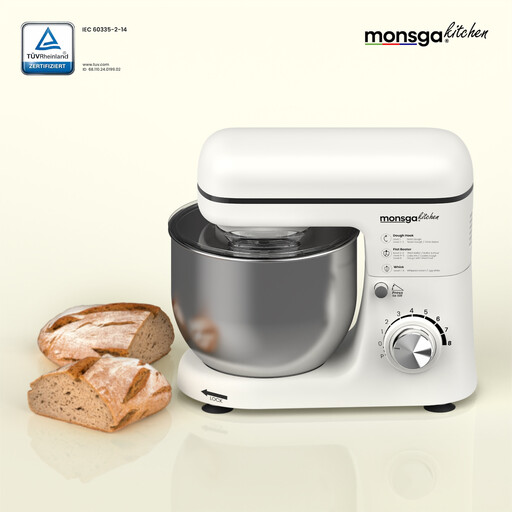
Why we chose it: For those who take baking or bread-making seriously, a stand mixer is a wise investment. This model combines a powerful motor with a large stainless steel bowl, offering the capacity and stability needed for kneading dense doughs or whipping large volumes of cream.
The bowl is made of food-grade 304 stainless steel, which is resistant to corrosion. The powerful suction cups under the mixer ensure rock-solid stability, far more effective than slippery bases.
Its planetary mixing action ensures ingredients are incorporated perfectly and evenly. The large 5-litre capacity is ideal for family-sized batches.
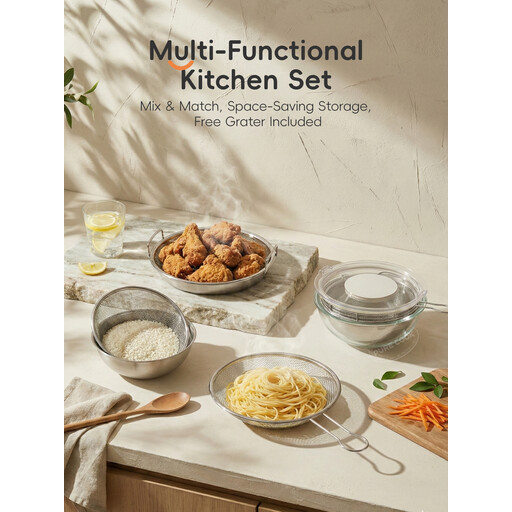
Why we chose it: This is the dream all-in-one solution for meal prep enthusiasts. This ultra-versatile set includes bowls of all sizes, a colander, a grater, and airtight lids for mixing, washing, grating, and storing.
The lids are designed for a truly airtight seal, solving the problem of unreliable closures. The 304 stainless steel prevents rust and odour retention.
An all-in-one, perfectly stackable set that optimises storage while covering a multitude of functions (mixing, storing, draining, grating).
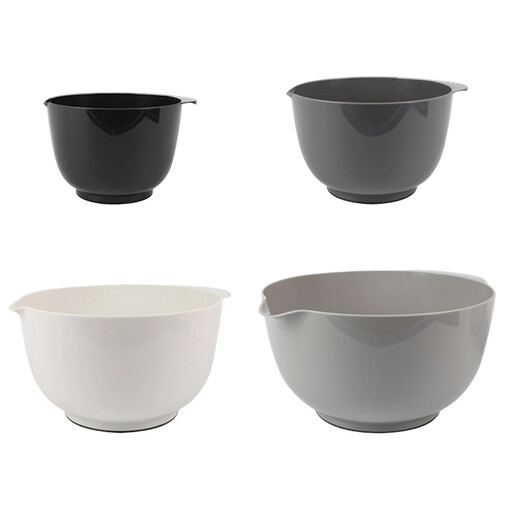
Why we chose it: Perfect as a starter set or for simple daily needs, this set of BPA-free plastic bowls is a practical and affordable option. The different sizes cover all the basic needs, from a small dressing to a large family salad.
The non-slip base is wide and well-integrated, offering far superior stability compared to entry-level models. The BPA-free plastic eliminates any health concerns.
Lightweight, stackable, and featuring a stable base, they are easy to handle and store. A simple, functional choice that is a great fit for any kitchen.
Explore our full selection of products that meet our quality criteria and current safety standards.
1. Can a stainless steel mixing bowl really rust? Absolutely. Low-grade stainless steel can definitely rust. Rust appears when the metal is low in chromium and nickel, the two elements that protect it from corrosion. That's why you should always look for the inox 304 or 18/8 designation, which indicates a food-grade alloy designed to hold up under normal conditions (including the dishwasher).
2. What's the difference between a cul-de-poule and a salad bowl? Although they are often confused, there is a technical difference. A cul-de-poule has a rounded, hemispherical base with no flat bottom. This shape is designed to optimise whisking, as ingredients can't get stuck in corners. A salad bowl, on the other hand, has a flatter base and more flared sides, making it more stable for serving but sometimes less ideal for certain baking bowl techniques.
3. Can all mixing bowls go in the microwave? No, absolutely not. Metal bowls (stainless steel, aluminium) should never be placed in a microwave oven. Only glass bowls (like Pyrex) and certain ceramic or plastic models are compatible. It is essential to always check the pictograms or the manufacturer's instructions. An accidental trip to the microwave could damage your bowl and, more importantly, your microwave.