
Livraison le jour même ou le lendemain

Qualité garantie

Débloquez vos offres de bienvenue: Livraison GRATUITE | Jusqu'à -80 % | 30 jours d'essai gratuits à JoyPlus
Téléchargez l'application
Good manga drawing supplies are about more than just a collection of colours. The precision of your line work, how well the ink works with your paper, and how easy everything is to store all have a direct impact on your creative comfort. Whether you’re a beginner, a drawing student, an illustrator or an aspiring mangaka, a few simple checks can help you avoid disappointing purchases.
A set might boast a wide range of shades without including a single proper inking tool. Yet a manga illustration often calls for several functions: sketching, outlining, fine details, solid areas, shading and white highlights. A well-designed manga drawing kit should adapt to the way you work, rather than just showing off an appealing palette.
A fine nib is ideal for facial expressions, hair and intricate details. A brush nib, on the other hand, lets you vary the line thickness depending on how much pressure you apply. If you only choose markers with the same nib, your lines may lack depth or precision.
Claims like “waterproof” or “water-resistant” should be taken with a pinch of salt. The result also depends on the surface you’re using. On very porous paper, the ink can bleed, soak through the sheet or lose its sharpness. Always test on a scrap of your chosen paper before starting a page.
For inking, go for a set that offers several sizes. The Pigma Sensei pens, for example, come in 0.3 mm, 0.4 mm, 0.6 mm and 1.0 mm tips. This range lets you move from delicate details to bolder outlines.
Manga inking pens with fibre or plastic nibs generally give a consistent, even line. Brush-tip markers respond more to the pressure of your hand. They are particularly well suited to expressive outlines, clothing folds and motion effects.
To achieve a clean black line, check the details about permanence, water resistance and lightfastness. The Pigma Micron, Pigma Sensei and Pitt Artist Pen Manga ranges use, according to their product descriptions, black Pigma ink or Indian ink that is claimed to be water-resistant and fade-resistant.
These features don’t mean you can skip testing on your paper. They become especially important if you plan to add colour later with watercolour brush pens.
Mixed-media paper, smooth manga paper and Bristol board generally work better for inking than highly absorbent sheets. To make your markers and pens last longer:
The water-based inks in Koi Coloring Brush Pens blend easily and can be reactivated with water. However, they don’t offer the same finish as a permanent black ink designed for final inking.
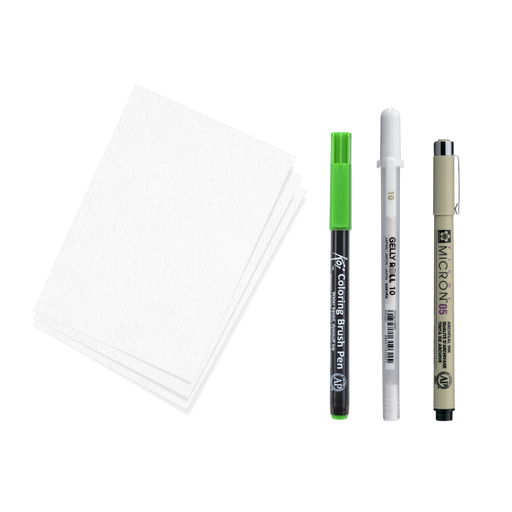
Why this choice suits this profile: This set covers the essentials with a black Pigma Micron 05, a white Gelly Roll Basic 10, an emerald green Koi Coloring Brush Pen and three A6 sheets. The video tutorial accessible via QR code provides a helpful framework for your first sessions.
It doesn’t rely on a large palette alone: it brings together black outlines, white highlights and colour in a clearly defined project. Its compact format also stops you from buying supplies you might not need straight away.
A guided project, three complementary tools and A6 mixed-media paper included.
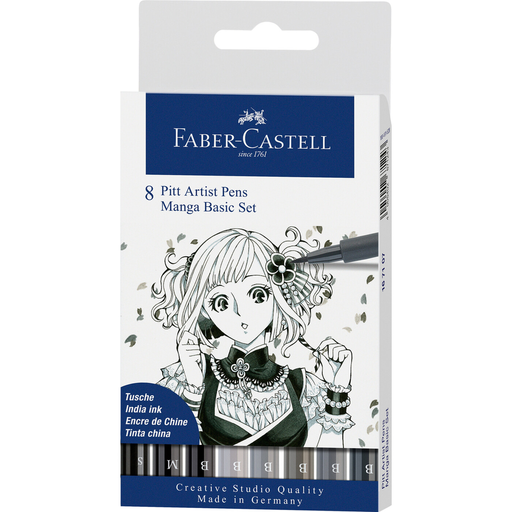
Why this choice suits this profile: The eight flexible brush nibs are aimed at illustrators who enjoy using pressure to create line variations, outlines and shading with a single set.
The selection isn’t limited to a single line width: the flexible nib lets you go from fine to broad by adjusting pressure. The Indian ink is claimed to be water-resistant and fade-resistant.
Eight brush-tip pens, a black ink claimed to be permanent, and a design intended for manga and comics.
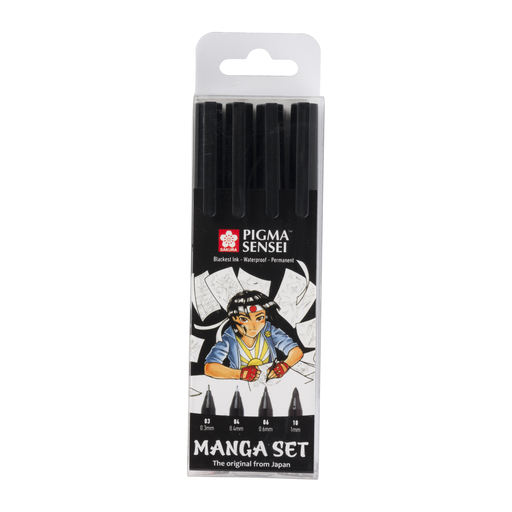
Why this choice suits this profile: The four sizes cover detail work, outlines, lettering and bolder strokes. This format suits artists who regularly switch between finished sketches, Japanese illustration and inking.
The nib sizes are clearly differentiated, which reduces the risk of ending up with unhelpful duplicates. The product description states that the Pigma ink is water-resistant and fade-resistant.
Four nibs from 0.3 to 1.0 mm and Pigma archival ink claimed to be water-resistant.
We’ve put together a comprehensive, real-time selection of products that meet these demanding criteria as well as European safety standards.
For solid areas, gradients and colouring, manga markers with brush nibs offer more versatility. The SAKURA Koi Coloring Brush Pen – 12 Colors set gives you twelve water-based, blendable colours suitable for illustration, colouring and lettering. The six-pack of Koi also includes a colourless blender marker.
The Koi pens don’t necessarily replace a black ink designed for outlines. A common approach is to do the line work with a Pigma Micron, a Pigma Sensei or a Pitt Artist Pen Manga, then add colour once the ink is completely dry. However, do check compatibility with your paper to avoid bleeding.
For a creative gift with a Japanese theme, the SAKURA Cherry Blossom Creation Kit pairs a Pigma Micron 02, a Gelly Roll Stardust and a fuchsia Koi. The Great Wave set, meanwhile, includes a Pigma Micron 03, a white Gelly Roll and a Prussian blue Koi, along with three A6 sheets and a video tutorial.
To begin, simple equipment is enough: a pencil or mechanical pencil, fairly smooth paper, a black inking pen in several sizes and a few colours. A guided set like the SAKURA Manga Creation Kit lets you get started with three complementary tools, without building up a large collection straight away.
They can be useful if you plan to add wet colour or if you want a durable line. However, the claimed resistance should always be tested on the paper you’re using. Let the ink dry thoroughly and do a test before colouring an illustration you care about.
It depends on how often you use it, the paper you use and how well you look after it. A nib used on an abrasive surface will wear out more quickly. Closing the cap promptly, storing the pen according to the manufacturer’s recommendations and avoiding high temperatures all help to preserve the ink flow and the nib.