
Livraison le jour même ou le lendemain

Qualité garantie

Débloquez vos offres de bienvenue: Livraison GRATUITE | Jusqu'à -80 % | 30 jours d'essai gratuits à JoyPlus
Téléchargez l'application
When creating manga pages, illustrations or comic book inking, the tools you choose directly affect the clarity of your lines. However, commercial labels aren't always very clear: a pen sold as "fine" isn't necessarily suited to details, while a black ink may prove incompatible with washes or eraser touch-ups.
Before buying ink pens for manga drawing, take the time to check the nib, the ink's performance and its compatibility with your paper. Here are the criteria to examine when comparing different sets, rather than simply counting the number of pens in the box.
A set may contain several pens whose nibs ultimately produce an almost identical line. For manga, a genuinely useful selection typically combines a very fine nib for expressions and textures, a medium nib for outlines, and a broader nib for silhouettes or solid areas.
Fine-tipped markers are therefore not all the same. A plastic nib often gives a regular, precise line, whereas a fibre nib offers a softer feel and a different line width.
Ink that bleeds under a wash or when it comes into contact with a marker can ruin an already well-advanced page. Look for mentions of waterproof ink, permanent or water-resistant, while checking the usage conditions specified by the manufacturer. The result also depends on the paper, the amount of ink deposited and the drying time.
The mention lightfast ink or fade-resistant concerns the visual longevity of the drawing over time. It does not mean the artwork can be displayed in direct sunlight without care, nor that all surfaces will protect it in the same way.
Even ink designed for illustration can bleed through very porous paper. To avoid smudging, always test the pen on a scrap from the same pad before starting your page. Smooth papers intended for drawing, illustration or comic books generally suit crisp outlines better than standard printer paper.
For manga drawing, a balanced selection might cover thicknesses close to 0.3 mm, 0.4 mm, 0.6 mm and 1.0 mm. These values remain indicative: the pressure you apply and the paper's texture noticeably change how the line looks.
A black India ink or permanent pigmented ink is particularly suitable for drawings intended to be preserved or coloured over. However, you need to clearly distinguish between the terms "black", "water-resistant" and "fade-resistant": each describes a different property.
The products presented below claim to have permanent, waterproof and fade-resistant ink. To maintain a consistent line, close each pen immediately after use and store it according to the manufacturer's recommendations, usually horizontally in a dry place.
A manga inking pen should remain comfortable to hold during long sessions. Pay attention to the grip, the nib's rigidity and how easy it is to store. These sets require no special setup. However, the cap must be replaced promptly to prevent the ink from drying out.
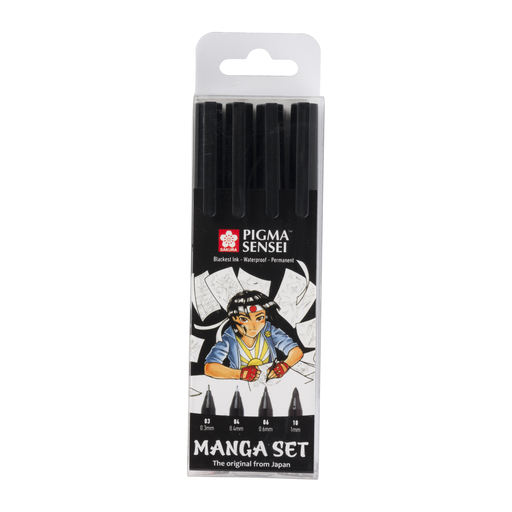
Why this choice suits this profile: The four stated widths, from 0.3 mm to 1.0 mm, let you start with a single set to create details, outlines and bolder strokes.
The differently designed nibs reduce the risk of buying several pens with too similar a result. Testing on your chosen paper is still strongly recommended.
Four stated nibs: 0.3 mm, 0.4 mm, 0.6 mm and 1.0 mm. Pigma ink claimed to be waterproof and fade-resistant.
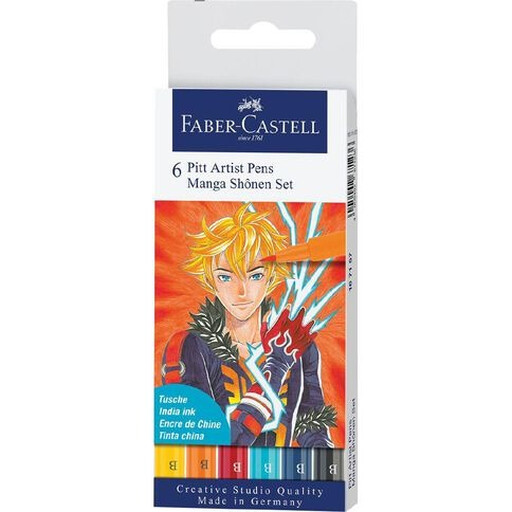
Why this choice suits this profile: This set of six pens is aimed at illustrators who want a range of nibs dedicated to manga inking and comic book scenes.
The product listing mentions six matching nibs along with a permanent black ink claimed to be water-resistant and fade-resistant.
Set of six artist pens. Black India ink claimed to be waterproof and fade-resistant, suitable for inking and final drawing.
Why this choice suits this profile: The combination of plastic and fibre nibs suits those who alternate between technical details, lettering, textures and bolder outlines.
The different nib constructions provide distinctly different feels. Testing the ink on porous paper also helps avoid unpleasant surprises.
Ultra-fine plastic nib of 0.3 mm, 0.4 mm nib, 0.6 mm fibre nib and 1.0 mm thick fibre nib.
We have compiled a comprehensive list, updated in real time, of products that meet these demanding selection criteria and European safety regulations.
A medium nib generally works well for main outlines, while a 0.3 mm or 0.4 mm nib is better suited to eyes, hair, folds and small details. To vary line thickness, it's better to choose a set of several sizes than a single pen.
Not necessarily. The term "waterproof" indicates water resistance under the conditions specified by the manufacturer, but drying time and paper type remain decisive. Let the ink dry and test on a similar sheet before tackling your final page.
It all depends on how often you use them, whether you close the cap, storage conditions and the paper's porosity. The nib can also wear out before the ink reservoir is empty. Replacing dried-out pens or those whose line becomes irregular helps keep your outlines clean and precise.