Savoury snack fans keeping an eye on fat
After a workout, you fancy a crunchy savoury snack and want to compare its fat reduction with a similar product.


If you’re looking for a lower-fat savoury snack after exercise, check for a quantified reduction compared with a similar product, then compare the fat and salt content per 100 g. This reduction alone doesn’t tell you whether the snack is suitable overall. Nutri-Score, which Santé publique France says is voluntary, can be a useful addition when checking the nutritional information.
After a workout, you fancy a crunchy savoury snack and want to compare its fat reduction with a similar product.
The words ‘lower fat’ aren’t enough to help you choose: you also want to compare the salt content shown per 100 g.
You check the logo when it appears on the pack, without automatically ruling out a product that doesn’t display it. Santé publique France states that displaying Nutri-Score is voluntary.
First decide whether you’re after a savoury snack or want to consider how this product fits into a snack after exercise. Then compare the figures on the same basis: per 100 g.
| Criteria | What to check | Who is it for? |
|---|---|---|
| Fat reduction | The stated reduction, the similar product used as a reference and the fat content per 100 g. | If you fancy a crunchy savoury snack but want to cut down on fat, the comparison should relate to the reference product you’re buying. Around 31% of consumers put this verifiable reduction first. |
| How it fits into your snack | The portion you have in mind, followed by the protein and carbohydrate figures on the label. | After exercise, some people want to think about their snack as a whole rather than choosing based only on the ‘lower fat’ claim. This overall composition is the main priority for around 31% of consumers. |
| Salt and other values | Salt per 100 g; and, if needed, sugars, saturated fat and energy value. | A lower-fat snack can still be salty. If this trade-off matters more to you, the label can help you choose between recipes. Around 25% of consumers prioritise salt and other nutritional values. |
| Front-of-pack guide | Nutri-Score, if displayed, followed by the nutritional information and ingredients. | If you’re choosing quickly between several packs, you can look for a visible guide before checking their composition. Around 13% of consumers look for this guide first, without treating its absence as a reason to rule out a product. |
A comparison of fat content doesn’t describe the snack’s entire nutritional profile or what else you’ll eat after exercise.
Decide whether you’re simply after something savoury and crunchy or want to assess your snack as a whole. If it’s the latter, check the protein, carbohydrates and portion size too.
According to Santé publique France, displaying it is voluntary. The DGCCRF distinguishes this logo from the nutritional declaration required for prepacked food, subject to the applicable exemptions.
Use the logo when it’s there, but compare the nutritional information even when it doesn’t appear on the pack.
The reduction highlighted on the packaging doesn’t, on its own, tell you how much salt the product contains.
Compare the salt per 100 g in the snacks you’re considering, then take into account how much you plan to eat.
Auchan describes a Vico lentil crisp flavour with fine herbs as ‘40% less fat than classic crisps’. This claim doesn’t apply to the brand’s other recipes.
Check the exact product name, flavour and pack size before using a claim or nutritional values to make a comparison.
Auchan describes Natur’&Bon lentil crisps with fine herbs using a quantified claim for a fat reduction compared with classic crisps.
Belin offers products including Croustilles savoury snacks made with puffed maize, as listed by Auchan.
Carrefour’s range includes crackers, pretzels and breadsticks, including sesame breadsticks labelled ‘light’.
E.Leclerc lists crackers, sticks and pretzels in its Marque Repère range of savoury snacks.
Auchan’s savoury snack range includes salted crackers, cheese wafers and snacks made with chickpea flour.
This 30 g pack of chickpea crackers could suit you if you fancy a savoury snack after exercise. To choose it on the basis that it’s ‘lower fat’, you’ll need a comparison of its fat content with a similar product.
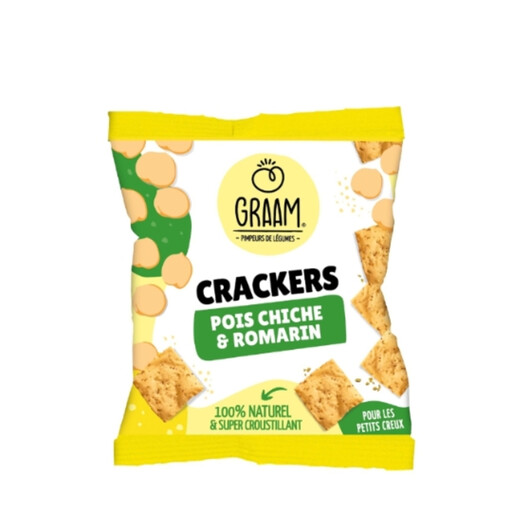 Image unavailable
A chickpea cracker to consider if you’re after a 30 g pack of savoury snacks after exercise. To compare its fat content, check which product it’s being compared with and read the label for the exact product. Its pack size alone isn’t enough to judge your snack as a whole.
No. Santé publique France says that producers display Nutri-Score voluntarily. The DGCCRF states that a nutritional declaration is required for prepacked food, subject to the exemptions set out in the regulations. So the absence of the logo shouldn’t be confused with a lack of nutritional information.
Start with the fat content per 100 g and the similar product referred to in the claim. Under European Regulation (EC) No 1924/2006, a claim that a product has reduced fat must refer to a reduction of at least 30% compared with a similar product. Then check the salt content and the portion you have in mind.
No. A reduction in fat describes just one aspect of the snack, not everything you eat after exercise. If you want to consider the composition of your snack, check the portion, protein and carbohydrates too. These figures alone don’t show whether a product meets your personal needs.
Check the ingredients and allergen information on the packaging for the exact product before eating it. Don’t assume the information applies to a different flavour or pack size.
First compare their nutritional values per 100 g when a nutritional declaration applies, as explained by the DGCCRF. Then take into account the portion you plan to eat: the pack size isn’t necessarily the same as your portion.