
Livraison le jour même ou le lendemain

Qualité garantie

Débloquez vos offres de bienvenue: Livraison GRATUITE | Jusqu'à -80 % | 30 jours d'essai gratuits à JoyPlus
Téléchargez l'application
In the kitchen, everything starts with good prep. And yet, a tool as basic as kitchen scissors is often a source of frustration. A pair that struggles to snip a few herbs, rusts after a couple of dishwasher cycles, or has a handle that gives out mid-carve on the Sunday roast chicken: these are scenarios we all know too well.
Choosing the right pair isn't about just grabbing the first one you see. The market is flooded with models that make tempting claims but disappoint in the long run. To help you see things more clearly and invest in a pair that won't let you down, we've broken down the common pitfalls to avoid and the criteria that truly matter.
To never be disappointed again, focus on a few key points that make all the difference.
The longevity and effectiveness of your scissors depend above all on the quality of their blades. The go-to choice? Opt for stainless steel kitchen scissors. But be warned, not all stainless steels are created equal.
Steels like 3Cr13 or 40Cr13 are good indicators of quality for home use. They offer an excellent balance between hardness (for a long-lasting edge) and high corrosion resistance. This is a feature found on many professional kitchen shears.
The type of scissors you should choose depends directly on how you plan to use them.
A good grip is crucial for working with precision and safety. The handles should fit the size of your hands and, ideally, be made of a non-slip material like polypropylene (PP) or feature a "soft-touch" coating.
On the most powerful models, a safety lock is a major plus. It keeps the blades closed when the scissors are not in use, preventing any nasty surprises in the kitchen drawer.
Instead of an endless list, we've selected three models that cater to very specific user profiles. The goal: to help you find the pair that truly matches your needs.
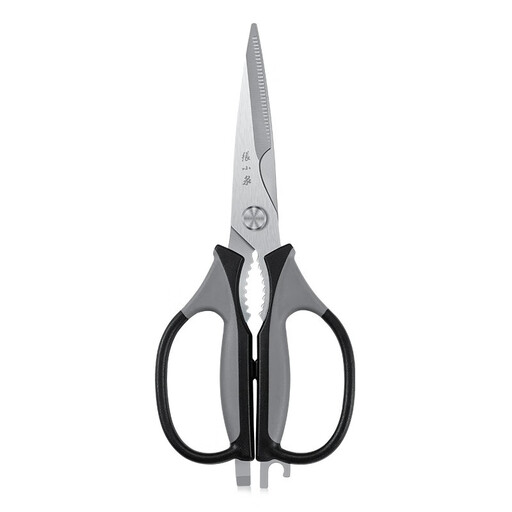
Why we chose it: Perfect for everyday tasks. Snipping herbs, opening a bag, cutting parchment paper... this simple and effective pair gets straight to the point. It's the reliable, no-fuss tool for common kitchen needs.
This model focuses on the essentials: cutting. No superfluous gadgets, just a simple construction and stainless steel blades designed for regular use.
Everyday simplicity and efficiency. Its blades are sharp and its handles are comfortable for all small prep tasks.
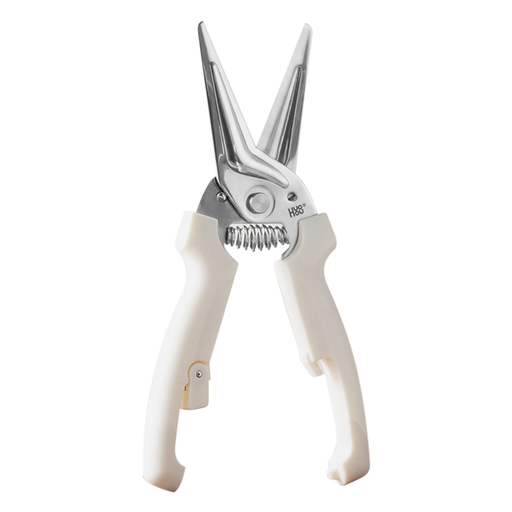
Why we chose it: For those who regularly prepare poultry, pork ribs, or shellfish, a powerful tool isn't a luxury. You need shears capable of cutting through small bones and cartilage effortlessly and safely.
These are true kitchen shears built for power. The 3Cr13 steel, spring-loaded mechanism, and robust handles are specifically designed to tackle poultry bones, preventing broken handles or prematurely dulling blades.
Its spring-loaded mechanism, which delivers powerful, effortless cutting. The safety lock is a bonus for storage. Perfect for poultry and bone-in cuts of meat.
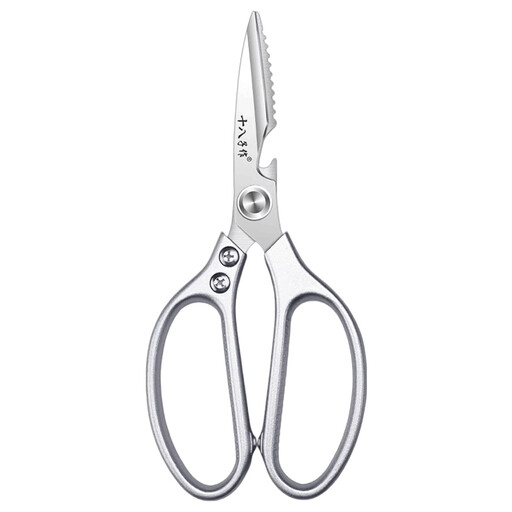
Why we chose it: For those who seek out tools that blend performance, aesthetics, and durability. This is the kind of object that prioritizes premium materials and a design that inspires confidence, making it an investment built to last.
Its "full-metal" stainless steel construction eliminates the #1 weak point: plastic handles. This one-piece design is not only ultra-durable but also perfectly hygienic, leaving no crevices where residue can hide.
Its 100% steel design, a guarantee of maximum durability and hygiene. Its sleek, professional design immediately inspires confidence.
We have put together a complete selection of products that meet our quality criteria and current safety standards.
Hand washing is strongly recommended to preserve the blade edge. Be sure to dry them immediately after cleaning to prevent any corrosion spots, even on stainless steel. Skip the dishwasher: harsh detergents and heat can damage the blades and the pivot joint. For sharpening, use a tool specifically designed for scissors, not a knife sharpener.
Yes, but only with a model designed for it. Look for terms like poultry shears, bone shears, or "heavy-duty." These pairs have thicker blades, a reinforced pivot, and provide better leverage. Trying this with regular scissors is a recipe for disaster.
Kitchen scissors are made from food-grade stainless steel, which ensures they are hygienic and resistant to corrosion. Their design is also much more robust to handle cutting a wide variety of foods. Some models can even be taken apart for thorough cleaning. Office scissors, on the other hand, are not intended for food contact and therefore have no place in your kitchen.