
当日/次日达

品质保障

开启新人专享福利: 全场免邮 | 低至 2 折 | 免费试用 30 天 JoyPlus 会员
下载 Joybuy
A rechargeable JISULIFE portable fan slips into a bag, a pocket or a suitcase and goes with you on public transport, to concerts and on holiday. The trick is navigating the technical specs, which often lump together maximum battery life, airflow speed and motor power as if they were the same thing.
Before you choose your mini portable fan, three mistakes keep cropping up:
The capacity, given in mAh, gives you a rough idea of the energy reserve, but it doesn't tell you the real battery life on its own. Charging time, the number of speeds and the power level you use all matter just as much.
A fan with a 5000 mAh battery offers a comfortable reserve for a long day, but how long it actually runs depends directly on the setting you choose. The JISULIFE Life 4 models claim between 2.5 and 16.5 hours, while the 9S versions go up to 22 hours. These figures are only a guide – they vary depending on the speed selected and the conditions you use it in.
The USB-C format is especially handy. You can charge your fan with a mains adapter, a power bank or certain computers that have the same port. Just check that the cable supplied works with your setup and use a charger that follows the instructions in the manual.
A pocket fan needs to be light enough that you forget it's in your bag or jacket. The JISULIFE handheld models shown here weigh around 130 to 180 g, compared with 280 to 282 g for the Life 4 neck fan.
The right size really depends on what you'll be doing:
For journeys on the Tube, train or plane, also think about whether it has a lock, a wrist strap and a sturdy power button. A device that switches on at the bottom of your bag can drain its battery without you even realising.
The more speed levels a fan has, the easier it is to match the breeze to the situation – a gentle draught at your desk, a more direct flow outdoors. The JISULIFE models we've picked offer between 3 and 5 speeds, while the Pro1S takes it up to 100 levels.
An LED screen usually shows the speed you've chosen and the battery level. That's a handy detail before you head off to work or hit the road, because it stops you discovering a nearly flat battery just when you need it most. When comparing two models, also look at the size of the air outlet, the weight and the claimed power. A single marketing figure isn't enough to tell two devices apart.
Noise depends on the setting and the environment. A fan described as quiet might be fine in an office on a low speed, but become noticeably louder at full power. The available spec sheets don't always give a standardised acoustic measurement in decibels, either.
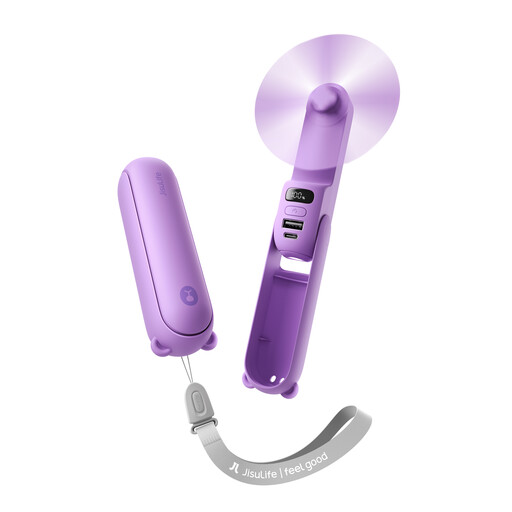
Why this choice suits this profile: Foldable and lightweight at around 130 g, this model is ideal for students, commuters and anyone who wants to try a mini portable fan without turning their bag into a suitcase.
The spec sheet details 3 speeds, a 2500 mAh battery and a claimed battery life of 15 to 24 hours depending on the setting, rather than just giving an average figure that's hard to interpret.
A foldable design, an LED screen, a light and a power bank function all in one 3-in-1 device.
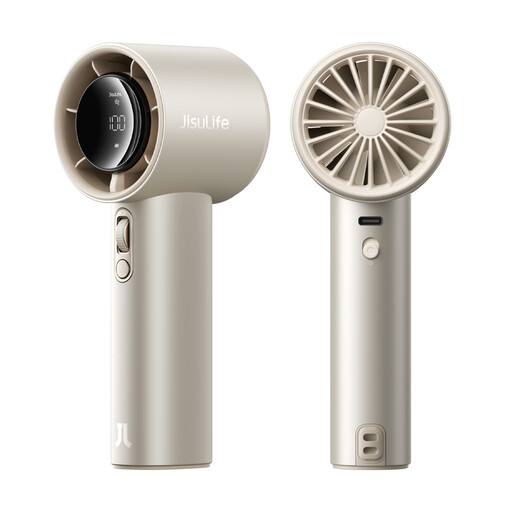
Why this choice suits this profile: Its aluminium alloy casing, LED screen and 100-level dial are aimed at users who want refined finishes and very precise control over the airflow.
The information states the 5000 mAh capacity, a charging time of 1.5 to 2 hours with a suitable input, and a battery life that changes depending on the level selected.
A claimed speed of up to 9 m/s, a tracking display and fast charging with a USB-A to USB-C cable supplied.
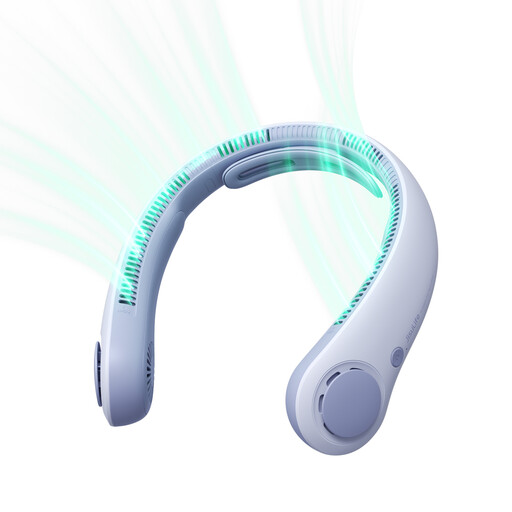
Why this choice suits this profile: The hands-free format is perfect for concerts, outdoor work, hiking or journeys where holding a device quickly becomes tiresome.
Its bladeless design reduces the risk of direct contact with rotating parts. The air intakes still need to be kept clear and the device should be kept away from moisture.
A 5000 mAh battery, 5 speeds, USB-C charging in 3 to 4 hours and a claimed battery life of 2.5 to 16.5 hours.
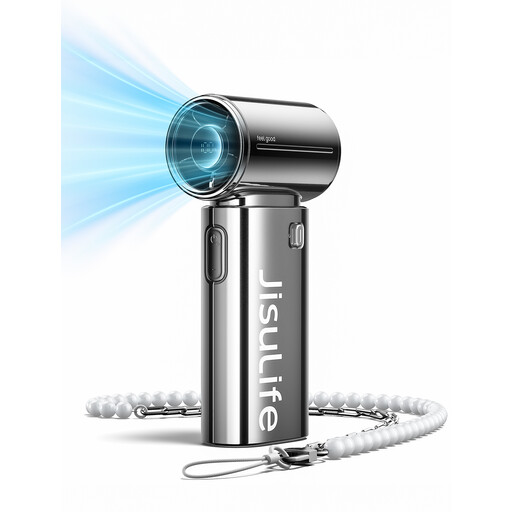
Why this choice suits this profile: Its pocket-sized format, wrist strap and 5000 mAh battery meet the needs of travellers, sports enthusiasts and anyone who spends time outdoors.
The screen shows the speed and battery level, while the 5 settings let you avoid running it at maximum power continuously.
A 9-blade design, a claimed speed of up to 10 m/s, a weight of around 180 g and a battery life that can reach 22 hours depending on the mode.
We've put together a full selection, updated in real time, of products that meet these criteria as well as the applicable European safety requirements.
To get the most out of your rechargeable fan all summer long, adopt a few simple habits:
The CE mark doesn't mean a product is harmless in every situation. It confirms that it meets the regulatory framework that applies to it. Before using it for the first time, check the manual, the labelling and the seller's recommendations.
Depending on the model, a full charge usually takes between 1 and 5 hours. The F8S claims around 1 to 2 hours, the Life 4 around 3 to 4 hours and the Life 7 around 4 to 5 hours. In practice, the time depends on the charger you use, the cable and the remaining battery level.
The power consumption depends on the speed you select and how long you spend charging the device. According to the spec sheets for some models, a 5000 mAh battery represents about 18.5 Wh. To space out your charges, choose the right level for the situation and switch the fan off as soon as you no longer need the airflow.
A fan with a lithium-ion battery may be subject to the rules of the airline and the airport. Generally, carry it in your cabin bag and make sure it can't switch on accidentally. Always check your carrier's guidelines before you travel.