
Livraison le jour même ou le lendemain

Qualité garantie

Débloquez vos offres de bienvenue: Livraison GRATUITE | Jusqu'à -80 % | 30 jours d'essai gratuits à JoyPlus
Téléchargez l'application
A rechargeable portable fan slips into a bag, sits on a desk or can be worn around your neck. However, not every model meets the same needs. A tiny device may lack power, while a model with a large battery can become awkward to carry.
To avoid a disappointing purchase, focus on actual battery life at different speeds, the charging method and ease of use. Here are the main points to consider before choosing a mini portable fan for your home, commute, holidays or outdoor activities.
A quoted battery life of 20 or 30 hours generally applies to the lowest fan setting. At full power, the battery may run down considerably faster. It is therefore better to look for a usage range at different speeds rather than relying on a single headline figure.
Battery capacity, expressed in mAh, also provides a useful indication, but it cannot predict operating time on its own. The motor, number of blades and airflow power also affect energy consumption.
A powerful fan is not necessarily pleasant to use in an open-plan office, library or on a train. For longer sessions, check that it offers several settings, including a gentle mode. A quiet fan is ultimately a matter of context: the noise level varies depending on the speed, but also on the distance between the device and the user.
The shape of the airflow matters just as much. A pocket fan generally directs air towards the face or upper body. A compact desk model, on the other hand, can cover a wider area thanks to its adjustable angle or oscillation function.
Holding a device for several hours can quickly strain your wrist. For concerts, travelling or outdoor work, a hands-free model is often more practical. A bladeless neck fan also limits direct access to the blades, but you should still read the instructions and keep the air inlets clear.
Before placing your order, also check the battery type, the cable supplied, usage warnings and the information provided by the manufacturer or the responsible party established in the European Union. An electrical appliance must never be used in the rain or dismantled.
For regular use, choose a rechargeable battery of at least 2,000 mAh. A capacity between 4,250 and 5,000 mAh is better suited to long days, provided you are happy to accept a slightly heavier device.
USB-C makes it easy to recharge from a laptop, power bank or compatible adapter. Also check the quoted charging time: some devices regain their charge in one to two hours, while others require three to five hours. Being able to use the fan while it is charging can be useful at your desk, but only if the manufacturer permits it.
Three speeds are generally enough for a desk or bedroom. Five settings offer more flexibility, allowing you to switch from a gentle breeze to a more concentrated airflow. Some devices even offer very gradual adjustment. That said, a long list of settings cannot compensate for an underpowered motor or poorly designed air outlet.
Figures such as 3.5 m/s or 10 m/s should be compared with caution, as measurement protocols are not always identical. They are mainly useful for positioning models within the same specification sheet, rather than guaranteeing the same sensation in every situation.
A travel fan should remain light enough to carry every day. A weight of between 130 and 180 g is generally suitable for a handheld or pocket model. A fan worn around the neck may be heavier, particularly because of its battery and frame.
For desk use, look for a stable base, an adjustable tilt and, where necessary, an oscillation function. In a car, pay closer attention to the power source: a USB car fan requires a USB port or suitable charger and may not operate independently.
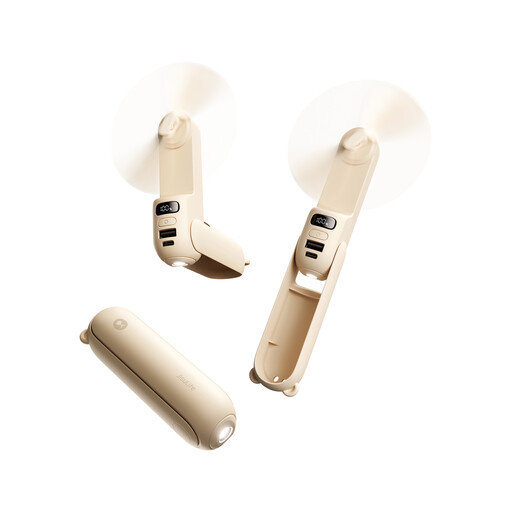
Why this choice suits this user: At around 130 g and with a foldable design, it is ideal as a first purchase or for everyday travel. It combines a fan, a light and a power bank in a case that is easy to store.
The display shows the selected speed and remaining battery level, helping to prevent unexpected shutdowns. However, the quoted battery life of between 15 and 24 hours depends on the chosen setting.
Three speeds, one- to two-hour charging, a light function and a 2,500 mAh battery.
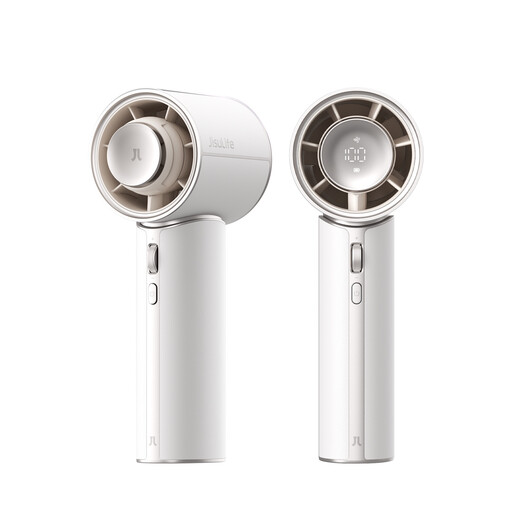
Why this choice suits this user: Its faux-leather finish, digital display and detailed settings are designed for users who value presentation as much as precise airflow control.
The ventilation levels can be adjusted from 1 to 100, allowing you to fine-tune the airflow instead of being restricted to just a few settings. The quoted battery life ranges from 3 to 30 hours depending on the selected intensity.
4,250 mAh battery, quoted two- to three-hour charging time, case and retractable lanyard.
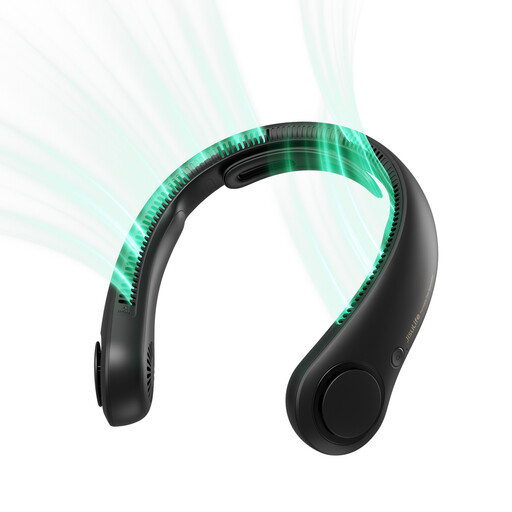
Why this choice suits this user: The hands-free design is ideal for festivals, walking commutes, outdoor work and any activity where holding a fan quickly becomes inconvenient.
Its bladeless design prevents direct contact with the blades. The product details quote a battery life of 2.5 to 16.5 hours and specify that this depends on the selected speed.
5,000 mAh battery, five speeds, USB-C charging and a quoted weight of approximately 282 g.
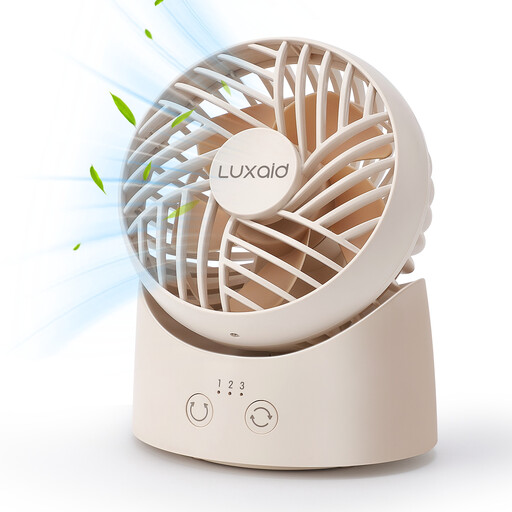
Why this choice suits this user: Its compact desk-fan design fits easily on a work surface, bedside table or shelf without taking up too much room.
The 60° oscillation stops the airflow from staying in one place. However, its actual capacity, listed as 1,800 mAh, should be taken into account before ordering.
Three speeds, Type-C charging, oscillation and a quoted battery life of up to eight hours.
We have brought together a complete, real-time updated selection of products that meet these exacting criteria, as well as European safety requirements.
To maintain a consistent airflow, dust the grilles with a dry cloth or small brush after switching off the device. Do not block the air inlets with clothing, a bag or a cushion. Also avoid leaving the fan in a car parked in direct sunlight, particularly if it contains a lithium-ion battery.
Service life depends on how often the fan is used, the number of charging cycles and storage conditions. If you do not use it for several weeks, store it in a dry place and make sure it retains sufficient charge. If the battery swells, becomes unusually hot or changes shape, stop using the device immediately.
Energy consumption is generally low, as these devices use a small-capacity battery. The exact cost depends on the battery capacity, charger efficiency and electricity price. A full charge for a 5,000 mAh battery represents a modest amount of energy compared with that consumed by many household appliances.
Some models allow this, while others recommend not using them during charging. Consult the instructions for the device in question. Use a cable that is in good condition, place the fan on a clear surface and unplug it if it becomes unusually hot.
A foldable mini portable fan weighing between 130 and 180 g is easy to carry in a bag. For a long journey, choose a model with a battery indicator, USB-C charging and quoted battery life across several fan settings. Also check the rules of the airline or transport operator regarding devices equipped with a lithium-ion battery.