Anyone who likes to drizzle honey over breakfast
If you enjoy honey on toast, in yoghurt or in a drink, runny honey in a squeeze bottle is a convenient choice for serving straight from the bottle.


For your first shop, choose runny honey in a squeeze bottle if you want to drizzle it straight onto toast or into yoghurt. A jar may be a better choice if you prefer a creamy texture. The packaging alone won’t tell you where the honey comes from or whether it’s organic, so check the label before you buy.
If you enjoy honey on toast, in yoghurt or in a drink, runny honey in a squeeze bottle is a convenient choice for serving straight from the bottle.
If the country of harvest matters to you, compare the labels, especially for blended honey. The brand name and place of manufacture don’t tell you where the honey was harvested.
If you want runny honey that’s both organic and in a squeeze bottle, check all three details on the specific product rather than assuming them from the packaging alone.
For your first purchase, start with how you plan to use the honey, then check its texture, packaging and label details.
| What to check | Look for | Who is it for? |
|---|---|---|
| Serving and portioning | The words “runny honey” and “squeeze bottle” or “squeeze”, as well as the net weight. | If I want to drizzle honey over toast without spooning it out, I’d choose a squeeze bottle and runny honey; around 31% of consumers would put easy portioning first. |
| Where the honey comes from | The country or countries of harvest shown on the label, which may differ from the country of manufacture. | If I want to know where a blend comes from, the bottle alone won’t tell me; around 31% of consumers would make this their main consideration. |
| Organic certification | Organic certification on the specific product, as well as a runny texture if you also want a squeeze bottle. | I’m looking for an organic option without giving up the convenience of a squeeze bottle; around 23% of consumers would prioritise this combination. |
| Label details and household use | The product name and best-before date. If there’s an infant in your household, don’t give them honey. | Before buying for my household, I want to know what the product is and who I can serve it to; around 15% of consumers would make this their main concern. |
In France, the DGCCRF says that the country of origin is the country where the honey was harvested. For honey from several countries placed on the market from 14 June 2026, the DGCCRF specifies that those countries and their percentages must appear in the main field of vision, in descending order by weight.
Auchan’s squeeze-bottle options for easy serving are described as runny honey. The shape of the packaging doesn’t mean you can skip checking this detail.
For toast or yoghurt, look for both “runny honey” and “squeeze bottle” on the product you choose.
Auchan’s L’Apiculteur product is made in France, but the honey is listed as coming from France and Spain.
Check the countries of harvest on the label. For blends covered by the rules in force from 14 June 2026, also check the percentages shown.
Organic certification alone doesn’t tell you whether the honey is runny, comes in a squeeze bottle or is from a single country.
Check the product’s certification, texture, packaging and origin separately.
Anses advises against giving honey to children under one because of the risk of infant botulism, whatever the honey’s origin.
Don’t give them honey, even in a drink or homemade food.
These products show what to compare on the label. A brand name doesn’t guarantee that all its honey has the same origin or packaging.
Auchan offers runny honey in 250 g squeeze bottles, including an organic option displaying the Euro-leaf and AB logos.
Auchan offers L’Apiculteur runny honey in a 450 g soft squeeze bottle.
Monoprix’s honey range includes Lune de Miel flower honey in a 500 g squeeze bottle.
Monoprix’s honey range includes both its own-brand products and other brands, including one in a squeeze bottle.
This option suits anyone looking for runny honey to serve straight from the bottle at breakfast. Compare its packaging and label details with your preferences for origin and format.
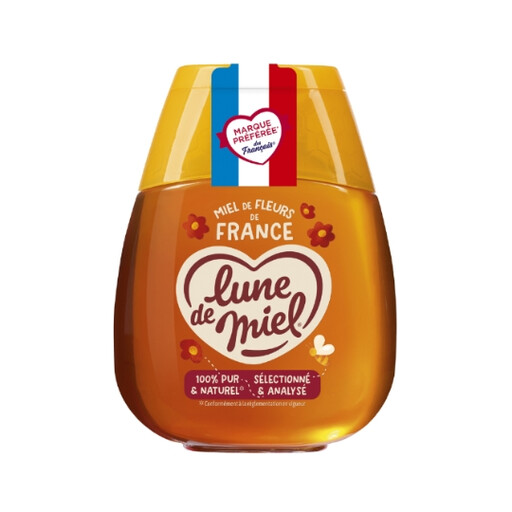 Image unavailable
If you’re buying honey for the first time and want to serve it straight from the bottle, this option combines honey described as runny with a dispensing nozzle.
It comes in a 250 g size. Check the origin and best-before date on the packaging before you buy.
It’s mainly handy for serving runny honey straight from the bottle. Check the texture of the product you choose. If you prefer creamy honey, compare options in jars too.
The DGCCRF highlights details such as the product name, the country where the honey was harvested, the best-before date, and information about the manufacturer or seller. These details help you compare products beyond their packaging.
Check the countries of harvest rather than where the honey was made. According to the DGCCRF, for blends from several countries placed on the market from 14 June 2026, the countries and each one’s share must be shown in the main field of vision, in descending order by weight.
No. Anses advises against giving honey to infants under one because of the risk of infant botulism, whatever its origin. Choosing an organic option doesn’t change this advice.
Follow the instructions on the product you’ve bought. Auchan’s product details for L’Apiculteur runny honey say to store this option at room temperature. Check the instructions for any other bottle.