People who use honey regularly
If you often drizzle it over toast, add it to yoghurt or drinks, or use it in recipes, a 500 g bottle of runny honey can mean fewer top-ups than a smaller container.


For regular use, a 500 g squeezy bottle means you can keep more honey to hand; 250 g is better for occasional use or a first try. The bottle makes serving easier, but it doesn’t tell you where the honey comes from. Check the countries of harvest, the product description and, if it matters to you, organic certification separately.
If you often drizzle it over toast, add it to yoghurt or drinks, or use it in recipes, a 500 g bottle of runny honey can mean fewer top-ups than a smaller container.
If the country of harvest influences your choice, distinguish it from the place where the honey was made or packed. According to the DGCCRF, the country of origin of honey is the country where it was harvested.
Runny honey in a squeezy bottle is a convenient way to serve a small amount at breakfast or add it to a recipe. Check that the product is specifically described as a squeezy bottle, rather than simply as runny honey.
When stocking your cupboard, start with how often you use honey, then check each product for the details that matter to you: its origin, bottle type and any organic certification.
| Criteria | What to check | Who it matters to |
|---|---|---|
| Size and how often you use it | Compare the net weights of 250 g and 500 g with how often you use honey and the space you have available. | If I use honey every day, I’d rather keep a bottle to hand without having to replace it too often; around 36% of consumers would make a size suited to this kind of use their priority. |
| Country of harvest | Read the country or countries of harvest on the label; don’t assume they are the same as the place where the honey was packed. | When I’m looking for a specific origin, I want to be able to distinguish it from the manufacturer’s address; around 29% of consumers would put this information first. |
| Easy pouring | Look for the wording “squeezy bottle” and check that the honey is described as runny. | If I want to drizzle honey over toast or into yoghurt without reaching for a spoon, ease of serving is my priority; around 21% of consumers would make it their main criterion. |
| Organic certification | Check for the organic label and read the countries of harvest separately, especially for a blend. | If I choose organic honey first, I don’t want to confuse that with its origin; around 14% of consumers would prioritise organic certification. |
A French brand or packaging in France doesn’t mean the honey was harvested there. The DGCCRF defines the country of origin of honey as the place where it was harvested.
If you’re looking for honey from a particular place, read the relevant information on the label rather than relying on the company’s address.
A smaller size means less honey to use up when you’re trying a product or only use it occasionally. But if you use honey often, you’ll need to top it up more frequently.
Choose the net weight to suit how often you use it: 250 g if you’re trying a product, or 500 g if honey regularly features in your recipes.
Organic certification and geographical origin answer two different questions. Auchan, for example, sells a 250 g organic squeezy bottle described as a blend of honeys from several regions.
If both criteria matter to you, check the organic label and the countries of harvest for the product you’re considering.
The Anses advises against giving honey to babies under one because of the risk of infant botulism, regardless of where the honey comes from or how it is presented.
Do not give honey to a child under one, even if it comes in a squeezy bottle.
These products give you a few different sizes to compare. For each one, check the weight and origin of the product you’re considering buying.
E.Leclerc sells Nid d’Abeille runny blossom honey in a flexible 500 g bottle.
Auchan sells runny honey in 250 g and 500 g squeezy bottles, as well as a 250 g organic option.
Monoprix sells Lune de Miel Squeeze Blossom Honey in a 500 g bottle.
This 250 g option is runny honey with a dosing spout, worth considering for occasional use or if you’d like to try a smaller size. If you use honey often, compare its weight with a 500 g bottle before you decide.
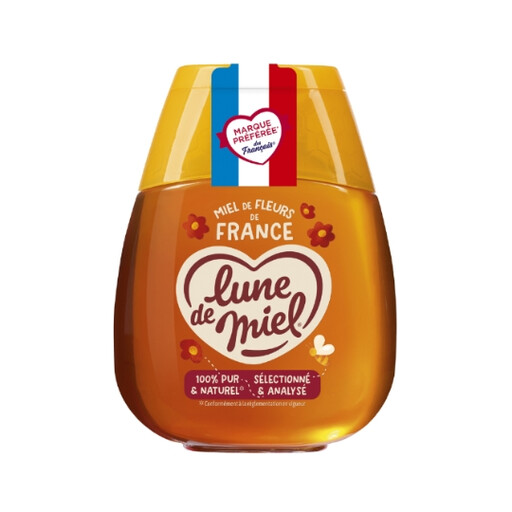 Image unavailable
The 250 g size is suited to occasional use or a first try if you’d like to pour the honey straight from the bottle. The product name specifies that it is runny honey with a dosing spout.
Check the product description, the country or countries of harvest, the best-before date, and the manufacturer’s or seller’s details. The DGCCRF explains that the origin of honey is the country where it was harvested, which may not be the country where it was packed.
No: the organic label alone doesn’t tell you where the honey was harvested. Auchan describes its 250 g organic squeezy bottle as a blend of honeys with origins in Central America, South America and Europe. So check the origins listed for the product you’re interested in.
Follow the storage instructions on the bottle you buy. The Auchan and Monoprix listings mentioned for their squeezy bottles say to store them at room temperature; don’t assume the same applies to another product.
No, not to a child under one. The Anses advises against giving honey to babies of this age because of the risk of infant botulism, regardless of where the honey comes from or the type of bottle it is in.