Shoppers who pay close attention to claims
If “no sugar” is your top priority, check the exact claim and the “of which sugars” figure per 100 g. A recipe labelled “no added sugars” may still contain sugars from its ingredients.


If you’re looking for granola with “no sugar”, don’t assume that “no added sugars” and “low in sugars” mean the same thing. For a quick breakfast, first choose the texture you want — crunchy granola or muesli — then compare the “of which sugars” figure per 100 g, the ingredients and the allergens for the specific recipe.
If “no sugar” is your top priority, check the exact claim and the “of which sugars” figure per 100 g. A recipe labelled “no added sugars” may still contain sugars from its ingredients.
Ready-to-serve granola is a quick breakfast option. However, fruit, nut and chocolate varieties have different recipes, so compare their nutritional information rather than relying on the product name alone.
Check the recipe and any “may contain” warnings on the pack you choose. Depending on the variety, the products reviewed contain cereals with gluten, nuts or warnings about possible traces of other allergens.
To compare the claims, start with the amount of sugars per 100 g. Texture, ingredients and whether you can collect the product will help you narrow down your choice.
| Factor | What to check | Who is it for? |
|---|---|---|
| Claim and sugars | Read the exact claim, then check the “of which sugars” figure per 100 g. | If I’m specifically looking for a product with “no sugar”, a different claim alone doesn’t meet my criteria. Around 31% of shoppers put this distinction first. |
| Texture and convenience | Choose between crunchy granola and muesli, and compare each variety separately. | For a quick breakfast bowl, I want the crunch of granola, even if that limits the recipes that suit me. This comes first for around 31% of shoppers. |
| Ingredients and allergens | Check the cereals, nuts and any “may contain” warnings for the specific recipe. | Before choosing a flavour, I need to make sure its ingredients and allergen information meet my requirements. This is the top priority for around 23% of shoppers. |
| Collection availability | Check that the product is available at your chosen store and for your selected collection option. | When I’m planning a quick breakfast, I need a pack I can actually collect. Around 15% of shoppers prioritise local availability. |
The two claims don’t mean the same thing. Bjorg’s product information for its 375 g muesli with no added sugars lists 13 g of sugars per 100 g and includes dried fruit among its ingredients.
If total sugar content matters to you, check the “of which sugars” figure per 100 g on the pack you choose.
Jordans’ almond, hazelnut and seed recipe contains nuts; the recipes reviewed also include oats and barley. The Bjorg muesli reviewed carries warnings about possible traces.
Check the ingredients and allergen information for the specific variety, including on the pack you receive.
The range includes almond, hazelnut and seed granola, as well as dark chocolate granola. Both are listed as low in sugars in the product information reviewed at Auchan.
The 375 g organic muesli with no added sugars is for those who are happy with muesli containing dried fruit rather than crunchy granola.
Carrefour offers a 400 g box of Granola Crunchy Red Berries with No Added Sugars.
E.Leclerc lists a 350 g reduced-sugar muesli with crunchy chocolate and hazelnut clusters under this brand.
This selection is for muesli, which may suit you if you’re happy with a different texture from crunchy granola for your quick breakfast.
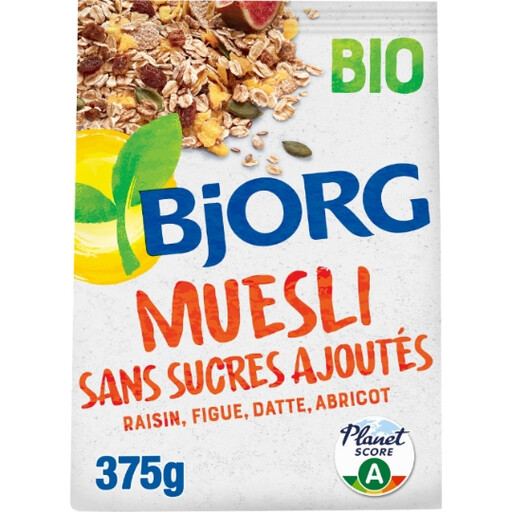 Image unavailable
Worth considering if you prefer muesli served with milk or yoghurt to crunchy granola. The pack contains 375 g; check the pack you receive for the sugar claim, the “of which sugars” figure per 100 g and allergen information.
No. Bjorg’s product information for its 375 g muesli with no added sugars lists 13 g of sugars per 100 g and includes dried fruit. Check the “of which sugars” figure if the total amount of sugars is what matters most to you.
First, decide between granola and muesli, then compare the claims and sugars per 100 g. Next, read the ingredients and allergen information for each variety. If you plan to collect the product, check that it’s available at your selected store.
Follow the storage instructions on the pack and seal it carefully after use. If you transfer the granola to another container, make sure it’s clean, dry and airtight.