
Livraison le jour même ou le lendemain

Qualité garantie

Débloquez vos offres de bienvenue: Livraison GRATUITE | Jusqu'à -80 % | 30 jours d'essai gratuits à JoyPlus
Téléchargez l'application
As a product expert at Joybuy, I evaluate dozens of storage containers every day. My goal? To guide you beyond the marketing hype to find a model that is durable, practical, and safe. Because while a good food storage container can simplify your life in the kitchen, a poor choice can quickly become a source of daily frustration.
Say goodbye to the lunch box that leaks in your bag or the dish that holds on to the lingering smell of last week's curry. Let's break down the common pitfalls and essential criteria for making a smart purchase.
Before you buy, let's review the classic disappointments that force us to replace our containers far too often.
To avoid these issues, focus on a few technical specifications that make all the difference.
The choice of material is crucial for the use, durability, and safety of your food container.
A truly airtight food container is more than just a lid that sits on top. The locking system is an essential feature.
To optimise your kitchen and your time, check your container's compatibility with your appliances. The icons on the packaging or the product itself are your best friends.
Rather than just a list, we've matched each product to a user profile. The goal: to help you find the container that will truly fit your daily life.

Why we chose it: Its large 2-litre capacity is ideal for preparing several meals in advance. The ability to cook directly in it (casseroles, lasagnas...), store, and then reheat makes it the perfect ally for meal prep.
Its borosilicate glass body withstands oven heat (up to 400°C) and thermal shock, eliminating any risk of breakage. Its 4-clip locking system ensures a foolproof seal.
Extreme versatility: oven, microwave, freezer, and dishwasher safe. Large 2L capacity is ideal for families or batch cooking.

Why we chose it: For those who pack their lunch, health and the absence of residual odours are non-negotiable. This 0.8L glass dish with a lid is the perfect portion size, and the glass ensures that the taste of your food is preserved.
Pyrex's pure, non-porous glass ends the nightmare of plastic containers that stain and retain odours. It's the guarantee of a healthy and durable solution for your daily meal box.
Healthy material that doesn't retain stains or odours. Oven, microwave, freezer, and dishwasher safe for complete versatility.
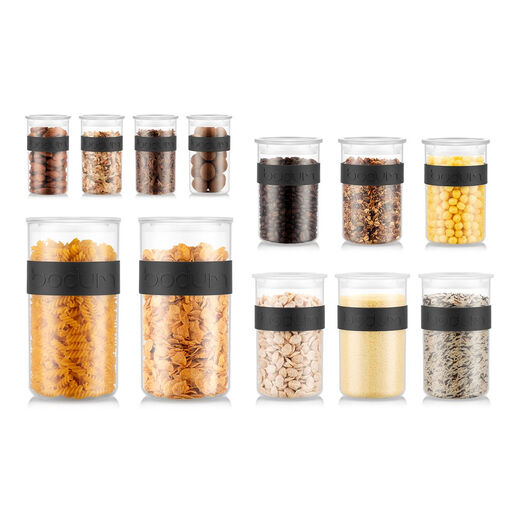
Why we chose it: For storing dry goods (pasta, rice, flour, cereal), a complete set is the ideal solution. This 12-piece set with 4 different sizes allows you to create a harmonious organisation system and optimise cupboard space.
Made from BPA-free plastic, these containers are a safe option for food contact. Their airtight lids protect food from moisture and pantry moths, thus preventing waste.
A complete and versatile set for impeccable organisation. Lightweight, durable, and BPA-free material, perfect for storing dry foods.
We have selected other products for you that meet our demanding specifications for quality and safety.
1. How can I prevent my glass container from breaking in the oven? The main risk is thermal shock. Never place a glass storage container straight from the refrigerator or freezer into a preheated oven. Let it come to room temperature for 15 to 20 minutes first. Likewise, never place a hot dish on a cold or wet surface. Finally, always remember to remove the plastic lid before putting it in the oven.
2. Are BPA-free plastic containers truly safe? Yes, the "BPA-free" label indicates that the manufacturer has used alternatives to Bisphenol A, a controversial chemical compound. Plastics like polypropylene (PP) or Tritan are commonly used and considered safe for food contact by European health authorities. This is an essential safety criterion for a plastic food container.
3. How do I effectively clean the silicone gasket on an airtight container? To prevent mould and bad odours, remember to remove the gasket from the lid at least once a week. Wash it by hand with warm, soapy water, rinse it thoroughly, and let it air dry completely before putting it back in place. This is the secret to ensuring a perfect seal and long-term hygiene.