
Livraison le jour même ou le lendemain

Qualité garantie

Débloquez vos offres de bienvenue: Livraison GRATUITE | Jusqu'à -80 % | 30 jours d'essai gratuits à JoyPlus
Téléchargez l'application
Between poorly stored dry goods, leaky lids and containers that are a pain to clean, choosing the right food storage containers deserves a bit of thought. A well-designed set makes organising, meal prepping and transporting your lunch so much easier, without relying on disposable packaging.
Here are the key factors to consider before you buy, along with a selection suited to different everyday needs.
The term "airtight" usually means the lid limits air exchange. It doesn't necessarily guarantee no leaks during transport. For a leak-proof lunch box, check for a seal, clips or a locking system that's clearly described.
Sauces, soups and very liquid foods need a particularly reliable closure. A container designed for rice or pasta won't necessarily be suitable for a work bag carried upright.
A multi-piece set might look like a bargain, but oversized containers quickly take over your cupboards. On the other hand, containers that are too small make meal prep for the whole family difficult.
Before choosing an airtight container set, measure the space available in your cupboards and fridge. Also consider your typical portion sizes: a small container for sauces, a medium one for a single portion, and a large one for leftovers or dry goods.
Grooves, removable seals and clip mechanisms can trap food residue. When the different parts are difficult to take apart, cleaning becomes a chore. Also check the manufacturer's instructions for dishwasher, oven and microwave use.
A plastic lid should never be heated as a rule. For metal products, like a stainless steel bento box, the microwave and oven are generally not suitable.
For borosilicate glass food containers, look for a product page that clearly states the material and permitted uses. Borosilicate glass is valued for its resistance to temperature changes, but that doesn't mean all containers can go straight from the fridge to the oven. Always follow the limits given by the manufacturer.
For stainless steel, the 316L grade refers to a composition known for its corrosion resistance. It doesn't mean you can ignore the care instructions. Some manufacturers advise against storing highly acidic or salty foods in it for long periods.
In all cases, check the food contact information, the pictograms on the packaging and the usage instructions intended for the European market.
A truly useful assortment combines several volumes. Small sizes are ideal for spices, dried fruit and toppings. Medium containers hold individual portions, while large ones are perfect for flour, rice, pasta or cooked leftovers.
Kitchen storage jars are particularly handy when they're stackable and easy to identify. Labels can also simplify stock rotation: note the contents and, if needed, the opening date.
For a lunch at the office or a child's meal, separating foods prevents textures from mixing. A compartmentalised lunch box can hold carbs, vegetables and sides, provided you check the leak-proofness and closure of each compartment.
The number of clips, the presence of a seal and the rigidity of the lid are often more telling than simple marketing claims. For a container used daily, choose a model that's easy to lock and clean.
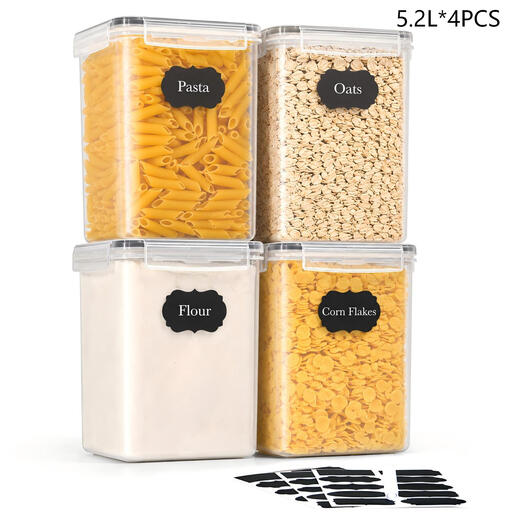
Why this choice suits this profile: This compact set lets you start organising your food better without cluttering your cupboards. It's ideal for small kitchens, students and anyone wanting to try organising by category.
The limited number of pieces reduces the risk of buying sizes that will sit at the back of a cupboard. The containers are presented for pasta, rice, sugar and flour.
4-piece set with labelling accessories mentioned in the product name, particularly suitable for dry foods.

Why this choice suits this profile: The range of volumes, from 150 ml to 1,040 ml, works well for both individual portions and storing leftovers in one set.
The capacities are listed piece by piece, making it easier to compare them to your actual needs rather than relying on the total number of containers.
Borosilicate glass stated, eight capacities and removable lids according to the product page.

Why this choice suits this profile: Its five compartments meet the needs of meal prep, office lunches, picnics and separate portions for children.
The description states there are four locking loops. However, make sure to fasten each one and do not use the box in the oven or microwave.
316L stainless steel stated, five-compartment tray and PP lid with four loops.
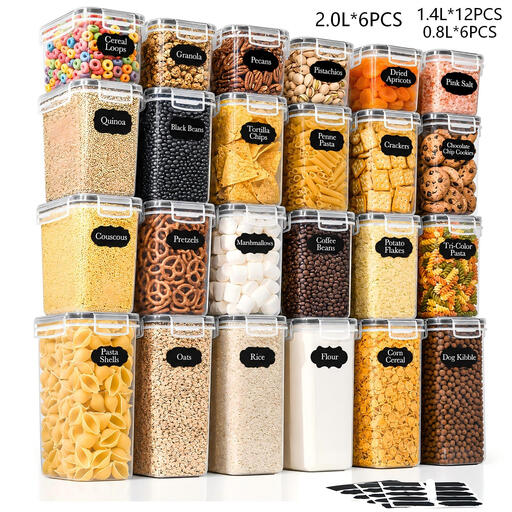
Why this choice suits this profile: A 24-piece set can help organise a family kitchen, with containers for carbs, flour, sugar, spices and leftovers.
The labels and tags mentioned can help reduce forgotten items at the back of cupboards. Still, remember to measure your available space before buying.
24-piece set intended for dry food storage, with identification accessories mentioned.
We've put together a comprehensive, real-time updated selection of products that meet these criteria and the requirements of European safety regulations.
Glass lets you see the contents immediately and works very well for leftovers, while plastic is often lighter for transport. 316L stainless steel can be a good option for on-the-go meals, but it shouldn't be placed in the microwave. The right choice depends on the weight you prefer, how you reheat food and the instructions specific to each product.
A set of four to eight pieces is usually enough to separate small sides, individual portions and leftovers. Families and meal prep enthusiasts can opt for a larger set, provided they have enough storage space.
Not necessarily. Check for a seal and a closure mechanism designed for liquids. Always carry the container securely closed in a stable bag and follow the manufacturer's usage recommendations.